Wednesday, February 17, 2016

The Miracle of Creativity

by Theodore Kinni
strategy+business, January 20, 2016
There’s a great cartoon by Sidney Harris that sums up every book I’ve read about creativity. Two scientists are standing in front of a blackboard looking at a mathematical equation. In the middle of the equation are the words, “Then a miracle occurs.” One scientist says to the other, “I think you should be more explicit here in Step Two.” As in that equation, there seems to be an essential and impenetrable mystery to the creative process.
In this regard, the most recent addition to the groaning shelf of creativity books, Wired to Create: Unraveling the Mysteries of the Creative Mind (Perigee, 2015), by Scott Barry Kaufmanand Carolyn Gregoire, is not much different than its predecessors. Kaufman and Gregoire are something of a dream team for such a book: He is the scientific director of the Imagination Institute in the Positive Psychology Center at the University of Pennsylvania, and she is a senior writer at the Huffington Post who specializes in the human mind. Nevertheless, this dynamic duo is unable to fully explain the creation of Picasso’s Guernica, much less Shigeru Miyamoto’s Super Mario Bros. 
Unlike most creativity authors, however, Kaufman and Gregoire admit that prying open this particular black box may be beyond our ken. They repeatedly call out creativity’s contradictory nuances. For instance, they tell us thatmindfulness, as championed by Harvard psychologist Ellen Langer, is both an important ingredient of creativity and an obstacle in its path. Mindfulness helps when it enables us to be more attentive and observant; it is a hindrance when it interrupts our ability to attain the state of flow, which psychologist Mihaly Csikszentmihalyi has championed. “Creative observation is a skill that requires a balance of paying attention to the world around us and of tuning into our own inner landscape — a balance of mindfulness, a focused, nonjudgmental awareness on the present moment, and mind wandering,” explain Kaufman and Gregoire.   
A call to embrace the messy business of creativity can sometimes make for a bewildering mix of advice. But it also enables the authors to avoid the kind of step-by-step prescriptions that transform the creative process into a rote and often fruitless exercise. Indeed, they say, “this delicate, and sometimes extreme, dance of contradictions may be precisely what gives rise to the intense inner drive to create.” 
Instead of a detailed process, Wired to Create includes ten “habits of mind.” They are labelled: imaginative play, passion, daydreaming, solitude, intuition, openness to experience, mindfulness, sensitivity, turning adversity to advantage, and thinking differently. It’s less about doing and more about being. The habits support and foster the “fundamental thought processes, creative problem-solving skills, and ways of being” that the authors claim underlay every kind of creativity. 
The habits, Kaufman and Gregoire tell us, are derived from scouring scientific research over the past hundred years and also extracting “common themes from within the minds and lives of eminent creators throughout the course of human history.” In other words, if you’ve read other books on creativity and the human mind, you’ve probably seen some of this stuff before.
It would be nice to report that Wired to Create is the uber-text on creativity. At the start of the book, when the authors devote a chapter to describing the evolutionary development of creativity theory and process, it seems like they might be going for it. But while they also include a bit of practical advice for getting your creative juices flowing for each of the habits of mind (or operationalizing them, if you prefer), they don’t fully deliver on an all-enveloping theory. In the end, Kaufman and Gregoire concede, “Creativity works in mysterious and often paradoxical ways. We human beings are messy creatures, to be sure, and creativity is a process that that reflects our fundamentally and chaotic and multifaceted nature. It is both deliberate and uncontrollable, mindful and mindless, work and play.” 
And then a miracle occurs.

Jessica Jackley: Tapping Into the Inner Entrepreneur

by Theodore Kinni


A Sotheby's employee views 'Whispering Wall II' by Burhan Dogancay | Reuters/Toby Melville
Reuters/Toby Melville
Patrick lost everything in the brutal, decades-long civil war in northern Uganda. After his village was attacked, he fled south with his younger brother, ending up near Uganda’s border with Kenya. One morning, destitute and wondering whether he would eat that day, Patrick realized that the solution to his predicament lay beneath him. He could make bricks from the clay-laced soil and sell them.
When Jessica Jackley met the brick maker in 2004, his business was thriving. He had hired several employees and was living in a new brick home of his own. Patrick is one of the many boot-strapping entrepreneurs whose stories the Stanford Graduate School of Business alumna tells in her new book, Clay Water Brick: Finding Inspiration from Entrepreneurs Who Do the Most with the Least.
Jackley says Patrick is one of the people in East Africa who inspired her to tap into her inner entrepreneur. In 2005, she cofounded Kiva, a pioneering nonprofit that enabled individuals to lend small amounts of money — as little as $25 — directly to people who needed a few hundred dollars to start or grow their own businesses around the world. In the decade since, Kiva has facilitated more than $775 million in microloans by more than 1.3 million lenders to almost 1.8 million borrowers in 83 countries.
The more elite of a community that you’re in, the more resources on hand, the more you start to hold yourself to standards that are too high. 
Jessica Jackley
Jackley left Kiva and, in 2009, cofounded a for-profit venture, ProFounder, a low-cost, securities-based crowd-funding site for small businesses. The company shut down after three years, when it became clear that it faced insurmountable obstacles in the legal landscape, Jackley said. Currently, she is working on her third new venture — a social media business, which she says is in stealth mode prior to an anticipated launch in July 2016.
In the following edited interview, Jackley, who received her MBA from Stanford GSB in 2007, talks about her book and the entrepreneurial journey that it charts.

You clearly have a lifelong desire to help people in need. How did you come to focus on entrepreneurship as a means of realizing that desire?

I was dissatisfied with the mechanisms in traditional philanthropy that seemed to turn my desire to help others into a transaction between haves and have-nots as opposed to a relationship between people. Then, in my first job out of college, as a temp at theCenter for Social Innovation at Stanford, I heard Dr. Muhammad Yunus speak about microfinance. It was funny, because even though I was in this very entrepreneurial place, maybe the entrepreneurial capital of the world, I was slow to understand how entrepreneurship could solve social problems. After that, it really clicked when I went to East Africa and met entrepreneurs whose lives had been changed by microlending. I understood that the people who I so longed to help could themselves be entrepreneurs.

Aren’t entrepreneurs a small subset of people, with a select set of skills?

Harvard professor Howard Stevenson said that entrepreneurship is the pursuit of opportunity without regard to resources. I think that living entrepreneurially, thinking entrepreneurially, using the best qualities of entrepreneurship is something that is available to all of us. It’s not exactly mind over matter, it’s more like the decision to move forward, despite what you might lack.

You started Kiva with $3,500, which you loaned to seven East African entrepreneurs. What did starting in such a small way teach you?

Had I been through business school already, I probably would have thought that we couldn’t start Kiva at all. I hope it’s old-school thinking, but there’s this idea that you need a very polished business plan, with projections that reach five, ten years out — that it’s not even worth doing something unless it’s a billion-dollar opportunity. Ridiculous.
The more elite of a community that you’re in, the more resources on hand, the more you start to hold yourself to standards that are too high — especially in the beginning. Entrepreneurship is never about what we have. It’s about what we do.

Clay Water Brick is written as a series of lessons for aspiring entrepreneurs. One of them is rooted in the discovery that one of Kiva’s valued field partners was stealing loan money. What did you learn from that?

One of the biggest lessons was to let people in, to not get embarrassed and wall them out and try to fix the problem behind closed doors. For us, that meant not just our board, not just our advisors, but our lenders, our whole community. Letting everyone in not only showed them that we were being transparent, but it also got us lots of ideas and suggestions to help us get out of trouble. It was really pretty magical to watch how people gave us a lot of grace.
It was a lesson for me in terms of personal struggles, too. I learned that you shouldn’t put on a strong face and go through life not asking for help and not being genuine about what you’re experiencing. That’s a recipe for a very unhappy life.

Did that come into play when you faced the decision to close down ProFounder, too?

The book would have been done a lot sooner had I really come to terms with, and understood, that chapter in my life earlier. It would have been possible to keep ProFounder going, but I don’t think it would have been the responsible thing to do.
Entrepreneurs are supposed to go hard at all costs — just keep plowing forward and leave the disasters in their wake. But having been through a divorce, I felt like, “OK, I know what disaster is like, and I know who bears the brunt of that.” I wanted to make sure I was always, at all costs, protecting my wellness and my family.

In the book’s acknowledgements, you thank MBA Admissions Director Derrick Bolton for rejecting your first application to Stanford GSB. Why are you thankful for that?

One, that was the year that Kiva was born. I don’t know if Kiva would have happened on some other timeline, but I highly doubt it because I would have been sitting in classrooms instead of tromping around Uganda.
Two is more personal. I’d been a staffer at the business school for three years, and although it hurt not to get in, when I did get in the next year, I felt like I really earned it.
Three, it taught me this amazing lesson about the importance of holding things with an open hand and knowing where I want to go, regardless of the things I can’t control. A lot of people look at a milestone, like getting into business school, and think that they can’t make the next step in their lives without it. I learned that I was still the same person — I still had the same dreams and still went forward to the same destination.

Krisztina “Z” Holly’s Required Reading

By Theodore Kinni
strategy+business, January 6, 2016
We’re often told that entrepreneurship and innovation are the keys to social and organizational prosperity. But how do you nurture those qualities on a large scale? This is a question that Krisztina “Z” Holly is seeking to answer.  
Instead of propounding theories and conducting studies, Holly has turned her career into something of experiment in entrepreneurship and innovation. In the 1990s, Holly, who holds two engineering degrees from the Massachusetts Institute of Technology, worked at a number of high-tech startups. She cofounded Stylus Innovation, which brought the first Microsoft Windows-based telephony development tool to market and was acquired by Artisoft in 1996.
In the 2000s, Holly explored the role of academia in entrepreneurship and innovation. She served as the founding executive director of the Deshpande Center for Technological Innovation at MIT and then as vice provost for innovation at University of Southern California and the founding executive director of its Stevens Center for Innovation.

Most recently, Holly has been exploring the role of government in promoting entrepreneurship and innovation. She served as an advisor to the Obama administration and chair of the Global Agenda Council on Fostering Entrepreneurship for the World Economic Forum. Currently, she is an inaugural entrepreneur-in-residence for the City of Los Angeles Mayor’s Office, with a mandate to identify ways the city can help entrepreneurs start businesses and create jobs.
I asked Holly about the books that she has found most helpful in her career. She called out three titles, all from outside the business genre, that highlight the importance of reaching beyond boundaries, understanding psychology and social dynamics, and inspiring others in the quest to stimulate organizational entrepreneurship and innovation.
A New Culture of Learning: Cultivating the Imagination for a World of Constant Change, by Douglas Thomas and John Seely Brown (CreateSpace, 2011). “If you are trying to innovate, this book is valuable for many reasons. It shows how to create an environment that maximizes learning, thrives on change, and instills iteration, experimentation, and collaboration as organizational values. It explains the importance of tapping into the full spectrum of knowledge both inside and outside the organization, through techniques such as peer-to-peer learning and customer engagement. And it emphasizes the need for leaders to establish a shared vision to shape and direct innovation without stifling it. Some of the specific tools described in the book have become dated since its publication in 2011, but this only reinforces the authors’ point: When technological change is fast-paced, your learning paradigm becomes crucial.”
Impro: Improvisation and the Theatre, by Keith Johnstone (Faber & Faber, 1979). “Reading this canonical book on improvisation reveals a deep-thinking author who is seemingly unfettered by social convention. A book about teaching actors might seem pretty far removed from the business world, but any leader can benefit from applying the techniques and the insights into social dynamics that Johnstone used to unleash the confidence, imagination, and spontaneity of his students. He’s really preaching a leadership mind-set that is wide open to new ideas and to encouraging other people to open up, too. Achieving that attitude involves being true to ourselves and helping the whole team get past fears about judgment and failure. For instance, Johnstone says people need ‘a guru to give permission to allow forbidden thoughts into their consciousness.’ And then he shows how leaders giving voice to their own weird and crazy ideas can give a voice to others. That is the real value of this book: It helps you become a leader who can harness human nature and unlock the creative potential of other people.”
Endurance: Shackleton’s Incredible Voyage, by Alfred Lansing (McGraw-Hill, 1959). “This is the definitive book on Shackleton’s ill-fated expedition to Antarctica in 1914 and my favorite adventure story. You may remember the 18-month saga that began when Shackleton’s ship got trapped in the ice. After a brutal winter, it broke up and sank. Shackleton and his men set up camp on the ice. When the ice broke up, they sailed more than 300 miles in lifeboats to an uninhabited island. Then Shackleton took a small crew, sailed another 800 miles to South Georgia Island, and marched 36 hours nonstop across ice-covered mountains to a whaling station. And then, most amazingly, without any hesitation or recuperation time, he immediately enlisted help and set off into the teeth of the approaching winter to rescue the rest of the members of the expedition. It was a miracle of perseverance and motivation, and a powerful example of how people respond when their leaders build a sense of deep trust and actually step up and make personal sacrifices. The fact that this failed expedition came to be celebrated as a magnificent victory also illustrates how our greatest accomplishments sometimes come after we are forced to give up our original goal.”

Thursday, December 24, 2015

How to Justify a Breathtaking CEO Pay Ratio

By Theodore Kinni
strategy+business, December 22, 2015

In August 2015, the U.S. Securities and Exchange commissioners voted 3-2 in favor of a new rule that requires public companies to report their CEO’s total annual compensation as a ratio to their employees’ median pay. The SEC didn’t rush into this decision. Far from it. The vote came five years after the passage of the Dodd-Frank Act, which mandated the rule, and two years (and 280,000 public comments!) after the SEC announced that it would consider complying with that mandate. Moreover, the rule has plenty of loopholes. For instance, it doesn’t apply to companies with annual revenues below US$1 billion. And it doesn’t take effect until 2017.
The delay and controversy were blamed on a number of plausible causes: that it was a ploy by unions to gain negotiating leverage; that it didn’t measure anything of consequence; that it would cost too much to implement. But it’s hard not to believe that the real reason corporate lobbyists and leaders weren’t enthusiastic about a swift adoption of this rule was fear. As the Economic Policy Institute has shown, the ratio of CEO pay in major companies to the median pay of their employees is somewhere around 300:1. Formally reporting such ratios in stark terms would likely add fuel to the already roaring fire surrounding economic inequality. In 2014, according to a Pew Research Center survey, the people of Europe and the U.S. pegged economic inequality as “the greatest danger to the world.” (In 2015, inequality dropped a ranking or so because ISIS took the top spot.)
The leaders who fret about class warfare might want to add Harry G. Frankfurt’s slim book, On Inequality(Princeton University Press, 2015), to their reading lists. Frankfurt is a professor emeritus of philosophy at Princeton University. He is also the author of On Bullshit (Princeton University Press, 2005), which topped the New York Times bestseller list a decade ago and opened with this provocative line: “One of the most salient features of our culture is that there is so much bullshit.” His definition of this barnyard epithet: a widespread tendency for people to use words and language to obfuscate.

In his new book, which contains adapted versions of two previously published papers, Frankfurt argues that much of the discourse around economic inequality fits the bullshit bill. He finds nothing morally objectionable about economic inequality per se. “The egalitarian condemnation of inequality as inherently bad loses much of its force, I believe, when we recognize that those who are doing considerably worse than others may nonetheless be doing rather well,” he writes.
On the other hand, Frankfurt also finds nothing inherently beneficial about economic equality. “Inequality of incomes might be decisively eliminated, after all, just by arranging that all incomes be equally below the poverty line,” he writes. “Needless to say, that way of achieving equality of incomes — by making everyone equally poor — has very little to be said for it.”
This might make On Inequality sound like a straw man argument for astronomical CEO salaries. But Frankfurt does not let companies off the hook. Rather than strive to eliminate inequality, he says we should focus on eradicating poverty. He proposes a “doctrine of sufficiency,” which asserts that we have a moral obligation to see that everyone has “enough” money. Frankfurt defines “enough” as a standard that allows people to live a happy life or, at least, one in which their unhappiness cannot be alleviated by more money.
Indeed, what does it matter if some employees have more than others, as long as all employees have what they need? Isn’t this the reasoning behind ideas like the $15 minimum wage? Fast-food workers across the U.S. aren’t going on strike for hikes to CEO-level pay. They simply want to earn enough from their work to live above the poverty line.
On Inequality contains plenty of fuel for flameouts on both sides of the economic inequality debate. And I suspect that Frankfurt would welcome them. (Certainly, they could help him sell lots of books.) But I came away from this volume thinking that any CEO who could run a profitable business that also provided a reasonable living for each of its employees would richly deserve a breathtaking pay ratio.

Saturday, December 19, 2015

Rita Gunther McGrath’s Required Reading

by Theodore Kinni
strategy+business, December 9, 2015
When Rita Gunther McGrath studied the 4,793 publicly traded companies with market capitalizations of US$1 billion or more, she could find only 10 that had achieved at least 5 percent annual growth in net income from 2000 to 2009. What distinguished this handful of companies whose performance had weathered the biggest bust since the Great Depression? They acted as if, as McGrath told me in a 2014 strategy+businessinterview, “whatever they were doing today wasn’t going to drive their future growth.”
This finding dovetailed nicely with the Columbia Business School professor’s conviction that competitive advantage in many sectors was becoming increasingly transient — and that companies planning to capture such an advantage and ride it into the sunset were in for a jarring trip. McGrath made a compelling argument for this thesis in The End of Competitive Advantage: How to Keep Your Strategy Moving as Fast as Your Business (Harvard Business Review Press, 2013), which Walter Kiechel chose as the best strategy book of that year.
McGrath was delving into the challenges of attaining competitive advantage long before the study. In collaboration with Ian C. MacMillan of Wharton’s Sol C. Snider Entrepreneurial Research Center, she also wrote The Entrepreneurial Mindset: Strategies for Continuously Creating Opportunity in an Age of Uncertainty (Harvard Business School Press, 2000),MarketBusters: 40 Strategic Moves That Drive Exceptional Business Growth(Harvard Business School Press, 2005), and Discovery-Driven Growth: A Breakthrough Process to Reduce Risk and Seize Opportunity (Harvard Business Press, 2009). 
I asked McGrath, who is ranked among the top 10 global gurus on theThinkers50 list, what books — aside from her own — she recommends to executives determined to cope with the fleeting nature of competitive advantage. Here’s her reading list.
The Little Black Book of Innovation: How It Works, How To Do It, by Scott D. Anthony (Harvard Business Review Press, 2011). Too often, companies invest in the trappings of innovation — boot camps, workshops, the occasional visit to Silicon Valley, skunkworks — instead of the actual work of innovation. In this readable, practical book, Anthony draws on years of consulting experience to explain how to make innovation actually happen. Chockablock full of real stories of successes and failures, red flags and remedies, the book is a great primer for anyone tasked with creating new products, services, and platforms in their organizations.
American Icon: Alan Mulally and the Fight to Save Ford Motor Company, by Bryce G. Hoffman (Crown, 2012). Hoffman’s riveting reportage describes how Mulally, an auto-industry outsider (he was a longtime Boeing executive) successfully transformed Ford’s toxic culture and losing product strategy in the late 2000s. Mulally’s financial wizardry erased billions in debt and his attention to both the hard stuff (eliminating brands, streamlining structures, moving resources to where they were needed) and the soft stuff (changing the culture, creating a One Ford leadership team, honing the values, making hard HR choices) set the company up to exit the Great Recession in fine form. Ford was the only member of the Big Three that didn’t need a bailout. Every page of the book has valuable lessons for any leader seeking to create a stellar organization and culture in today’s transient advantage economy. 
Business Model Generation: A Handbook for Visionaries, Game Changers, and Challengers, by Alexander Osterwalder and Yves Pigneur (Wiley, 2010);The Four Steps to the Epiphany: Successful Strategies for Products That Win,by Steve Blank (K&S Ranch Press, 2005). I suggest reading these two books together because they have taken the planning and design of new ventures to a higher level. They provide a set of bedrock concepts and a methodology for lean entrepreneurship. Their authors will help open your mind to the possibilities of different business models, to new ways of sequencing investment, and to nurturing entrepreneurship within large, established companies. No senior executive responsible for growth should be without this two-piece toolkit. 
The Hard Thing about Hard Things: Building a Business When There Are No Easy Answers, by Ben Horowitz (HarperBusiness, 2014). Every chapter of Horowitz’s no-holds-barred book offers hard-won lessons for the CEOs of startups and rapid-growth tech companies. Unlike the pablum that many business book authors deliver, this entrepreneur and VC (Horowitz is a co-founder of Silicon Valley firm Andreessen Horowitz) refuses to sanitize the story: for instance, he admits that CEOs often don’t have great choices and, instead, must find the least-worst option to take their companies forward. Most endearing is Horowitz’s inclusion of details from his personal life in the book. This is as close to the whole story as you can get.

Wednesday, November 25, 2015

A Good Barrel for Bad Apples in Business

by Theodore Kinni
strategy+business, November 25, 2015

The business news headlines in the early fall of 2015 read like a scandal sheet. In September, the former owner of Peanut Corporation of America was sentenced to 28 years in prison for knowingly selling contaminated peanut butter that killed nine people and sickened hundreds more. Turing Pharmaceuticals, launched earlier this year by a hedge fund manager, purchased a 62-year-old drug that treats a parasitic infection called toxoplasmosis — the only drug of its kind — and bumped the price from $13.50 per tablet to $750. Volkswagen was coping with the fallout from revelations that engineers may have equipped diesel-powered cars with software aimed at deceiving emissions tests.

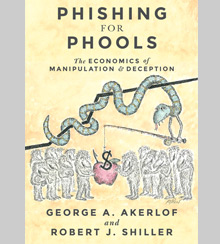
We tend to think of the people at companies who engage in such behavior as outliers, the few bad apples that spoil the barrel. But in their new book, Phishing for Phools: The Economics of Manipulation and Deception (Princeton, 2015), George A. Akerlof, Koshland Professor of Economics at University of California, Berkeley, and Robert J. Shiller, Sterling Professor of Economics at Yale University, argue that we should direct our attention to the barrel instead. The barrel is free markets, which, according to tenets that go back to Adam Smith, are guided by an invisible hand that ensures the individual pursuit of profit is transformed into common good. Unfortunately, that’s not the whole story.

“Free markets do not just deliver this cornucopia that people want. They also create an economic equilibrium that is highly suitable for economic enterprises that manipulate and distort our judgment, using business practices that are analogous to biological cancers that make their home in the normal equilibrium of the human body,” Akerlof and Shiller write. “Insofar as we have any weakness in knowing what we really want, and also insofar as such a weakness can be profitably generated and primed, markets will seize the opportunity to take us in on those weaknesses. They will zoom in and take advantage of us. They will phish us for phools.”

Phishing for Phools is an extension of the authors’ work on how psychological forces can warp markets, as described in their previous book, Animal Spirits: How Human Psychology Drives the Economy, and Why It Matters for Global Capitalism (Princeton, 2009). The two Nobel Prize–winning economists — Akerlof in 2001 for his work on the market effects of asymmetric information, Shiller in 2013 for his contributions to economic forecasting — define phishing in a broader way than usual. They say it is any activity that entices us to do something that is not in our own interests, but rather in the interest of the “phisherman” (as opposed to the rational behavior assumed in conventional economic theory). They see two kinds of phishing going on in free markets. The first includes emotional and cognitive glitches. A gambling addict who feeds the paycheck needed to feed his family into a slot machine has been legally phished by a casino. The second includes misleading information that is purposely created by the “phishermen.” Investors who received doctored account statements from Bernie Madoff’s firm were illegally phished in this manner.

Whether the phishing is legal or illegal, ethical or unethical, Akerlof and Shiller see it as being driven by the natural operation of free markets: “The free-market equilibrium generates a supply of phishes for any human weakness.” The two authors endeavor to prove this by describing an ongoing epidemic in phishing in a dismayingly wide variety of market contexts: in marketing and advertising; in industries where high-pressure sales tactics are common, such as auto sales, real estate, and credit cards; politics (the market for candidates); food and pharmaceuticals; innovation; tobacco and alcohol; and finance.

You’ll likely be familiar with many of the examples in the book, which are drawn mainly from contemporary inductees into capitalism’s hall of shame: Big Tobacco and its decades-long battle to discredit the link between smoking and cancer, the S&L crisis, the junk bond crisis, the subprime loan crisis. But they are worth rereading in order to understand what they have in common — that is, how and why they are all examples of phishing.

Happily, Akerlof and Shiller identify four obstacles to free-market phishing. There are “standards bearers,” who measure and enforce quality, such as the testing and certification of electronic appliances provided by Underwriters Laboratories. There are “business heroes,” such as Better Business Bureaus (and, presumably, rating sites, like Yelp and TripAdvisor). There are “government heroes” and their legal checks, such as the Uniform Commercial Code, and also “regulator heroes” like the Food and Drug Administration.

Unhappily, however, phishing continues, and the power of those who resist it is constantly being undermined by phishermen in search of larger hauls. As a case in point, the authors offer up the sad tale of the bond ratings agencies, whose cooptation by bond issuers resulted in reckless and inflated estimates that supported and intensified the explosion of subprime mortgages during the housing boom of the 2000s.

Phishing for Phools doesn’t offer much in the way of solutions. “The free market may be humans’ most powerful tool. But, like all very powerful tools, it is also a two-edged sword,” Akerlof and Shiller write. “That means that we need protection against the problems.” However, the only protection they prescribe is a greater recognition among economists of free-market phishing — a recognition that “it is inherent in the workings of competitive markets.” That would be a good a thing, I guess. But economists could debate the merits of this thesis until the end of time, and the rest of us would still be taken for phools.

Wednesday, November 11, 2015

Have you been called?

by Theodore Kinni
strategy+business, November 11, 2015
When I was a kid, I really wanted to win the recently established millionaire drawing in the New Jersey lottery. (I remember thinking that I would never need to work after pulling down the princely annual sum of $50,000 for 20 years.) Other than that, I’ve never had what I would call a calling. And it turns out I’m in good company: 60 to 70 percent of people don’t feel like they have a calling, either, according to studies cited by Martin Seligman in his introduction to Being Called: Scientific, Secular, and Sacred Perspectives (Praeger, 2015).
The genesis of Being Called was a meeting at Canterbury Cathedral in 2013, initiated by Seligman and his research team. Seligman, a professor at the University of Pennsylvania, is a pioneer in the field of positive psychology, the study of strengths that enable people to thrive. The purpose of the gathering was to bring together an unusually diverse and distinguished group of secular and religious figures — social scientists, like Seligman; religious leaders, including Jonathan Sacks, then chief rabbi of the U.K.; and political and business leaders, such as Australian Prime Minister Kevin Rudd — to explore the idea of “being called into the future.” The event inspired this academic collection of essays that attempt to define the nebulous subject of callings, and to establish some boundary lines (as loose and permeable as they may be) around it.

All three of the book’s editors — David Bryce Yaden, Theo D. McCall, and J. Harold Ellens — attended the Canterbury conclave. They also describe experiencing callings in their essays. Yaden, a psychologist who serves as the lead editor, awoke in his college dorm to a feeling of warmth in his chest that spread throughout his body and became an “experience of boundless unity” — an overwhelming sense of oneness with the world. As he thought about that experience in the weeks that followed, an inner voice directed him to become a “scriptor” — a Latin word meaning author or scribe, which he had to look up. McCall says that his vocation as an Anglican priest seemed obvious to people around him and inevitable as early as his mid-teens. Ellens reports a half-dozen numinous experiences that contributed to a “sense of destiny” and led him to the ministry.

But the essays in this accessible collection don’t just focus on the pulpit. Finding your calling — and following its dictates in order to live an authentic life — has become a popular work-life topic in recent years ...read the rest here

Monday, November 2, 2015

Best Business Books 2015: Managerial Self-Improvement

What a Character!

by Theodore Kinni

strategy+business, November 2, 2015


Illustration by Gérard DuBois


David Brooks, The Road to Character (Random House, 2015)

Fred Kiel, Return on Character: The Real Reason Leaders and Their Companies Win (Harvard Business Review Press, 2015)

Jeffrey Pfeffer, Leadership BS: Fixing Workplaces and Careers One Truth at a Time(HarperBusiness, 2015)

In 1859, as Great Britain’s Victorian era steamed into its third decade, a Scotsman named Samuel Smiles published a book titled Self-Help; with Illustrations of Character and Conduct. In it, Smiles preached “the practice of the virtues of industry, frugality, temperance, and honesty,” copiously illustrating its transformative power with “the instances of men, in this and other countries, who, by dint of persevering application and energy, have raised themselves from the humblest ranks of industry to eminent positions of usefulness and influence in society.”

Self-Help was a hit in England and farther afield; the aspiring entrepreneurs of the Meiji Restoration made it a bestseller in Japan. The book catapulted 47-year-old Smiles to gurudom, and, as is the wont of gurus, he wrote several volumes that capitalized on the popularity of his boot-strapping thesis over the next four decades. Thus, Smiles played an instrumental role in launching the broad category of business books under consideration here: self-improvement books for managers.

In addition to the literary impetus Smiles provided to would-be gurus, he anticipated this year’s most notable managerial self-improvement theme by about a century and a half. In his book Character (1871), he wrote, “In the affairs of life or of business, it is not intellect that tells so much as character — not brains so much as heart — not genius so much as self-control, patience, and discipline, regulated by judgment.” Character building and its rewards are the principal focus of two of this year’s three best business books on the theme of self-improvement for managers. The third — the best of the bunch — reminds us to take the first two with a grain of salt...read the rest of the essay here

Friday, October 23, 2015

One Algorithm to Rule Them All


As a student in a 1970s high school computer lab, I used a teletypewriter to punch holes in a paper tape, dialed a phone number and jammed the handset into two rubber cups. Somehow, an unseen computer on the other end was told to do something. I didn’t see the point.
     In the 1980s, as a newly minted account executive at a consulting firm, I assured a colleague I’d be dead long before any work I might do would require learning to use a computer. (I also was sure that I wouldn’t ever need to type — that’s what the secretaries outside my office did on electric typewriters, which corrected typos at the touch of key!)
     Thirty years on, the opportunities that I’ve missed in computer science — a set of disciplines that is arguably the most influential and powerful in the world — are obvious. To avoid further embarrassment, I took up Pedro Domingos’s new book, The Master Algorithm: How the Quest for Machine Learning Will Remake our World (Basic Books, 2015). 
     Unlike me, Domingos did not miss the import of computer science. While I was ignoring the computers popping up on every desktop, he was earning alicenciatura in electrical engineering and computer science from Instituto Superior Técnico at University of Lisbon. After reading about machine learning in a book on artificial intelligence, he skipped an MBA and, instead, earned a Ph.D. in information and computer science from the University of California at Irvine. Now a professor at the University of Washington, Domingos is a leading expert in the fields of machine learning and data mining. His Tolkienesque quest — and the book’s subject — is the most powerful algorithm of all.  
     This master algorithm, which many experts, whose views Domingos gives a hearing, think is a Computer Age chimera, would allow machines to learn without human assistance. “Every algorithm has an input and an output: the data goes into the computer, the algorithm does what it will with it, and out comes the result,” Domingos explains. “Machine learning turns this around: in goes the data and the desired result and out comes the algorithm that turns one into the other.”
     Learning algorithms are already commonplace. Netflix uses them to pick movies for us; Amazon to recommend books; Google to search out Web pages. But Domingos is pursuing something much more far-reaching. “In fact, the Master Algorithm is the last thing we’ll ever have to invent because, once we let it loose, it will go on to invent everything that can be invented,” he writes. “All we need to do is provide it with enough of the right kind of data, and it will discover the corresponding knowledge.”
     The corresponding knowledge includes a cure — or, more accurately, myriad cures — for cancer. In theory, Domingos argues, the master algorithm could create a program capable of spitting out the exact formula for a therapy designed to kill a specific patient’s cancer — based on a tumor’s genome, the patient’s medical history and profile, and a “vast database of molecular biology.” Unfortunately, little of the data necessary to fuel such a program exists as yet. But then neither does the master algorithm... read the rest here

Roger Martin’s Required Reading

by Theodore Kinni

strategy+business, October 7, 2015


Prosperity is a theme that runs through Roger Martin’s work in a continuous and unwavering line. Ranked third on the Thinkers50 biannual ranking of the most influential global business thinkers, Martin has served as a director and cohead of Monitor Company, dean and Premier’s Research Chair in Productivity and Competitiveness at University of Toronto’s Rotman School of Management, and, starting in 2013, institute director of the Martin Prosperity Institute. Throughout, he has sought to illuminate the ways and means of economic success for individuals, corporations, and nations.

A prolific writer, Martin has authored numerous books and articles detailing his findings. In The Opposable Mind: How Successful Leaders Win through Integrative Thinking,(Harvard Business Review Press, 2007), he explains how the ability to hold two conflicting ideas in constructive tension can enable leaders to make better decisions and produce superior ideas. In The Design of Business: Why Design Thinking Is the Next Competitive Advantage (Harvard Business Review Press, 2009) and Playing to Win: How Strategy Really Works (with A.G. Lafley; Harvard Business Review Press, 2013), Martin explains how to enhance corporate success through innovation and strategic thinking.

Finally, in Fixing the Game: Bubbles, Crashes, and What Capitalism Can Learn from the NFL (Harvard Business Review Press, 2011) and, most recently, Getting Beyond Better: How Social Entrepreneurship Works (with Sally R. Osberg; Harvard Business Review Press, 2015), he examines the flaws that are undermining democratic capitalism and the potential of socially responsible business to heal and reinvigorate the system. 

Curious about the underpinnings of his own success, I asked Martin about the books that most influenced him in his professional journey. He offered up the following three titles... read the rest here.