Occasional posts on business books, their authors and publishers, tidbits from my book and article research, quotes from interviews with experts and executives, and hopefully, not too much self-promotional bushwa.
Every MBA knows economist Joseph Schumpeter’s theory of creative destruction. So why is it that established, resource-rich companies still get the stuffing kicked out them by upstarts that seemingly appear out of nowhere? Steve Blank, who’s credited with launching the Lean Startup movement, offers an interesting take on that question in a new post on his blog.
“In the 21st century it’s harder for large corporations to create disruptive breakthroughs,” writes Blank. “Disruptive innovations are coming from startups — Tesla for automobiles, Uber for taxis, Airbnb for hotel rentals, Netflix for video rentals and Facebook for media.” Blank says there are four reasons for this. “First, companies bought into the false premise that they exist to maximize shareholder value,” he writes. As a result, they subscribe to metrics like return on net assets, return on capital deployed, and internal rate of return that discourage investment in in long-term innovation. Second, too often company leaders are execs who excelled at functions like finance or procurement. “They knew how to execute the current business model,” says Blank. The third reason is “the explosive shifts in technology, platforms and markets that have occurred in the last 15 years.” Presumably, this adds too many wild cards for companies to track. And finally, there is the explosion of startups that has been engendered by easy access to venture capital. “For the first 75 years of the 20th century, when capital for new ventures was scarce, the smartest engineering talent went to corporate R&D labs,” says Blank. Now, these talented people are starting their own companies.
The state of IoT in the U.S. companies: Frankly, I dread the Internet of Things. Samsung makes it out to be a charming ménage that will include my fridge, but the reality is more likely to be an endless stream of texts regarding the intimate details of my washer’s cycle. Meh.
That complaint registered, a new report prepared by Machina Research for the Telecommunications Industry Association (TIA) suggests that we’re all going to have a lot more stuff to reset whenever our ISPs hiccup. Based on 15-minute surveys completed by a relatively small group of 200 senior execs in companies with revenues of more than $10 million across industries, the TIA reports that 48% of U.S. businesses are already using IoT technologies, and another 43% will be joining them within the next two years. (In short, pretty much everybody.) And spending will follow suit: 44% of corporate IT budgets in 2020 will be dedicated to IoT.
The report further suggests that the corporate focus on IoT is shifting from its use as a straight-up enhancer of product revenue and profit to its use as a real-time data-generation machine that will yield valuable insights that can be used across the business. Read the rest here.
It shouldn’t come as much of a surprise that Jo Ann Jenkins is an enthusiastic reader: Until 2010, she was the chief operating officer of the Library of Congress. With a staff of 4,000, a budget of more than US$1 billion, and 838 miles of bookshelves, it is the largest library in the world.
Jenkins left that position for another massive organization, AARP. Formerly known as the American Association of Retired Persons, AARP is one of the world’s largest nonprofits, with nearly 38 million members. Initially, Jenkins served as president of AARP Foundation, where she led that organization’s development and social impact initiatives, including Drive to End Hunger, and increased the foundation’s donor base by 90 percent in two years. In 2014, she was named the first permanent female CEO of AARP.
Jenkins put AARP’s large and influential platform to good use from the get-go. In her first statement as CEO, she declared her intention to redefine outdated stereotypes about health, wealth, and self-fulfillment image in old age.
Jenkins has detailed her ideas in a new book, Disrupt Aging: A Bold Path to Living Your Best Life at Every Age (PublicAffairs, 2016). Disrupt Aging reminds us that almost one-third of the U.S. workforce is now composed of people age 65 and older, and offers a host of ideas for capitalizing on the life and work experience they bring to the job. After reading it, I asked Jenkins to share a few books that have influenced her career and thinking. Read the rest here
Two blips that simultaneously popped up on the Tech Savvy radar the other day gave me pause. The first isan article, by Fast Company reporter Cale Guthrie Weissman, which describes an employee communication software platform named Odo — shorthand for odometer.Qualtrics, a developer of customer experience, market research, and employee management software valued at more than $1 billion, developed Odo to better connect and enhance the performance of its 1,100 employees.
“Not only does this program provide a way for people within an organization to chat with each other,” writes Weissman, “but it also lets employees record their own metrics and request any internal task be done. The feature that caught my eye, though, is that it gives everyone access to birds-eye cameras looking over the office’s entire open floor plan.”
CEO Ryan Smith is convinced that Odo helps create a culture of radical transparency at Qualtrics. The system with its dozens of overhead cameras ensure that everyone has access to everything. “Bolstering this are the water coolers,” writes Weissman. “On every floor in the Provo office is a drink station with a screen and camera mounted atop it. This screen connects with the other offices around the world, making it possible for trans-Atlantic water cooler conversation. The system is voice-activated, so if someone is talking to the screen in Dublin, people in Provo will see who’s on the line.” Read the rest here
Enjoyed lending an editorial hand on this one: MIT Sloan Management Review, June 15, 2016 by Morela Hernandez and Derek R. Avery
Gender and racial inequality in pay is making headlines these days, and many companies are moving to eradicate it. One major and often unrecognized obstacle companies face is a less-than-robust understanding of the role of the salary negotiation process and the biases and behaviors of job seekers — as well as the people responsible for hiring them — in the problem. This may be a function of the taboos associated with offering prescriptive advice by gender and race. Nevertheless, decades of social psychological research demonstrate that these differences can play a key role in producing pay inequality.
Consider gender: There is a substantial and significant body of research examining how gender differences influence negotiation strategies and outcomes, how they stem from conformity with social roles, and how they depend, to some extent, on context. Specifically, researchers consistently find that women tend to negotiate lower salaries than men because of gender-specific role expectations. Women are expected to value the relational aspects of employment over more instrumental exchanges. Therefore, they can be more sensitive than men about being perceived as pushy or aggressive, and end up with lower pay.
In the case of race, markedly less is known. There is relatively little research examining its influence on negotiation. And scholars have focused more on discriminatory behaviors minorities must contend with in employment processes, rather than the role they themselves play in those processes.
We do know that a Black-White salary gap exists, and that researchers have attributed it to factors such as social network differences, salary expectations, and risk aversion due to different perceptions of economic insecurity. In our own research, we have found that the context of the job negotiation itself is partly responsible for the salary gap. That is, because of the distinctive race-related psychological features that influence people’s expectations, a Black job seeker can face unique challenges...read the rest here
Joel Peterson could have written his first book on any number of topics. As treasurer, CFO, and then CEO of Trammell Crow Co., the world’s largest private real estate development firm, he helped craft countless deals. As the founder of Peterson Partners — a private equity group with $1 billion in investments — and JCP Capital, he has become a savvy judge of companies and entrepreneurs. And as chairman of the board of JetBlue and a director at dozens of other companies over the past 35 years, he is an expert on corporate management and governance.Yet Peterson, the Robert L. Joss Consulting professor of Management at Stanford Graduate School of Business, chose to write about trust.“I believe that trust is more powerful than power itself,” explains Peterson. “It supports innovation and flexibility, and it makes life more enjoyable and more productive. People who live in high-trust environments thrive.”Peterson defines trust as a giving up of control, at some level, to another person. His book, The 10 Laws of Trust, which he wrote with David Kaplan, explores the mechanisms of trust creation in organizations. “You have to be intentional about building a high-trust environment. It doesn’t just happen,” he says. “It’s just like diet or exercise.”Peterson provides three tests for deciding who to trust. The first is character. “We can’t trust a leader without integrity, who we can’t count on to do what he or she says,” he explains. Next is competence. You trust your mom, for example, but would you trust her to fly a 747 to London? The third, he says, is authority to deliver. There’s no point in trusting a pilot to fly to London if she doesn’t have permission to take off.“It’s folly to trust anybody if all three aren’t present,” Peterson says. Read the rest here
Imposing order on the morass of people analytics: HR execs are being bombarded with sales pitches for people analytics that promise to improve every aspect of workforce management from recruiting to what HubSpot’s execs so charmingly called “graduation.” But how do you weave this rather bewildering assortment of digital tools together in a way that is aligned with and supports your talent and corporate strategies?
Jean Paul Isson and Jesse S. Harriot, respectively VP of business intelligence and predictive analytics and former chief knowledge officer at Monster Worldwide, take a good shot at answering that big-picture question in their new book, People Analytics in the Era of Big Data. The authors encapsulate their approach in a framework that organizes people analytics into 7 “pillars” that are broadly based on the responsibilities of the HR function: workforce planning; sourcing; acquisition/hiring; onboarding, culture fit, and engagement; performance assessment and development; churn and retention; and wellness, health, and safety. “The ultimate goal of this framework,” they write, “is to focus your organization’s attention on those areas that are keys to talent analytics success and will lead to greatest return on investment.”
As you might expect, a comprehensive overview of people analytics leads to a pretty thick and sometimes dense book. But the authors ground the pillars in practice using case studies and interviews. One of them describes how Société de Transport de Montréal, the city’s public transport agency, which serves 2.5 million riders per day, is implementing and using people analytics. It is featured in the excerpt below ...read the rest here
How do some companies grow from producing fire hoses to building products for the aerospace industry? They have an ability to exploit their markets while exploring new ones. | Reuters/Christian Charisius
It’s been nearly 20 years since Clayton Christensen explained why so many industry-leading companies miss the potential of new technologies and are supplanted by competitors that seemingly emerge from nowhere. Since then, corporate strategists have realized that avoiding what Christensen called the innovator’s dilemma requires that companies simultaneously compete in their mature businesses and pursue the opportunities that arise from new technologies and business models. Of course, that’s easier said than done.
“The main obstacle is something we call the success syndrome,” explains Charles O’Reilly, the Frank E. Buck Professor of Management at Stanford Graduate School of Business and author, with Michael Tushman of Harvard Business School, of a new book titled Lead and Disrupt. “There’s lots of high-quality research that shows once companies have the right strategy, the more they can align their organization with it; that is, the more they’ve got the right people, structure, metrics, and culture in place, the better they can exploit that strategy.” The problem is that the alignment supporting exploitation is very different from the alignment that supports the exploration of new technologies and business models. “Exploitation, which is where companies typically make money, tends to drive out exploration,” he says.
To find out how companies navigate this conundrum, O’Reilly and Tushman searched out corporations that, over many decades, had been able to transform themselves even as their markets and technologies were fundamentally disrupted. The authors list 27 of these companies in the book; their average age is 130 years.
They all had one thing in common. “What is true of all of these companies is that they’re in different businesses today, even when they are in the same industry,” O’Reilly says. “They’re all alive today only because they’ve been able to take their assets and capabilities and move into new businesses.”
Goodrich, for example, started out making rubber conveyor belts and fire hoses in 1870. When the automobile and airplane appeared, it used its expertise to make tires. Then, during World War II, when the supply of natural rubber dried up, it developed synthetic rubber, which allowed it to make products for the defense and aerospace industries.
How did Goodrich, which was acquired by United Technologies Corp. in 2012, do it? “Part of what we were arguing in the book is that it is a leadership issue, not a technology issue. There have to be senior leaders who are willing to fund exploratory projects, to scale them if they’re successful and to kill them if they’re not,” says O’Reilly. “If you look at companies that have failed, most of the time you find that they didn’t miss the technology. They had it. Smith Corona was the world’s biggest typewriter company for 50 years. They had one of the first word processors. But its leaders made decisions not to fund it.”
By way of contrast, O’Reilly points to Fujifilm. “In 2000, just as global film sales hit their peak, CEO Shigetaka Komori says, ‘What assets and capabilities do we have that would allow us to move into new areas?’ And over the next five to 10 years, as film sales fall off a cliff, he helps leverage those assets and capabilities into things like regenerative medicine, cosmetics, pharmaceuticals, and liquid crystal display films,” he says. Juxtapose that with Kodak, which had the same technologies but continued to focus on film. “Today, Fujifilm is a $23 billion company with an annual growth rate of more than 10% over the past 15 years. Kodak goes bankrupt in 2012.”
O’Reilly describes Komori as ambidextrous. Ambidextrous leaders are great at running big, mature, exploitative businesses, while simultaneously leveraging corporate assets and capabilities to explore new areas.
There have to be senior leaders who are willing to fund exploratory projects, to scale them if they’re successful and to kill them if they’re not.
Charles O’Reilly
It’s not easy to be an ambidextrous leader. “First of all, these leaders have to be able to sanction ‘explore’ and ‘exploit’ operations. That typically requires that there is some compelling strategic intent,” says O’Reilly. Beyond that, he notes, the leaders need to run very different businesses in a way that makes them feel united, with a common identity, yet still recognize that these different organizations require different metrics, incentives, and cultures. They also have to make sure their senior team is aligned. Resistance from the senior team slows things down and leads to failure, O’Reilly says.
As if this isn’t challenging enough, there is also the question of how to handle the process of exploration and exploitation when the ambidextrous leader moves on. “We spent a number of years working with IBM,” O’Reilly says. “For reasons I don’t fully understand, the company was ambidextrous under Lou Gerstner and Sam Palmisano. But it’s much less ambidextrous today. I think it really does have to do with a leader — that’s who makes the ultimate decision about allocation of resources and people.”
Should every company leader seek to exploit and explore? “That depends largely on the extent to which a firm is likely to be disrupted,” says O’Reilly. “If I’m leading Exxon, yeah, I probably should be investing in alternative technologies. But fundamentally, at least up until now, that industry has not moved very rapidly. How worried should I be? How much effort should I be putting into exploratory ventures? Probably not a lot.
“If I’m running General Motors, well, cars have been cars for a long time. But 10 years from today? Car buying habits are clearly shifting with the millennials, and there’s likely to be some form of self-driving cars.” Adds O’Reilly, “In fact, GM seems to have bought into this idea of ambidexterity. And they’ve got [President] Dan Ammann and [Vice President of Strategy] Mike Abelson, who are running all their experiments.”
The lesson for leaders: Be aware of the potential disruptive threats to your company. The more immediate they are, the more likely it is that you should be leading with both hands.
You’re probably intuitively familiar with the Peter Principle, even if you can’t quote it verbatim: “In a hierarchy, every employee tends to rise to his level of incompetence.” Unfortunately, Laurence J. Peter, the University of Southern California education professor who coined the term in 1969, didn’t offer a better alternative. And in the past 47 years, no one else has, either. (A trio of Italian professors did, however, win a 2010 Ig Nobel Prize for using game theory to prove it’s better to simply promote employees at random [pdf].)
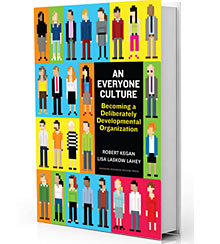
But now there may be hope. What if your company were to embrace the Peter Principle? What if it could accept that eventually all employees will reach their level of incompetence, recognize when each employee has reached it, and then help people move beyond their own fallibilities? Would such a company succeed? This, in essence, is the beguiling thesis of An Everyone Culture: Becoming a Deliberately Developmental Organization (Harvard Business Review Press, 2016).
An Everyone Culture hails from what might be described as the Left Bank of the Charles River — its lead authors are Robert Kegan and Lisa Laskow Lahey, professors at Harvard’s Graduate School of Education, which is separated from the Harvard Business School by the river and a sharp divergence in worldview. Rather than seeking competitive advantage in a company’s products or strategy, as HBS professors would, Kegan, Lahey, and their colleagues believe an edge can be found in the ability of corporations to develop adults as humans.
Indeed, the authors argue that a highly evolved company, which they call a “deliberately developmental organization (DDO),” can incorporate the psychological advancement of employees into the work itself. Kegan and Lahey want us to imagine that “hardwiring development into your bottom line” could, in addition to boosting profitability and quality, impact the firm’s culture so that “in the regular daily operations of the company, [it will] be a continuous force on behalf of people overcoming their limitations and blind spots and improving their mastery of increasingly challenging work.”
This might sound like corporate utopianism — or, for those of a more cynical bent, dystopianism. But the authors develop the argument by parachuting us into three existing DDOs, all of which serve as highly effective, day-in-the-life case studies. Bridgewater Associates, perhaps the largest and most successful hedge fund in the world (with US$150 billion in assets and 1,500 employees), pursues “radical transparency” by recording every meeting and providing the audio files to everyone in the company. Decurion Corporation, a Los Angeles-based real estate development, acquisition, and property management company with 1,100 employees, holds “fishbowl” conversations: Attendees sit in a circle, arrayed around a smaller inner circle of people most involved in the issue at hand, and discuss subjects such as the stalled development of a customer loyalty program or an executive’s habit of “withdrawing her goodwill.” At Next Jump, Inc., an e-commerce company that runs reward programs for other corporations and has 200 employees, all new hires attend a three-week personal leadership boot camp in which they learn how to identify and address their “character weaknesses.”
Beyond detailing the ways in which the three companies operate, the book explains the theory of adult development that underpins a DDO, and describes its key attributes: “the depth of its developmental community (which we callhome); the breadth of its developmental practices (which we call its groove); and the height of its developmental aspirations (which we call its edge).”
So, should your company become a DDO? And would you want to work for one?
The book includes a full chapter devoted to each of these questions. In regard to the first one, the authors believe the results of the companies they focused on point to a clear yes. In seeking to maximize employee potential, they write, Bridgewater, Decurion, and Next Jump have achieved a range of remarkable goals. They’ve figured out “how to increase retention, profitability, coaching support, readiness to learn, speed to promotability, [and] frankness in communication” while cutting back on political maneuvering, impression management, behind-the-back disparagement, and disengagement. They have learned “how to anticipate crises no one in the company has experienced and manage successfully through them; how to invent future possibilities no one has experienced and realize them.”
While they are willing to generalize from the particular experience of companies, the authors are less cavalier about arguing that every person will embrace the possibility of DDOs. From the outset, they repeatedly warn readers they are likely to have a visceral reaction to the idea of working in a DDO. “If you are, like most people, more wary of feeling vulnerable, ashamed, and unworthy — especially at work — you might find yourself feeling alarmed soon after you enter.” But for the few, the introspective and the bold, DDOs may make perfect sense. Such companies tend to be good destinations for the “rarer kind of person,” whom the authors describe as “valuing the experience of your own vulnerability and running right toward it.”
I’m definitely in the wary camp. It’s not so much that I’m worried about feeling vulnerable, ashamed, and unworthy — I’m used to that. But I would be wary of working in a DDO because I have a hard time believing that: (1) a corporation can always be trusted to look out for my best interests; (2) my psychological development is an employer’s business; or (3) bosses and coworkers are qualified to act as therapists.
But I could be wrong. It’s possible that the novelty and relative scarcity of DDOs makes them seem strange and alien. Perhaps if I were to convene a fishbowl session in which my colleagues could tell me, with radical transparency, their opinions of me and my work, I might become a more productive, more evolved human being.
Are your employee apps ethical? Companies are providing employees with more and more digital services for purposes that range from enhancing teamwork to getting a better night’s sleep. But do they promote agency — or addiction? Perhaps it’s time for managers to take a closer look at the design of those services — and question the techniques they employ to create a compelling user experience.
Toward this end, Tristan Harris has some choice words in a new article on Medium. “I’m an expert on how technology hijacks our psychological vulnerabilities,” he begins. “That’s why I spent the last three years as Google’s Design Ethicist caring about how to design things in a way that defends a billion people’s minds from getting hijacked. When using technology, we often focus optimistically on all the things it does for us. But I want you to show you where it might do the opposite.”
Harris goes on to call out common hijacks that are intentionally and unintentionally built into the design of websites and apps. They include: menus that give the impression of choice, while limiting it; the embedding of intermittent, variable rewards that induce addictive behaviors; reliance on powerful motivators such as social approval and reciprocity; and seven more.
“I’ve listed a few techniques but there are literally thousands,” adds Harris. “Imagine whole bookshelves, seminars, workshops and trainings that teach aspiring tech entrepreneurs techniques like these. Imagine hundreds of engineers whose job every day is to invent new ways to keep you hooked.”
Harris, who studied under Professor BJ Fogg in Stanford’s Persuasive Technology Lab, is talking about big social media services offered to the general public by companies, such as Facebook, Instagram, TripAdvisor, and NYTimes.com. But his conclusion applies to digital services aimed at employees, too:
“The ultimate freedom is a free mind, and we need technology that’s on our team to help us live, feel, think and act freely. We need our smartphones, notifications screens and web browsers to be exoskeletons for our minds and interpersonal relationships that put our values, not our impulses, first. People’s time is valuable. And we should protect it with the same rigor as privacy and other digital rights.”
Peters is one of the handful of people who helped transform the business book genre from a staid backwater into a mass market — with 1.8 million titles in print, it’s the fifth-largest book category on Amazon. He has written 29 of those titles and sold more than 10 million copies of them. In the process, Peters helped define the term business guru and inspired more wannabes than Madonna. At age 73, he enjoys an engaged, multigenerational audience, including 135,000 Twitter followers.
Because Peters is a voracious reader, I thought he would make an ideal subject for my monthly “Required Reading” column for strategy+business, in which business notables call out a very short list of books they think leaders should read. But a brief call to New Zealand, where Peters goes to beat the New England winters, to discuss his four favorite books somehow turned into a one-and-a-half-hour marathon.
“I have to tell you a story about a neighbor of mine in Massachusetts who would be on anybody’s top 10 list of [Warren] Buffett–like people,” Peters opened. “I was at a dinner with him 18 months ago and, out of nowhere, he said, ‘You know what the number one problem is with big company CEOs?’ I said, ‘I can think of at least 70 things, but damned if I can narrow it down.’ And out of his mouth pops, ‘They don’t read enough.’” ...read the rest here
Two questions that managers of intelligent machines should ask: It’s been a couple of years since Stephen Hawking warned that artificial intelligence could “spell the end of the human race.” The terminators aren’t here yet and unless they come very soon, the managers of AI-based technology have a couple of more immediate issues to address, according to Vasant Dhar of NYU’s Stern School of Business and Center for Data Science.
The first, which Dhar takes up in a new article on TechCrunch, is how to “design intelligent learning machines that minimize undesirable behavior.” Pointing to two high-profile juvenile delinquents, Microsoft’s Tay and Google’s Lexus, he reminds us that it’s very hard to control AI machines in complex settings. “There is no clear answer to this vexing issue,” says Dhar. But he does offer some guidance: Analyze the machine’s training errors; use an “adversary” — through means such as crowdsourcing — to try to trip up the machine; and estimate the cost of error scenarios to better manage risks.
The second question, which Dhar explores in an article for HBR.org, is when and when not to allow AI machines to make decisions. “We don’t have any framework for evaluating which decisions we should be comfortable delegating to algorithms and which ones humans should retain,” he writes. “That’s surprising, given the high stakes involved.” Dhar suggests addressing this issue with a risk-oriented framework that he calls a Decision Automation Map. The map plots decisions in two independent dimensions — predictability and cost per error — and suggest whether it would be better made by human or machine ...read the rest here
George Barbee brings a perspective to the subject of innovation that is both expert and unusually diverse. His 45-year career includes stints with large companies, entrepreneurial ventures, consulting firms, and educational institutions.
Barbee’s innovation career began in the product realm while he was serving as an executive with Wilkinson Sword and, later, with Noxell and Gillette, now divisions of Procter & Gamble. In the 1980s, he launched into service innovation and founded three companies. One of them, the Consumer Financial Institute, became the largest independent provider of financial planning in the U.S. and was acquired by PricewaterhouseCoopers (PwC) in 1986. He joined PwC as a partner, creating and leading a new strategy named the Global Client Service Partner, which generated several hundred million dollars in new revenue for the firm.
In 2000, Barbee (along with authors Jim Collins and Malcolm Gladwell and former Virginia governor Jim Gilmore) was named a Batten Fellow at the University of Virginia’s Darden School of Business. Since then, he has served as senior lecturer at the school, teaching service innovation, entrepreneurship, and marketing.
Most recently, Barbee wrote and published 63 Innovation Nuggets (for Aspiring Innovators) (Innovation Etc., 2015), which contends that innovation is both a learnable and teachable skill. In the book, he offers concise, practical strategies and tactics, as well as reading recommendations, for those who want to bolster their personal and organizational creativity.
When I asked Barbee to share a short list of books that most influenced the development of his capacity for innovation, he called out the following three books.
What Color Is Your Parachute? A Practical Manual for Job-Hunters and Career-Changers, by Richard N. Bolles (Ten Speed Press, 2015). “Bolles self-published the first 100 copies of Parachute in 1970, and he has revised and updated it annually ever since. Surely the most popular handbook for job hunters ever written, it has sold more than 10 million copies. But I love it not because it helped me find a new job, but because it helped me better understand myself.
“Parachute showed me how to chart and assess the various phases of my career. I’ve done the exercises in the book’s appendix more than 20 times over the years, and I kept my notes and used them to evaluate where I was, where I was going, and where I wanted to go in my life.
“Bolles’s manual taught me to appreciate my own strengths and weaknesses. It also helped me understand the importance of embracing diversity and identify the types of people I needed around me to maximize my ability to innovate in both personal and organizational settings. I think you should grab a copy of Parachute every time a new edition appears. Read it, do the exercises, make notes, and chart your growth. Use it to evolve and enhance your ability to innovate.”
How to Get Control of Your Time and Your Life, by Alan Lakein (P.H. Wyden, 1973). “Lakein is one of the pioneers of modern personal time management. He opened my eyes to the importance of setting priorities, keeping to-do lists, and regularly assessing my progress, as well as reassessing my goals.
“Alan Lakein’s ABC method of prioritization has wormed its way into my life in conscious and unconscious ways. His book also helped me balance my business and personal lives — and it enabled me to reach that very special nirvana that can result if you can integrate the two. By showing you how to manage your time in a disciplined way, this undeservedly out-of-print book helps you generate insights and focus on what is truly important, which really pays off when you are trying to launch and manage innovation efforts.”
The World Is Flat: A Brief History of the Twenty-First Century, by Thomas Friedman (Farrar, Straus and Giroux, 2005). “I worked in 40 countries in my career, but I’ve never been able to verbalize the trends and phenomena that I witnessed as insightfully as Friedman does in this book. That’s why I’ve been assigning it in the MBA class I teach at Darden since it was first published.
“There are some who feel that Friedman exaggerated the progress of globalization, but his thesis that the cultural and geographical barriers between nations are becoming lower and lower is certainly true with regard to business. And it jives with my experiences working with global companies. You should become familiar with the 10 ‘flatteners,’ seven ‘company rules,’ and three ‘convergences’ described in the book — some of the names have changed over the past decade, but they remain as relevant as ever.”
Befitting a Holmesian adventure, the first case in Small Data begins with a mysterious call. The interpreter for a Moscow-based entrepreneur is on the line. “The businessman wanted to launch a new business in Russia with the goal of generating at least a billion dollars a year,” Lindstrom writes. “When I asked the obvious question — what was the business? — I was told it was up to me.” Most people receiving such calls would think they were about to be scammed. But for Lindstrom, a self-described “forensic investigator of emotional DNA” with a global reputation, this was an exciting lead.
Soon after, the investigator, accompanied by two Watsons, is on his way to Russia aboard a private jet chartered by the entrepreneur. They spend a few days in Moscow and then fly 4,000 miles to Krasnoyarsk, a city in Siberia with a population of one million. And here, in the frozen steppes, Lindstrom takes the pulse of the Russian people and tries to identify the billion-dollar business opportunity harbored in their collective psyche.
He does this by mimicking anthropologists. Lindstrom notices that the locals upholster the inside of their apartment doors, that they lack mirrors, that the men stow their toothbrushes bristles-down and the women bristles up, and, most tellingly, that “every refrigerator seemed to have an extravagantly large collection of magnets.” To Lindstrom, this last clue was evidence that Russian parents doted on their young children. And he ultimately recommended that the entrepreneur launch Mamagazin.ru, an online community and e-commerce site aimed at Russian mothers and their children. Mamagazin.ru was a success, Lindstrom reports, until sanctions on imports forced it to close and retrench in 2015.
“The Case of the Refrigerator Magnets” is one of the seven tales in the book showcasing Lindstrom’s methods. Each is fascinating, but each also drives home a lesson that may or may not be intentional: It’s hard, perhaps impossible, for the average marketer to do what Lindstrom does.
Lindstrom strikes those of us who blunder through life as supernaturally sensitive and observant. When he comes across seemingly minute and irrelevant details (like whose clothes are hung where in a bedroom closet), his antennae begin to quiver. He also has decades of assignments under his belt, and each has contributed to a portfolio of insights that he can apply elsewhere. For instance, the sense of community Lindstrom discovered in Siberia informed his recommendations for redesigning a chain of grocery stores in the Southeastern U.S.
Happily, Lindstrom is willing to offer us a guide for building a brand. “Until recently, I never considered what I did for a living as a repeatable methodology,” he admits. “But over the past few years, nearly half a dozen companies have asked if I could distill my methods into a training program.”
Lindstrom outlines the result — the 7C Manifesto — in the final pages of the book. The Cs are collecting, clues, connecting, correlation, causation, compensation, and concept — and each represents a step in the process that Lindstrom follows. He also offers some useful advice for completing each step: In collecting, for instance, remove the internal filters that block your ability to observe clearly. When Pepsi asked Lindstrom to improve the public perception of his favorite soda, he eagerly accepted the assignment. But he also stopped drinking it. “Pepsi — its taste, its bubbles, its cans, its bottles, its advertising — was just too familiar,” he explains. “I had no distance from the brand, no frame of reference about desire, or craving, my own or other people’s. I couldn’t think straight. I couldn’t get inspired. I couldn’t do my job.”
Even with the helpful advice, I doubt that many of us could ever be able to do what Lindstrom does. There is some magic to his work, and some genius, and a lifetime of devotion to understanding how people’s emotions become intertwined with brands. But then, not being able to do what Sherlock Holmes can do has never stopped admiring readers from following his adventures with delight and astonishment. Why should it not be the same with Martin Lindstrom?
A seasoned business writer and editor, I work with leading consultants, corporations and non-profits, across sectors and geographies, to craft compelling content.
The kinds of writing and editing that I do:
• Books. I have played an instrumental role in the creation of more than 20 business books, as a named author, ghostwriter or editor.
• White papers and reports. I’ve ghostwritten and edited more than 100 white papers and reports.
• Articles, op-eds and reviews. I’ve written, ghostwritten and edited hundreds of pieces for business magazines, newspapers, blogs and web sites.
"And by this time his financial morality had become special and local in its character. He did not think it was wise for any one to steal anything from anybody where the act of taking or profiting was directly and plainly considered stealing. That was unwise — dangerous — hence wrong. There were so many situations wherein what one might do in the way of taking or profiting was open to discussion and doubt. Morality varied, in his mind at least, with conditions, if not climates." --Theodore Dreiser, The Financier (1912)
"Had not a long, practical struggle with life taught him that sentiment in business was folly?" --Theodore Dreiser, An American Tragedy (1925)
"Be nice to incompetents and they'll be nice back. Be nasty and they'll still be incompetent, so what do you gain by making an enemy?" --John Burdett, Bangkok 8 (2003)
"The world has no pity on a man who can't do or produce something it thinks worth money." --George Gissing, New Grub Street (1891)
"Even the building was creepy: long windowless corridors and flights of stairs that stripped your sense of direction to nothing, tepid canned air with too little oxygen, a low witless hum of computers and suppressed voices, huge tracts of cubicles like a mad scientist's rat mazes." --Tana French, In The Woods (2007)
"Only a lunatic would fail to distinguish between himself and his representative self. This banal distinction may be most obvious in the workplace, where invariably one must avail oneself of an even-tempered, abnormally-industrious dummy stand-in, who, precisely because it is a dummy, makes life easier for all others, who are themselves present, which is to say, represented, by dummies of their own." -- Joseph O'Neill, The Dog (2014)
He had indeed conversed so entirely with money, that it may be almost doubted whether he imagined there was any other thing really existing in the world; this at least may be certainly averred, that he firmly believed nothing else to have any real value." -- Henry Fielding, Tom Jones (1749)
"You invariably find among CEOs that life is business. There is an operative cruelty which is seen as an entitlement." -- E.L. Doctorow, City of God (2000)
"Employers are like horses. They require management." --P.G. Wodehouse, Carry On, Jeeves (1925)
"SECRETS ARE LIES CARING IS SHARING PRIVACY IS THEFT"--Dave Eggers, The Circle (2013)
"A desk is a dangerous place from which to watch the world." -- John LeCarré, The Honourable Schoolboy (1977)
"I can well imagine forms of servitude worse than our own, because more insidious, whether they transform men into stupid, complacent machines, who believe themselves free just when they are most subjugated, or whether to the exclusion of leisure and other pleasures essential to man they develop a passion for work as violent as the passion for war among barbarous races." -- Marguerite Yourcenar, Memoirs of Hadrian(1963)
"Because if you truly want to become filthy rich in rising Asia, as we appear to have established that you do, then sooner or later, you must work for yourself. The fruits of labor are delicious, but individually they're not particularly fattening. So don't share yours, and munch on those of others whenever you can." -- Mohsin Hamid, How to Get Filthy Rich in Rising Asia, (2013)
"They copied all they could follow, but they couldn't copy my mind. So I left 'em sweating and stealing, a year and a half behind." -- Rudyard Kipling, The Mary Gloster(1894)
"The only thing you got in this world is what you can sell. And the funny thing is you're a salesman, and you don't know that." -- Arthur Miller, Death of a Salesman
(1949)
"Every exercise of power incorporates a faint, almost imperceptible, element of contempt for those over whom the power is exercised." -- Sandor Marai, Embers (1942)
"Go to a tea shop anywhere along the Ganga, sir, and look at the men working in that tea shop--men, I say, but better to call them human spiders that go crawling in between and under the tables with rags in their hands, crushed humans in crushed uniforms, sluggish, unshaven, in their thirties or forties but still 'boys.' But that is your fate if you do your job well--with honesty, dedication, and sincerity, the way Gandhi would have done it, no doubt.
I did my job with near total dishonesty, lack of dedication, and insincerity--and so the tea shop was a profoundly enriching experience." -- Aravind Adiga, The White Tiger (2008)
"'Alex. Are you still buying advertising space?' 'For as long as the job doesn't require one to have a brain.' 'It's always nice to talk to a man who enjoys his work.' 'Fortunately I enjoy the money a whole lot better.'" -- Philip Kerr, The Pale Criminal (1990)
"'Oilmen are gamblers, most of them, and they'd rather take a little chance than spend a lot of money. Or wait for the technology to catch up.' He added after a moment, 'They're not the only gamblers. We're all in the game. We all drive cars, and we're all hooked on oil. The question is how we can get unhooked before we drown in the stuff'" -- Ross Macdonald, Sleeping Beauty (1973)
"I'm tempted to point out that our dealings, however unusual and close, were the dealings of businessmen. My ease with this state of affairs no doubt reveals a shortcoming on my part, but it's the same quality that enables me to thrive at work, where so many of the brisk, tough, successful men I meet are secretly sick to their stomachs about their quarterlies, are being eaten alive by bosses and clients and all-seeing wives and judgmental offspring, and are, in sum, desperate to be taken at face value and very happy to reciprocate the courtesy." -- Joseph O'Neill, Netherland (2008)
"I think that I shall never see A billboard lovely as a tree. Perhaps, unless the billboards fall, I'll never see a tree at all." -- Ogden Nash, Song of the Open Road, Happy Days (1933)
"When I go into the back entrance to our business, I smell the beans and the roasters and antiseptic-lacquered-with-fruit smell of the floor cleanser, and then, even more faintly, the strange bleary artificiality in the air, characteristic of enclosed shopping malls. The ion content in the oxygen has been tampered with by people trying to save money by giving you less oxygen to breathe. You get light-headed and desperate to shop. The air smells machine-manufactured, and the light looks manufactured or maybe recycled from previous light." -- Charles Baxter, The Feast of Love (2000)
"Some of us loved killing an hour of the company's time and others felt guilty for it afterward. But whatever your personal feelings on the matter, you still had to account for the hour, so you billed it to a client. By the end of the fiscal year, our clients had paid us a substantial amount of money to sit around and bullshit, expenses they then passed on to you, the consumer. It was a cost of doing business, but some of us feared it was an indication that the end was near, like the profligacy that preceded the downfall of the Roman Empire. There was so much money involved, and some even trickled down to us, a small amount that allowed us to live among the top one-percent of the wealthiest in the world. It was lasting fun, until the layoffs came." -- Joshua Ferris, Then We Came To The End (2007)
"The last line was so far away that the men were specks-bobbing bug-like fixtures, moving in what seemed to be a rainbow-haze of reds and yellows and blues. Those were the spray-painters, Simpson explained, and some of them made as much as seven dollars a day. He did not explain that they had no teeth after six months, little eyesight after a year, and that their occupational expectancy was about three years. In all likelihood he was not acquainted with these facts, and he would have been annoyed at their recital. To the best of his knowledge, there wasn't any law compelling a man to be a spray-painter." -- Jim Thompson, Heed the Thunder (1946)
"Since those birds were up around the top, the top numbers in one of the three biggest agencies in the country, with corner rooms at least twenty by twenty and incomes in the six figures, it had of course been years since any of them had personally dialed a number in an office. To expect them to would be against all reason" -- Rex Stout, Before Midnight (1955)
"What I'm getting at, Bobby, is you may notice, over time, as you study and learn, a certain amount of chicanery in this business of ours. But don't let that dismay you. It's just the nature of the business we're in, part and parcel of the good old capitalist system that's gonna make us both rich men before we die." -- Clancy Martin, How to Sell (2009)
"I'm a bookkeeper, and, the way I see it, there's nothing to life but bookkeeping...One rule is this: that if the risk of a transaction is very great it should not be considered at all, no matter what profit it offers if it is successful. That's one of the basic rules that should never be broken. You apply that rule to the idea of committing a murder and what do you get? There's too much risk, so you don't do it. The idea is no good. It's all a matter of debit and credit..." -- Rex Stout, Prisoner's Base (1952)
"I must look Ralph up and question him. He'll be in hiding by now, of course, but he's worth hunting out. He always has the most consistently logical and creditable reasons for having done the most idiotic things. He is" - as if that explained it - "an advertising man." -- Dashiell Hammett, The Dain Curse (1929)
Addresses a big problem: the inability of companies to get full value from external talent. Academic-style read. The solutions are aimed at big companies that hire a lot of outside help.
Adding Hallberg to my authors to watch list. Ambitious and mostly terrific novel set in NYC in late 70s. Could have been cut by a third, but the characters and story-telling pulled me thru.
 “In the 21st century it’s harder for large corporations to create disruptive breakthroughs,” writes Blank. “Disruptive innovations are coming from startups — Tesla for automobiles, Uber for taxis, Airbnb for hotel rentals, Netflix for video rentals and Facebook for media.”