Friday, February 9, 2018

The End of Scale

Learned a lot lending an editorial hand here:

MIT Sloan Management Review, Feb. 9, 2018

by Hemant Taneja with Kevin Maney


For more than a century, economies of scale made the corporation an ideal engine of
 business. But now, a flurry of important new technologies, accelerated by artificial intelligence (AI), is turning economies of scale inside out. Business in the century ahead will be driven by economies of unscale, in which the traditional competitive advantages of size are turned on their head.

Economies of unscale are enabled by two complementary market forces: the emergence of platforms and technologies that can be rented as needed. These developments have eroded the powerful inverse relationship between fixed costs and output that defined economies of scale. Now, small, unscaled companies can pursue niche markets and successfully challenge large companies that are weighed down by decades of investment in scale — in mass production, distribution, and marketing.

Investments in scale used to make a lot of sense. Around the beginning of the 20th century, the world was treated to a technological surge unlike any in history. That was when inventors and entrepreneurs developed cars, airplanes, radio, and television, and built out the electric grid and telephone system.

These new technologies ushered in the age of scale by enabling mass production and offering access to mass markets. Electricity drove automation, allowing companies to build huge factories to churn out a product in massive quantities. Radio and TV reached huge audiences, which companies tapped through mass marketing. The economies of scale governed business success.

Scale conferred an enormous competitive advantage. It not only lowered fixed costs — it also created a forbidding barrier to entry for competitors. Organizations of all kinds spent the 20th century seeking scale. That’s how we ended up with giant corporations, and universities with 50,000 students, and multinational health care providers.

Today, we’re experiencing a new tech surge. This one started around 2007, when mobile, social, and cloud computing took off with the introduction of the iPhone, Facebook, and Amazon Web Services (AWS), respectively. Now, we’re adding AI to the mix. AI is this century’s electricity — the technology that will power everything.

AI has a particular property that supplants mass production and mass marketing as a basis of competitive advantage. It can learn about individuals and automatically tailor products for them at scale. This is how the GPS navigation app Waze gives you a route map tailored to your destination at a specific moment in time — a map that probably won’t work for anyone else or at any other time and doesn’t need to. AI enables mass customization for increasingly narrow markets. If a product is custom built specifically for you, you’ll probably prefer it to a product that’s built for millions of people who are only kind of like you.

This is the basis of economics of unscale. The winning companies in today’s tech surge are companies that profitably give each customer exactly what he or she wants, not companies that give everyone the same thing.

There is another, equally important way in which the current tech wave is propelling economies of unscale. Because companies can stay nimble and focused by easily and instantly renting scale, they can adjust more quickly to changing demand and conditions at much lower cost and with far less effort.

Thus, scaled companies find themselves beleaguered by unscaled competitors. Stripe is an unscaled financial services company based in San Francisco that is challenging the big banks. Airbnb, also based in San Francisco, is an unscaled hotel company that is taking customers away from the big chain hotels. Warby Parker is a New York City-based unscaled eyewear company that is threatening the big eyewear brands.

If economies of unscale will rule in this new world of business, how can a corporation, which, by definition is a large, scaled-up enterprise, compete and thrive? Read the rest here


Wednesday, January 31, 2018

The Truth About Corporate Transformation

Learned a lot editing this article from the BCG Henderson Institute:

MIT Sloan Management Review, January 31, 2018

by Martin Reeves, et. al.

Transformative Corporate Change Technology Strategy LeadershipCorporate transformation sits atop the strategic agenda for many CEOs. While transformation is ideally undertaken preemptively, in practice it is much more commonly a reaction to changing — and challenging — circumstances. Such transformations represent a fundamental and risk-laden reboot of a company, with the goal of achieving a dramatic improvement in performance and altering its future trajectory.

Given the stakes, we were startled to find that the research underpinning the design and execution of corporate transformations is surprisingly thin. As a result, transformations are often guided by beliefs that, while seemingly plausible, are more anecdotal than empirical in nature. It’s time for a more evidence-based approach.

To study corporate transformation and its success factors, we analyzed financial and nonfinancial data of all U.S. public companies with $10 billion or more market cap between 2004 and 2016. We identified companies with a demonstrated need for fundamental change, namely, those companies with an annualized deterioration, relative to their industry average, in total shareholder return (TSR) of 10 percentage points or more over two years. This definition provided us with a large data set for empirical analysis including more than 300 companies across different industries over more than a decade.

Further, we trained a proprietary algorithm to quantify the strategic orientation of companies, based on semantic patterns within the “Management’s Discussion and Analysis” section of 70,000 10-K filings. We built a prediction model to identify formalized transformation programs, based on restructuring costs and major corporate announcements (as reported by Standard & Poor’s Financial Services LLC). And we conducted a multivariate regression analysis to determine the impact of a number of factors on change in TSR during transformations...Read the rest here.

Tuesday, January 30, 2018

How to Lead Cynics

strategy+business, January 30, 2018

by Theodore Kinni

We (and by we, I mean a random sample of American adults) have a pretty cynical opinion of you (and by you, I mean business executives). According to a Gallup poll conducted in December, 28 percent of us rate your honesty and ethical standards as low or very low, 54 percent rate them as average, and just 16 percent rate your honesty and ethics as high or very high. To put this in perspective, business executives rank just below lawyers. Among the 22 professions covered in the survey, only advertising practitioners, members of Congress, car salespeople, and lobbyists rank lower.

It’s certainly not my place or my intention to impugn the honesty and ethics of any single business leader, or any professional for that matter. But there is clearly a lot of cynicism out there these days. So if you’re not good at leading cynical people, chances are you’re not good at leading a lot of the people you’re supposed to be leading.

I like to think I know a bit about what it takes to lead cynical people because I’m one of them, by nature and by nurture. Often, business leaders are advised not to hire people like me. The conventional wisdom holds that cynics’ jaundiced world view makes us too difficult to be led. Worse, our rotten attitudes are going to infect our coworkers.

This is untrue. It’s possible that a small number of us are truly irredeemable cynics. But most of us are not. “Scratch any cynic and you will find a disappointed idealist,” as George Carlin, the late, great comedian (and a world-class cynic), put it. Cynics can make great employees, but only if you can allay our suspicions about your motives and reignite our idealism. To achieve that, I earnestly propose three simple guidelines. Read the rest here.

Tuesday, January 23, 2018

When a Japanese Company Adopted English as a First Language


strategy+business, January 23, 2018

by Theodore Kinni


On March 1, 2010, Hiroshi Mikitani, the founder and CEO of Rakuten, a Japan-based e-
retailer, announced that henceforth English would be the official language of the company’s 10,000 employees. Moreover, declared Mikitani, who often was billed as Japan’s Jeff Bezos, any employee who didn’t become fluent in English within two years would face demotion.

The initiative, dubbed “Englishnization” by Mikitani, shocked Rakuten’s 7,000 or so 
Japanese employees — 95 percent of whom did not speak their employer’s newly established lingua franca. It also made headlines around the world, and drew some domestic fire: “It’s stupid for a Japanese company to only use English in Japan when the workforce is mainly Japanese,” said Honda Motors CEO Takanobu Ito. (Five years later, Ito would be out and English would be in at Honda, too.)

Rakuten’s Englishnization didn’t shock Tsedal Neeley, author of The Language of Global Success: How a Common Tongue Transforms Multinational Organizations. “By mandating English,” writes the associate professor at Harvard Business School, “Rakuten was prepared to join the approximately 52 percent of multinational companies that had adopted a language different from that of their originating country in order to better meet global expansion and business needs.”

In The Language of Global Success, Neeley reports the results of her five-year longitudinal study of the initiative, which began a couple of months after Mikitani’s announcement. She also ticks off the reasons companies need a lingua franca. Communication and knowledge exchange top the list. Rakuten was operating in a fast-moving and highly competitive sector. And by 2010, the 13-year-old company was pursuing a strategy of global expansion. It was clear to Mikitani that the language barriers within Rakuten were bogging down everything — integration of acquisitions, management of business units in 27 countries, the minutiae of daily work. For instance, an email from an English-speaking employee in the U.S. to a Japanese colleague required translation, as did the reply and any additional messages — and the translations themselves often required interpretation. As you might guess, even simple exchanges could drag on for days. Read the rest here.


Wednesday, January 3, 2018

Five Principles for Organizing Collective Intelligence

Sloan Management Review, January 3, 2017

by Theodore Kinni

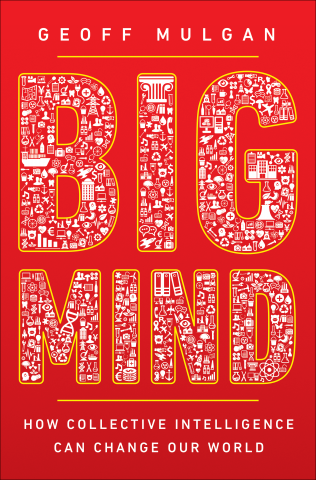
Big Mind Book Cover Jacket
Collective intelligence is nothing new. Back around 400 BC, the Greek historian Thucydides described how a “great many” soldiers counted the bricks in the wall of a besieged town and their individual totals were compared to determine the correct height for the assault ladders needed to capture it.

Geoff Mulgan, CEO of Nesta, the U.K.’s National Endowment for Science, Technology and the Arts, and a senior visiting scholar at Harvard University’s Ash Center, relates the story in his insightful new book, Big Mind. The book is about how the “collective” in collective intelligence works. That is, of course, a very timely topic now that technology has not only enabled us to muster larger collectives of intelligence than ever, but also has expanded them to include smart machines. Witness the entire open-source movement.

Big Mind is notable for a number of reasons. One of them is that we don’t have a lot of guides for managing and optimizing collective intelligence, in contrast to the shelves and shelves of books describing how to optimize the output of individual brains. Another reason is the five fundamental principles that Mulgan offers, in the excerpt below, in a nuanced answer to the question: “What is it, at the micro and macro levels, that allows collective intelligence to flower?” Read the excerpt here

Friday, December 15, 2017

Seeking Scale? Think Old

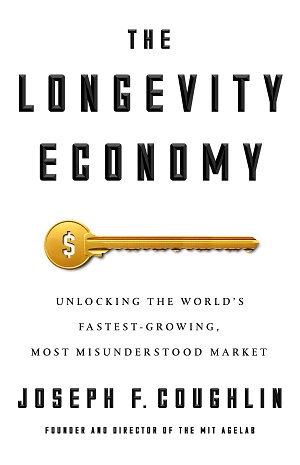
The Longevity Economy: Unlocking the World’s Fastest-Growing, Most Misunderstood MarketMIT Sloan Management Review, December 14, 2017

by Theodore Kinni


These days, scale is a top-of-mind issue among leaders of tech companies. Yet many of these leaders are missing the biggest and most obvious scaling opportunity they’ll ever encounter: old people.

The worldwide population of older adults — people age 65 and up — reached 617 million in 2015 (almost twice the total population of the United States); in the U.S. alone, older adults represent an $8 trillion consumer market. Thanks to longer life expectancies, there will be 1 billion people age 65+ by 2030, and 1.6 billion of them by 2050.

The problem — which Joseph F. Coughlin, director of MIT’s AgeLab and the author of The Longevity Economy, lays out in the excerpt below — is that most tech companies simply don’t get this deep-pocketed, growth market. Worse, because of the relative youthfulness of tech companies, their leaders are not only missing the biggest market they’re likely to see before they become old folks themselves, they’re also overlooking the job candidates who could help them tap it as well.

If your company is seeking scale, read the excerpt here.

Wednesday, December 13, 2017

How to Break Bad Business Habits

strategy+business, December 13, 2017

by Theodore Kinni

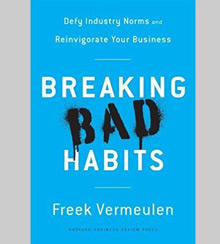
Back in the day, reading the newspaper on my morning commute to Manhattan was an origami-like exercise in folding and refolding. I never wondered why newspapers were printed on broadsheets that were too big for the bus. But Freek Vermeulen did. The clumsily sized standard for newspapers of record peeved him.

It took the associate professor of strategy and entrepreneurship at the London Business School years to ascertain that the widely used broadsheet dated back to 1712. That’s when the English government began taxing newspaper owners by the number of pages they printed. Bigger pages meant fewer pages and thus less tax. The tax was eventually abolished, but the broadsheet remained the standard — even though the cost of the paper was high and its unwieldy handling irritated readers such as Vermeulen.

In 2003, an English newspaper bucked the long-established standard. The struggling Independent ran an experiment. It offered its paper in broadsheet and in a format exactly half that size in one market. The smaller paper outsold the larger by three to one. The Independent’s leaders quickly adopted the half-size version nationwide, and the paper’s print circulation rose 20 percent annually for several years.

The lesson, says Vermeulen, and the worthy theme of his new book, Breaking Bad Habits: “Killing bad practices can open up new avenues of growth and innovation and reinvigorate your business.” Read the rest here.

Sunday, November 26, 2017

Creating Positive Moments for Your Customers

strategy + business, November 22, 2017

by Theodore Kinni


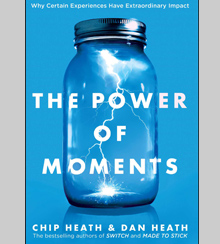
Quick question. Customers rank their interactions with your company on a scale of 1 (very negative) to 7 (very positive). Should you invest more resources in improving the experiences of customers who rank their interactions at a 1, 2, or 3, or those who rank them at a 4, 5, or 6?

When brothers Chip and Dan Heath, a professor at Stanford Graduate School of Business and a senior fellow at Duke University’s CASE Center, respectively, asked executives how they invest their resources, the executives estimated that, on average, their companies spend 80 percent of their resources trying to improve the experiences of their unhappiest customers. Yet, report the Heaths, in 2016, when Forrester Research tabulated its annual U.S. Customer Experience Index and modeled the financial results in 16 industries, it discovered that “there’s nine times more to gain by elevating positive customers than by eliminating negative ones.”

This finding supports the main point in The Power of Moments, the latest in a series of formulaic but insightful books by the Heaths that seek to illuminate questions with important business ramifications, such as how to make ideas sticky and how to create change successfully. The point in this case is that “positive defining moments” can produce extraordinary effects in both individuals and organizations. The book explains how such moments are created. Read the rest here
.

Wednesday, November 8, 2017

The €1 trillion challenge in European banking

strategy&, November 8, 2017 

Learned a lot lending an editorial hand on this whitepaper. 
Download or read it here


The €1 trillion challenge in European banking

Wednesday, November 1, 2017

Four Ways Nonprofits Can Increase Their Impact

Insights by Stanford Business, November 1, 2017

by Theodore Kinni

People reaching-out from behind a fence

Only a mere 50 years ago were philanthropic and charitable organizations in the U.S. defined as an independent sector distinct from government and business. Since then, the economic impact of the nonprofit sector in the U.S. has grown to $1.7 trillion.

The sector’s sheer heft — it’s larger than the banking and retailing industries — is one reason that Stanford GSB alumni and lecturers Bill Meehan and Kim Starkey Jonker wrote Engine of Impact: Essentials of Strategic Leadership in the Nonprofit Sector, which came out this November. Another is their conviction that the sector has entered a new era, which they’ve named the “Impact Era.”

The good news of the Impact Era is that, by 2025, philanthropists will likely contribute a record $500 billion to $600 billion annually to nonprofits, well above the $373 billion recorded in 2015. The bad news is the nonprofits will still come up short by $100 billion to $300 billion in the funding they require. “In brief, [nonprofits] will need more money, and lots of it,” according to Meehan and Jonker in the introduction to Engine of Impact.

Here, Meehan and Jonker discuss how nonprofits can make up the shortfall and meet the challenges of the Impact Era. Read the rest here.

Wednesday, October 25, 2017

Do-It-Yourself Oceaneering

strategy + business, October 25, 2017

by Theodore Kinni

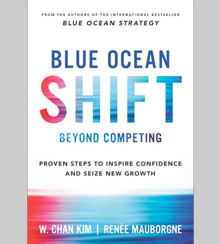
INSEAD professors W. Chan Kim and Renée Mauborgne hit the thought leadership lottery 
with the idea of blue oceans. Their 2005 book, Blue Ocean Strategy, Harvard Business School Press, which described the advantages of setting sail for new “blue ocean” markets devoid of competitors versus battling for percentage points of share in mature, commoditized “red ocean” markets, sold more than 3.5 million copies. The two professors, having found their own blue ocean, quickly ascended to the pinnacle of strategic consulting: INSEAD presented them with an institute and built blue ocean strategy into its MBA curriculum. Given all this success, the only truly surprising thing is that it took 12 years for Kim and Mauborgne to publish a follow-up.

For the most part, Blue Ocean Shift proves to be worth the wait. It is a practical, well-written guide to finding and exploiting blue ocean markets, informed by the experiences of companies and other organizations that have chosen to seek them out rather than compete toe-to-toe in established markets. Read the rest here.

Monday, October 16, 2017

Why Entrepreneurs Should Care Less About Disrupting and More About Creating

MIT Sloan Management Review, October 16, 2017

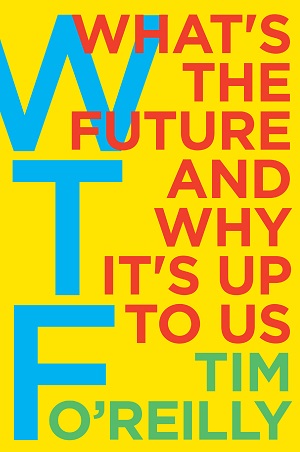
WTF? Book Cover Jacket
by Theodore Kinni

If you’re an entrepreneur or aspiring to become one, Tim O’Reilly is the kind of mentor you should try to enlist. He’s been there and done that in the New Economy since, well, pretty much since there’s been a New Economy.

O’Reilly started writing technical manuals in the late 1970s, and by the early 1980s, he was publishing them, too. His company, O’Reilly Media Inc. (formerly O’Reilly R. Associates), based in Sebastopol, California, helped pioneer online publishing, and in the early 1990s, it launched the first web portal, Global Network Navigator, which AOL acquired in 1995.

Since then, O’Reilly has been an active participant in a host of developments from open source to Gov 2.0 to the maker movement. He is founding partner of San Francisco-based O’Reilly AlphaTech Ventures LLC, an early stage venture investor, and he sits on a number of boards, including Code for America Labs Inc., PeerJ, Civis Analytics Inc., and Popvox Inc. He has also garnered a huge Twitter following @timoreilly.

In his new book, WTF?, O’Reilly takes issue with the vogue for disruption. “The point of a disruptive technology is not the market or competitors that it destroys. It is the new markets and the new possibilities that it creates,” he writes. “I spend a lot of time urging Silicon Valley entrepreneurs to forget about disruption, and instead to work on stuff that matters.” In the following excerpt, edited for space, O’Reilly shares “four litmus tests” for figuring out what that means to you. Read the excerpt here.

Sunday, October 15, 2017

How to Keep More of What You Make

Learned a lot about how to shelter wealth in private businesses while lending an editorial hand here. Read the rest at https://lnkd.in/gEFvJpu


Wednesday, October 11, 2017

Take a Timeout, Leaders


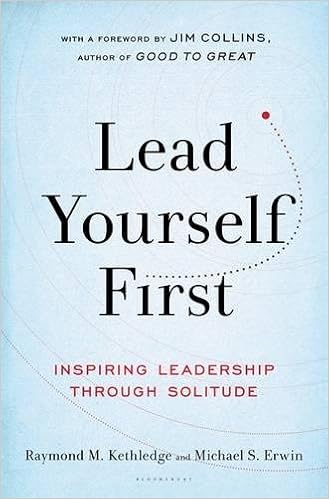
Image result for lead yourself firststrategy+business, October 11, 2017

by Theodore Kinni

On July 4, 1845, Henry David Thoreau went to the woods to live deliberately. After 
spending two years, two months, and two days in a 150-square-foot cabin that he built himself for $28.12 and a halfpenny, Thoreau had worked out the gist of the transcendentalist classic Walden; or, Life in the Woods. In it, he wrote, “I never found the companion that was as companionable as solitude.”

CEOs and other leaders would do well to get on companionable terms with solitude, too, according to first-time authors Raymond M. Kethledge, a U.S. Court of Appeals judge, and Michael S. Erwin, a leadership development consultant and assistant professor at West Point. Leaders don’t necessarily have to get off the grid and live in a hut for two years. But in Lead Yourself First, the authors make an extended argument that leaders should reserve some alone time “to find clarity, creativity, emotional balance, and moral courage.” They illustrate their thesis with numerous examples. Read the rest here.

Tuesday, October 3, 2017

Three Career Tips for the Purposeless

In which, I vent my frustration with the fetishization of purpose...

LinkedIn Pulse, October 3, 2017

by Theodore Kinni


“I’m not here to give you the standard commencement about finding your purpose. We’re millennials. We’ll try to do that instinctively,” Mark Zuckerberg told Harvard’s Class of 2017. “The challenge for our generation is creating a world where everyone has a sense of purpose.”

Baloney. A sense of purpose is like an appendix. If you’ve got one, good for you. If you don’t, you’re not missing anything important.

I’ve always been purposeless. As a kid, I kinda worried about it. I thought I was missing something essential because all I wanted to be was a New Jersey Lottery winner. (In those days, the grand prize was a cool million. Pretax. Woo-hoo!)

But getting a purpose was never a burning issue for me. Getting a job was far more important. I needed money—mainly because the only thing my parents ever agreed on was that one kid wasn’t enough.

Sans purpose, it did take me a long time—15 years—to find work that worked for me. But I learned some lessons along the way. I offer them here as shortcuts to everyone else who drew a blank ticket in the purpose lottery. Read the rest here.

Tuesday, September 19, 2017

Moving Beyond the Silicon Valley State of Mind


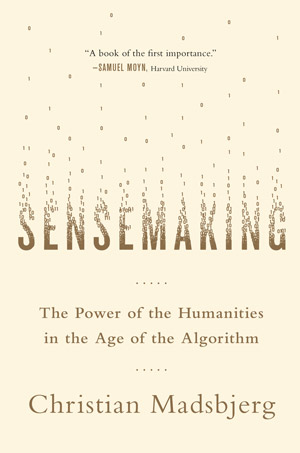
Sensemaking Book Cover JacketMIT Sloan Management Review, September 18, 2017

by Theodore Kinni

To steal a phrase from Anton Chekhov, the great danger of the Age of the Algorithm is that
 we will know everything and understand nothing. In his new book Sensemaking, a polemic defending the need for the liberal arts in business, Christian Madsbjerg, a founder of strategic consulting company ReD Associates based in Copenhagen and New York, argues that leaders shouldn’t try to know everything. Instead, they should try to make sense of something.

Madsbjerg offers up sensemaking as the antidote to algorithmic thinking — “a Silicon Valley state of mind” that relies exclusively on data for direction. Relying on data alone is taking “a journey determined by the reductions of a GPS,” according to the author. Sensemaking is the North Star: It provides the essential context for data — the rationale for collecting it and the perspective needed to gain insight from it.

In the excerpt below, Madsbjerg tells the story of Napa Valley’s Cathy Corison, comparing her approach to wine making with the data-driven approach of Leo McCloskey, founder of Sonoma, California-based Enologix, Inc., to illustrate the difference between traveling by the North Star and the GPS. Read the excerpt here.

Monday, September 18, 2017

Is Capitalism Killing America?

Insights by Stanford Business, September 18, 2017

by Theodore Kinni


On August 2, 2017, the Dow Jones Industrial Average hit a record-breaking 22,000 — its fourth 1,000-point advance in less than a year. That same day, I read the first sentence in Peter Georgescu's new book, Capitalists Arise! End Economic Inequality, Grow the Middle Class, Heal the Nation (Berrett-Koehler, 2017): “For the past four decades, capitalism has been slowly committing suicide.”

How does Georgescu, the chairman emeritus of Young & Rubicam (Y&R) and a 1963 graduate of Stanford Graduate School of Business, reconcile the Dow’s ascent with his gloomy assertion?

“The stock market has nothing to do with the economy per se,” he says. “It has everything to do with only one thing: how much profit companies can squeeze out of the current crop of flowers in the garden. Pardon the metaphor. But that’s what corporations do — they squeeze out profits.”

In the latter half of the 1990s, Georgescu shepherded Y&R through a global expansion and an IPO. He has served on the boards of eight public companies, including Levi Strauss, Toys “R” Us, and International Flavors & Fragrances. He also is the author of two previous books, The Constant Choice: An Everyday Journey from Evil Toward Good (Greenleaf, 2013) and The Source of Success (Jossey-Bass, 2005). An Advertising Hall of Fame inductee, the 78-year-old adman is still pitching corporate leaders. Now, however, he is trying to convince them to fundamentally rethink how — and for whom — they run their companies. Read the rest here.

Friday, September 15, 2017

Why Airbnb will always be a better business than Uber

Learned a lot about the nuances of platforms while editing this one by Jonathan Knee of Columbia Business School

MIT Sloan Management Review, Sept. 15, 2017

by Jonathan A. Knee


Platform Create EqualThe dramatic influence of the internet on how businesses operate and the emergence of a handful of gigantic, digitally enabled corporations have led to breathless pronouncements regarding the importance of a peculiar new class of monopolies built on digital platforms. These platforms, it is argued, fuel network effects that lead inexorably to winner-take-all marketplaces. This perspective is invariably coupled with infectious optimism and investment euphoria regarding the extraordinary scale and strength of network-effects businesses.

In theory, the key attribute of a network-effects business is its momentum-driven flywheel. Every new participant increases the value of the network to existing participants, attracts more new users, and makes the prospect of a successful competitive attack ever more remote — thereby bolstering the relative attractiveness of the business. The imagined innate indomitability of network effects stems at least in part from the breathtaking strength of notable platform businesses, like Facebook’s social network or Microsoft’s Windows operating system.

The problem is that not all platform businesses exhibit network effects. Moreover, even a cursory survey of the landscape does not support the oft-repeated assertion that such effects are “likely to strengthen a market’s winner-take-all tendency.” For every Facebook and Microsoft, there are literally hundreds of network-effects businesses operating in crowded sectors or in sectors where it is not clear that anyone will ever turn a profit. Take, for example, the once hot peer-to-peer lending space, which after more than a decade has attracted dozens of aspiring entrepreneurs and spawned a billion-dollar IPO but nevertheless has largely been a bust. The first mover in U.S. P2P lending, San Francisco-based Prosper Marketplace Inc., continues to struggle to achieve consistent profitability, and the billion-dollar IPO of San Francisco-based Lendingclub Corp. quickly ended in tears for investors.

Nor are digital platforms necessarily better businesses than the analog versions that they displace. Analog malls had the benefit of their shoppers being many miles away from competing malls, and the benefit of their retail tenants being committed to long-term leases. On the internet, platform competitors are only a click away and companies regularly and dynamically optimize their customer reach across competing platforms and directly via their own sites.

It is not that marketplace businesses built on e-commerce platforms do not have advantages or that they cannot thrive. Rather, it is that the mere existence of network effects tells entrepreneurs and investors relatively little about the attractiveness of a particular business. For example, there is almost no fundamental difference in the network effects enjoyed by Uber Technologies Inc. and Airbnb Inc., the global leaders in the ride-hailing and short-term lodging marketplaces, respectively. Yet, other characteristics of those industries ensure that Airbnb will enjoy dramatically stronger results than Uber will ever achieve. Read the rest here.

Tuesday, September 5, 2017

Why First Impressions Are Often Wrong


strategy+business, September 5, 2017

by Theodore Kinni


The list of human foibles is long. The 2015 s+b article “Beyond Bias” lists 24 of the most common biases, including blind spots, the illusion of control, and the concept of sunk costs. Since the early 2000s, Princeton University psychology professor Alexander Todorov has been studying one of those long-standing human foibles: the first impression.

In his new book, Face Value, Todorov pulls together all he’s learned about first impressions. At first glance — and upon a careful reading — it makes for a fascinating and thorough examination of the subject. Todorov’s expansive tour includes the history of physiognomy (the dubious science of predicting character from physical appearance) and a survey of modern first-impression research, much of which Todorov has conducted in his Social Perceptions Lab at Princeton. His conclusion: We find judging others based on a single glance irresistible, but the judgments we reach are usually wrong. Read the rest here.

Thursday, August 3, 2017

Blockchain is poised to disrupt trade finance

Learned a lot lending an editorial hand here:

PwC Next in Tech blog, August 3, 2017

by Grainne McNamara


Trade finance has enabled the exchange of goods for millennia. Babylonian cuneiform tablets dating back to 3000 BC mention the kind of promissory notes and letters of credit that still underpin international trade. And, aside from incremental improvements in the ways and means of trade finance, not all that much has changed in the fundamental elements of this approximately US$40 billion sector of the financial services industry over the past 5,000 years.

That is, until now. The advent of blockchain technology is on the verge of revolutionizing trade finance—and it threatens to leave behind any financial services company that doesn’t move with the times. Read the rest here.