Friday, May 24, 2019
Are meaning & purpose missing for your workforce?
Capital H Blog, May 24, 2016
by Matthew Deruntz and Christina Rasieleski
Organizations are increasingly offering lavish perks to attract and retain talent, and then tracking their success with annual engagement surveys. But what if they’re missing the point?
Despite a laser-like organizational focus on what is traditionally called employee engagement, most people remain less than satisfied with their jobs. Deloitte’s 2019 Global Human Capital Trends survey points to what may be really missing. Many workers lack autonomy and access to the tools and information they need; moreover, they aren’t satisfied with the design of their jobs or the day-to-day flow of work. In fact, most survey respondents rated their organizations only “somewhat effective” or “not effective” on a number of factors related to experience: positive work environment, meaningful work, growth opportunities, trust in leadership, and supportive management. These aren’t issues that organizations can address with free doggie daycare or on-site CrossFit. Instead, they need to reevaluate the fundamental human needs of their workforce.
For better or worse, work holds such a dominant place in many people’s lives that when it fails to meet their innate need for meaning and purpose, their entire lives can become less satisfying and fulfilling. To address this issue and recognize that everyone who contributes to the organization—whether as a full-time employee, contractor, or gig worker—is an individual with intrinsic human needs, organizations need to pivot from thinking about an “employee experience” to thinking about a “human experience” for their workforce. Read the rest here.
Posted by
Theodore Kinni
at
2:38 PM
0
comments
Labels: corporate success, employee experience, human resources, org culture, productivity, work
Tuesday, April 30, 2019
Bad meetings no more
strategy+business, April 30, 2019
Aldous Huxley had it wrong. Bad meetings — not mescaline — open the doors of perception. They lull me into a trance. I occasionally surface (did I snore?), murmur agreement (to who knows what), surreptitiously check my phone, and nod off again. If the deep breathing I often hear on conference calls is any clue, I’m not the only one who achieves spiritual transcendence in bad meetings.
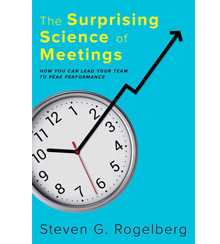
The authors of how-to books about meetings never consider the salutary effects of bad ones. Instead, they typically start with an adrenalin-like shot of statistics. Steven Rogelberg, Chancellor’s Professor at University of North Carolina, Charlotte, and author of The Surprising Science of Meetings, is no exception to the rule. He offers the usual litany of dismay. There are about 55 million meetings per day in the U.S. alone, and they cost US$1.4 trillion annually, not counting indirect costs such as employee frustration. “Too many meetings” is cited as the top time-waster by 47 percent of U.S. workers.
Nevertheless, Rogelberg doesn’t think that companies should eliminate meetings. “Was the great management guru Peter Drucker correct when he said, ‘Meetings are a symptom of bad organization. The fewer meetings, the better’?” Rogelberg asks. “The answer is an emphatic ‘no.’ Abolishing meetings is a false solution. Schedules with too few meetings are associated with substantial risks for employees, leaders, teams, and organizations.” Instead, the author advises breaking the cycle of bad meetings with the application of meeting science.
If anybody has a claim on the role of meeting scientist, it’s Rogelberg. He has been researching meetings using field surveys, laboratory studies, and experiments incorporating planted accomplices for 15 years. In this book, he weaves his findings and the research of others into an evidence-based approach to meetings that is sometimes eye-opening. Read the rest here.
Posted by
Theodore Kinni
at
10:54 AM
0
comments
Labels: bizbook review, books, corporate life, corporate success, management, personal success, strategy+business, work
Tuesday, April 23, 2019
Does your rewards strategy identify and address employee stressors?
Learned a lot lending an editorial hand here:
Inside HR, April 23, 2019
by Pete DeBellis
What is the basis for your company’s rewards offerings? For too many companies, it is purely benchmarks – that is, they make rewards decisions based on the rewards being offered by other companies with whom they believe they compete for talent. The problem: companies that follow this approach are left guessing about the desires and stressors of their actual workforce rather than knowing definitively what they want or need. In fact, based on Deloitte’s 2019 Global Human Capital Trends report, nearly one-quarter (23 percent) of organisations do not feel they know what rewards their employees value.
There’s nothing wrong with benchmarking per se: You should know what rewards your competitors are offering their employees. But that’s only one piece of the rewards puzzle. To optimise a rewards offering, you need to know a lot more about your rewards customers, that is, your company’s employees. Our research at Bersin finds that companies with mature, high-performing rewards functions achieve this by adopting some version of the following 4-step process, which uses the same kinds of surveys that marketers use to understand customers. Read the rest here.
Posted by
Theodore Kinni
at
4:14 PM
0
comments
Labels: corporate success, human resources, management, rewards, work
Thursday, April 18, 2019
In praise of the purposeless company
strategy+business, April 18, 2019
by Theodore Kinni
Photograph by Avalon_Studio
These days, my vote for the most misunderstood and misused management concept goes to “corporate purpose.” Back in 1973, the concept was crystal clear to Peter Drucker, who declared with admirable concision in Management: Tasks, Responsibilities, Practices: “There is only one valid definition of business purpose: to create a customer.” Since then, however, the definition of corporate purpose has mutated into pretty much any reason for being in business that isn’t explicitly connected to making money.
Business professors Sumantra Ghoshal and Christopher A. Bartlett unbottled this genie in a 1994 article in Harvard Business Review, in which they argued that strategy (“an amoral plan for exploiting commercial opportunity”) wasn’t enough: “A company today is more than just a business. As important repositories of resources and knowledge, companies shoulder a huge responsibility for generating wealth by continuously improving their productivity and competitiveness. Furthermore, their responsibility for defining, creating, and distributing value makes corporations one of society’s principal agents of social change. At the micro level, companies are important forums for social interaction and personal fulfillment.”
Why was a highfalutin corporate purpose seen as such a big deal? IGhoshal, who passed away in 2004, and Bartlett, who is now professor emeritus of business administration at Harvard Business School, concluded that companies had to transform themselves from economic entities to social institutions. They added that the “definition and articulation [of purpose] must be top management’s first responsibility.” Read the rest here.
Posted by
Theodore Kinni
at
4:10 PM
0
comments
Labels: business history, corporate life, corporate success, purpose, strategy, strategy+business
Thursday, April 11, 2019
We Lead People, Not Cardboard Cutouts
Learned a lot lending an editorial hand here:
Forbes, April 11, 2019
by Michael Gretczko![]()
GETTY
My wife and I just took our 5-year-old fraternal twins on a skiing vacation. Our daughter is caution incarnate. She likes to ski in a familial caravan — one parent ahead and one behind — and she wants constant feedback about her performance. Our son likes to get a rough idea of the conditions — icy here, snowboarders there — and push off. He doesn’t mind falling and doesn’t particularly care what we think of his performance. It’s astounding how different twins can be.
I’m constantly amazed how my children can uncover insights that allow me to see my role as a leader in a new light. I’m always seeking new ways to create engaged, high-performing teams, and typically, that devolves to some type of employee segmentation, by generation, job description or personality. We’re told that millennials often prefer to work this way, programmers want to work that way, and that Driver and Pioneer Business Chemistry styles want to work yet another way. But if my twins respond best to radically different conditions and parenting styles, can any type of segmentation be granular enough to respond to the individual needs of employees?
I suspect that it can’t. To engage with people on a truly human level — that is, to get beyond the employees-as-interchangeable-assets mindset — we need to be far more responsive to employees as individuals. Read the rest here.
Posted by
Theodore Kinni
at
4:20 PM
0
comments
Labels: corporate life, corporate success, human resources, management, personal success, work
Large businesses don’t have to be lousy innovators
strategy+business, April 11, 2019
by Theodore Kinni
Photograph by Kanchisa Thitisukthanapong
Gary Pisano, author of Creative Construction: The DNA of Sustained Innovation, doesn’t buy the idea that large enterprises are inherently lousy innovators. Back in 2006, Pisano, the Harry E. Figgie Professor of Business Administration at Harvard Business School, traced the origin of every drug approved by the FDA over a 20-year period to either one of the world’s 20 largest pharmaceutical companies or one of the 250 smaller, supposedly more innovative biotechs. When he compared the two groups, he discovered a “statistical dead heat” — R&D productivity was no better in the smaller biotechs than in big pharma.
Pisano also points to anecdotal evidence to support his opposition to the conventional wisdom about innovation in large enterprises. For every big, established company that failed at transformational innovation (think Blockbuster, Kodak, and Polaroid), he points to another that has succeeded. In 1964, when IBM announced its revolutionary 360 mainframe computers, it was already the largest computer company in the world and ranked 18th on the Fortune 500. In 1982, when Monsanto scientists invented the foundational technology for GMOs (genetically modified organisms), the company was 81 years old and number 50 on the Fortune 500. And in 2007, when Apple launched the iPhone, it had sales of US$24 billion and already stood at 123rd on the Fortune 500.
Pisano says that the difference between a Blockbuster and an IBM is the ability of leaders to sustain and rejuvenate the innovation capacity of their companies. It’s an ability he calls “creative construction,” and he writes that it “requires a delicate balance of exploiting existing resources and capabilities without becoming imprisoned by them.”
Walking that tightrope is a challenge for large companies. It’s tough to move the needle with innovation when the needle’s scale is measured in billions of dollars. “For J&J [Johnson & Johnson] to maintain its historical rate of top-line growth,” reports Pisano, “it must generate about $3 billion–$4 billion of new revenue per year.” The complexity of managing innovation in large organizations can also be daunting. “When you get to be the scale of a J&J, you have a lot of moving parts,” he explains. “You now have a system with serious frictions. Friction impedes mobility. Lack of mobility means lack of innovation.”
But large companies also have some advantages that can give them a leg up in innovation. “Larger enterprises like J&J have massive financial resources to explore new opportunities,” says Pisano. They can hedge their bets, tap deep reservoirs of talent, navigate regulatory agencies, and use their huge distribution networks and strong brands to roll out new products to millions of existing customers. Read the rest here.
Posted by
Theodore Kinni
at
8:53 AM
0
comments
Labels: bizbook review, books, corporate success, creativity, innovation, leadership, org culture, strategy+business
Wednesday, March 20, 2019
Leadership lessons from a guitar hero
strategy+business, March 19, 2019
by Theodore Kinni
About an hour into Still on the Run, a documentary exploring the career of rock guitar god Jeff Beck, Eric Clapton, another deity in the pantheon, pops up on screen and says, “I don’t even know how he’s doing it half the time.” Clapton is talking about Beck’s ability to give voice to the guitar. But his comment set me to wondering how Beck developed his unique style and what, if any, lessons his nearly 60-year career might offer those who aspire to reach the top of the business world.
With CEO tenure in large companies running five years or so, the fact that Beck has been numbered among the world’s best guitarists for about 10 times that long is worth exploring. Surely, innate talent and endless hours of practice count for a lot. But loads of guitarists have both, and haven’t had careers that lasted as long as the average CEO’s. Beck, however, has been an inveterate seeker of innovation in both technology and technique. And this habit has enabled the 74-year-old London-born musician to continuously expand his capabilities and transform his sound.![]()
Jeff Beck performs at the Bataclan in Paris in 1973.
Photograph by Philippe Gras / Alamy
As biographer Martin Power tells it in Hot Wired Guitar: The Life of Jeff Beck (Omnibus Press, 2014), Beck’s parents valued musicianship, but not the electric guitar, which in the 1950s was associated with rockabilly and other disreputable musical genres. When his parents refused even to spring for new strings for a borrowed guitar, the teenager began building his own crude instruments. Unable to tune his early efforts, Beck learned to bend the strings to pitch while playing, a work-around that became a signature. The wannabe lead guitarist stole the pickup needed for his first electric guitar and built its amp in his school’s science department. Since then, Beck continually explored and adopted technological advances in guitar effects and electronics — such as tape-delay units, fuzz boxes, and guitar synthesizers — to shape and extend his playing.
Beck’s eagerness to learn and incorporate techniques from far-flung places is another hallmark of his career. Like Clapton, he learned from American blues giants — and rode the wave of cultural appropriation that gave rise to rock and roll. According to Power’s biography, Beck says that the first time he heard Jimi Hendrix play, he thought, “Oh, Christ, all right, I’ll become a postman.” Then he followed Hendrix around to learn how he created his sound. Other inspirations include a women’s choir that recorded Bulgarian folk songs, operatic tenor Luciano Pavarotti, and electronic dance music. Beck describes his resulting style as “a form of insanity…. A bit of everything, really. Rockabilly licks, Jimi Hendrix, Ravi Shankar, all the people I’ve loved to listen to over the years. Cliff [Gallup], Les [Paul], Eastern and Arabic music, it’s all in there.” Read the rest here.
Posted by
Theodore Kinni
at
9:12 AM
0
comments
Labels: creativity, innovation, leadership, personal success, strategy+business, work
Saturday, March 2, 2019
Finding your company’s cultural sweet spot
strategy+business, March 1, 2019
by Theodore Kinni
“Culture eats strategy for breakfast” is a pretty tasty bon mot, though it’s doubtful that Peter Drucker, who usually gets credit for it, actually cooked it up. It can also cause severe indigestion when leaders ignore it. If you’re tempted to join them, read Rule Makers, Rule Breakers, by University of Maryland, College Park, psychology professor Michele Gelfand.
Gelfand has been studying culture and social norms for more than 20 years. Ever wonder why conjuring up a “burning platform” galvanizes workers instead of sending them scurrying for the exit doors? It’s the same reason that the heartbeats of firewalkers in the Spanish village of San Pedro Manrique, as well as the people watching them, become synchronized. It’s also why test subjects who eat fiery chili peppers together report a higher sense of bonding, and work better together in subsequent economic games. “Social norms, like participating in rituals, can increase group cohesion and cooperation,” says Gelfand.
Social norms are the glue that holds groups together. “They give us our identity, and help us coordinate in unprecedented ways,” Gelfand writes. “Yet cultures vary in the strength of their social glue, with profound consequences for our worldviews, our environments, and our brains.” And for companies, too. Read the rest here.
Posted by
Theodore Kinni
at
4:26 PM
0
comments
Labels: bizbook review, books, corporate life, corporate success, human resources, innovation, management, org culture, strategy+business, work
Friday, March 1, 2019
Two Capabilities for Building Organizational Agility
Learned a lot lending an editorial hand here:
Boss Magazine, March 2019
by David Mallon

A few years ago, agility was considered a competitive advantage — a trait that a company could develop and nurture to get a leg up in its industry and markets. But late last year, when Forbes Insights conducted a survey of 1,000 executives across industries and geographies, 81 percent of them identified organizational agility as the most important characteristic of a successful organization. Today, agility isn’t about raising the competitive stakes; it’s an organizational trait needed to get into the game.
At its core, agility is simply the ability to change direction quickly in response to external conditions. The problem, of course, is that for the past century, people have been building companies that were anything but agile.
How can you make your company more agile? Focus your efforts on developing the two capabilities that define the trait: sense and response. Read the rest here.
Posted by
Theodore Kinni
at
4:14 PM
0
comments
Labels: articles to ponder, change management, corporate life, corporate success, human resources, transformation, work
Wednesday, February 13, 2019
Middle Managers Deserve More Respect
strategy+ business, Feb. 13, 2019
by Theodore Kinni
Gary Hamel of London Business School thinks middle management should be eradicated; Bob Sutton of Stanford doesn’t like it but grudgingly acknowledges its inevitability — death, taxes, and the branch manager. The New York Times isn’t publishing a “Windowless Office” column about today’s most interesting managers, nor are business book readers clamoring for bios of the manager of a Tesla store or the director who runs a portion of iTunes. None of us looks to managers for leadership lessons. But maybe we should.
Most of the leaders I knew in my short career as a full-time employee weren’t CEOs. In more than a few of those jobs, I didn’t know the CEO’s name. It turns out that I’m not unusually oblivious: A 2017 survey found that 23 percent of Americans who work at companies with more than 500 employees are unsure of the name of the CEO. Thirty-two percent aren’t sure they could pick their CEO out of a lineup — a task that they will never be called upon to perform, hopefully. But we can all reel off the names of our managers.
That’s because managers are our leaders. They direct, coach, and appraise us. They play an outsized role in the quality of our work lives and work–life balance. They provide us the opportunities to grow and advance professionally. Aside from a few self-made founders like Mark Zuckerberg and scions like Donald Trump, I’d bet that almost all CEOs of large enterprises owe their positions to managers who recognized their potential early on and encouraged them to realize it. Read the rest here.
Posted by
Theodore Kinni
at
4:26 PM
0
comments
Labels: corporate life, corporate success, management, personal success, strategy+business
Sunday, February 3, 2019
How to design a collaborative rewards strategy which improves profit margins
Learned a lot lending an editorial hand here:
Inside HR, January 30, 2019
by Pete DeBellis
You’ve probably heard the ancient Indian fable about the blind wise men and the elephant. In it, each of the men touch an elephant in a different spot – trunk, tusk, ear, leg, tail, etc. Unsurprisingly, each comes away with an incomplete and inaccurate description of the beast. Trying to design and manage employee rewards from a functional silo presents a similar challenge.
When rewards professionals isolate themselves in a silo, they are, in essence, choosing to work with blinders on. They can’t see the full picture – missing critical details and nuances regarding how rewards can support talent acquisition and retention, and drive employee productivity and business results, among other things.
Consequently, the rewards that they design, which often add up to the largest expenses on a company’s P&L, don’t generate the return that they could and should, and their definition of “rewards” may be missing key elements of their employer’s value proposition, such as learning and development opportunities and much more.
Is this the case in your company? Bersin’s latest research into High-Impact Rewards suggests that approximately 80 percent of organisations are struggling to meet the expectations of their employees around rewards and are failing to drive high levels of maturity in their rewards function.
In many of these organisations, there is no or little collaboration between the rewards function and other HR functions, including talent acquisition, people analytics, learning and development, and diversity and inclusion. Moreover, when cross-functional communication does occur it tends to be unidirectional, with rewards functions sharing data, program, or policy information as needed and in a manner that does not generate or support true collaboration.
To help remedy this, the HR suite as a whole should look to embed regular communication across the suite, whether that means check-ins between functional leaders on a recurring cadence or, for more fluidity, deploying an online collaboration space.
The other 20 percent of organisations have more mature rewards functions. In these companies, rewards professionals collaborate consistently with their colleagues in other HR functions – especially talent acquisition – and throughout the broader organisation. Information sharing is a two-way street through which rewards teams not only share information, but also receive it from these other functions. Using such an approach with collaboration as a regular practice helps surface insights that can help rewards professionals design and deploy a compelling rewards offering, while also supporting the strategic mandates of other HR functions. Read the rest here.
Posted by
Theodore Kinni
at
9:32 PM
0
comments
Labels: corporate success, human resources, rewards, work
Friday, February 1, 2019
Will Manufacturers Rule the Global Economy Once More?
by Theodore Kinni
D’Aveni’s version of manufacturing could be labeled “when dinosaurs rule the Earth once more.” He thinks that hulking tyrannosaurs like battered General Electric are going to rise up and roar in the years ahead. If he’s right, the Dow Jones Industrial Average might actually become industrial again.
D’Aveni weaves this new vision on an intricate loom. Its weft is composed of additive manufacturing (AM), which includes all the evolving forms of 3D printing in combination with other production technologies, such as lasers and robotics; its warp is digitized, AI-powered management systems and platforms.
AM is a game-changing family of technologies, and D’Aveni illustrates them with a host of gee-whiz examples. Lockheed Martin can 3D-print the entire body and interior of its 12-ton, 50-foot-long F-35 fighter jets in about three months, compared with the two to three years it takes to make them using traditional technologies. (It’s now working to cut production time to three weeks.) Electronics parts supplier Lite-On is using 3D printers to make 15 million smartphone antennas annually, demonstrating the technology’s potential for cost-effective mass production. The medical device company Stryker, which is already 3D-printing joint implants, is developing machines that can be installed in hospitals to produce customized implants while surgeons and patients wait. Local Motors has demonstrated its ability to 3D-print a car — reducing the number of parts needed from 30,000 to 50. Read the rest here.
Posted by
Theodore Kinni
at
9:16 AM
0
comments
Labels: 3D printing, additive manufacturing, AI, analytics, innovation, manufacturing, robotics, strategy+business, technology
Wednesday, January 9, 2019
Ken Iverson’s Plain Talk
strategy+business, January 7, 2019
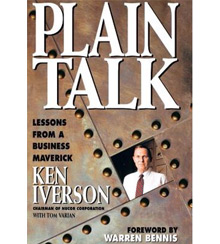
Twenty years ago, in 1998, my agent called and asked if I’d be interested in coauthoring a business book aimed at identifying 21 companies that would lead the way in the 21st century. If you know anything about the vagaries of prediction, you can imagine what a lesson in humiliation that gig turned out to be. (Oh, 3Com; oh, Nokia.) But on the plus side, the project introduced me to F. Kenneth Iverson, a highly successful corporate leader who isn’t nearly as well remembered today as he should be — and whose simple and clear directives from the late 20th century resonate clearly in the 21st century.
At the time, Iverson’s memoir/management exposition, Plain Talk: Lessons from a Business Maverick, was newly published. And he was chairman of Nucor Corporation, which, under his leadership, had come from nowhere to run circles around Big Steel and compete head-to-head with heavily subsidized foreign steelmakers.
Iverson, born in 1925, revolutionized the steel industry. But that wasn’t his initial intent. In 1965, he was a vice president at Nuclear Corporation of America, a profitless company in which he headed a unit making steel joists. As bankruptcy loomed, the board fired the company’s president and offered Iverson the position. “Apparently, managing the only profitable division in the company made me presidential material,” he recalled in Plain Talk. “Although I was just 39 years old, I wasn’t too flattered. No one else wanted the job. It was mine by default.”
Iverson didn’t waste time formulating a grand or complex strategy. He returned the company to profitability by doubling down on what worked: He focused on steel joists and sold off everything else that was losing money. Neither did he have the luxury of pursuing disruptive innovation. He was too busy trying to make money in a commodity business the old-fashioned way: by reducing costs and driving up productivity.
He also invested, somewhat counterintuitively, in vertical integration. In 1968, when the rising cost of bar steel (the main ingredient in steel joists) started squeezing profits, Iverson decided to make it instead of buy it. Unable to come up with the couple hundred million dollars needed to finance a traditional smelting mill, he latched onto the then-emerging minimill concept, in which electric arc furnaces melt scrap iron to make low-cost steel. By 1970, the minimill, which Iverson built with a US$6 million bank loan, was producing more steel than the steel joist business required and became a profit center in and of itself. In the years that followed, Nuclear Corporation of America was renamed Nucor, and it built more minimills and expanded into steel decking, bolts, and sheet steel. Read the rest here.
Posted by
Theodore Kinni
at
2:44 PM
0
comments
Labels: bizbook review, business history, corporate success, human resources, innovation, leadership, management, strategy+business
Saturday, January 5, 2019
Unlocking growth in the B2B telecom segment
Buyers of B2B telecom services are also frustrated with what they perceive as a lack of responsiveness within the industry — a condition that has resulted in a high level of customer churn. Their dissatisfaction is exacerbated by a demographic changing of the guard: more and more buyers have service expectations set by a lifetime of dealing with digitally native consumer companies such as Amazon and Netflix. They expect service requests and delivery to be fulfilled on demand, and they don’t want to do business with telcos that can’t meet their expectations.
The new competitors, attracted by this combination of industry sluggishness and customer unrest, fall into two broad categories. The first includes companies such as Cisco, Juniper and Brocade; they seek to establish direct relationships with enterprise customers. They expect to do this by building a broad base of customers in the B2B market and selling services that overlap with telcos’ offerings, such as software-based VPNs and firewalls. The second group of competitors, which includes companies such as Amazon and Masergy, is seeking to disrupt the industry in a more fundamental way, less bound to established offerings. These companies are leveraging their agility and digital savvy to create new kinds of customer-centric solutions, test them with early adopters and bring them to market at an unprecedented pace — a pace that telcos struggle to match.
Telecom operators know they have advantages, particularly in their networks and long-established relationships with enterprise customers. They know that to better serve existing customers, win over new ones, reverse declining revenues and stymie competitors, they will need a major shift in their capabilities and outward-facing identity. This requires transformation. But knowing the effort and investment involved in transformations, and the high rates of failure, how can telecom leaders improve the odds for success? Read the rest here.
Posted by
Theodore Kinni
at
3:30 PM
0
comments
Labels: digitization, innovation, productivity, technology, telecom, transformation, work
Tuesday, December 18, 2018
What are the 3 capabilities of highly effective HR leadership in the future?
Learned a lot lending an editorial hand here:
Inside HR, December 14, 2018
by Jeff Mike 
The forces behind this opportunity include a fundamental shift in the character of companies and a related shift in the nature of work itself. Changing demographics, particularly the attitudes of Millennials and Gen Xers, are pushing companies to embrace and act on purposes that are broader and more fulfilling than profit alone. Witness the rising incidence of employee activism in Silicon Valley and the emergence of the social enterprise.
Digital technologies are not only amplifying the demands of employees (and indeed, all corporate stakeholders), but they also hold out the tantalising promise of a more collaborative and productive workplace. As the tools of data-driven decision-making become more available to employees at all levels, work itself can be reimagined and the role of management fundamentally reshaped.
Instead of command-and-control hierarchies, companies can perform more like symphonies. We are already seeing this trend manifesting in the emergence of what we call the symphonic C-suite, in which siloes are torn down and top leaders play together as a team while also leading their own functional teams, all in harmony.
The above developments are people-centered, and that’s why HR is being pulled into the core of the business. To be able to successfully occupy that space, HR leadership will need three important capabilities that have been revealed and confirmed by Bersin’s high-impact HR research. Read the rest here
Posted by
Theodore Kinni
at
5:33 PM
0
comments
Labels: corporate success, human resources, leadership, management, work
Saturday, December 15, 2018
Are You Paying Lip Service to Work-Life Balance?
Impakter.com, December 13, 2018
by Theodore Kinni
The statistics on paid time off in the U.S. are bewildering. In 2017, American workers didn’t take 704 million paid vacation days, according to Project: Time Off. That’s $62.2 billion in unpaid benefits, and a lot of neglected families.
You might think these data points would have CEOs everywhere chortling with glee. But it seems like they are chained to their desks, too. Witness the standard CEO memoir, which pays lip service to any semblance of a life outside of work.
In the 365 or so pages of Who Says Elephants Can’t Dance?, his chronicle of his years at the helm of IBM in the 1990s, Lou Gerstner, Jr. devoted a mere couple of sentences to his family. Apparently, they were aware he had been asked to take on the massive IBM turnaround. But he says he agreed to take the job during a recruiting meeting and then, went home to announce his decision. “My wife, who had been quite wary of the idea originally, supported my decision and was excited about it,” Gerstner writes, almost as an afterthought at the end of Chapter 1. If the rest of the book is any indication, he disappeared into the corporate maw immediately thereafter and didn’t pop back up in the living room until a decade later.
The similarly-lengthy memoir of Harold Burson, the co-founder of the one of the world’s largest PR agencies, is another case in point. Burson wrote a 10-page postscript titled “The Role of Family” in The Business of Persuasion, the memoir he published last year. “As I reflect on the sixty-plus years since the formation of Burson-Marsteller,” he says, “I have come to realize that, for more than fifty of those years, I deprived my family of my companionship almost half the time.” I can’t help but think this is a conservative estimate, because Burson notes that he invariably traveled during 45 or more weeks each year, including over 100 trips to Europe for 10-14 days at a clip, as well as trips to Asia for a minimum of two weeks each. Sadder yet, Burson devotes less space in the memoir to his wife, whom he admits contributed much to his career and the success of his company, than he does to his love for West Highland white terriers.
Of course, CEOs such as Gerstner and Burson are of an older generation whose standard version of work-life balance looked like Leave It to Beaver (which is the version on which I cut my teeth). But I suspect that Gen X and Millennial CEOs may not be any better...Read the rest here
Posted by
Theodore Kinni
at
4:36 PM
0
comments
Labels: corporate life, leadership, management, personal success, work
Tuesday, December 11, 2018
Grow Faster by Changing Your Innovation Narrative
Learned a lot editing this one:
MIT Sloan Management Review, December 10, 2018
by George S. Day and Gregory P. Shea
An innovation narrative is an oft-overlooked facet of organizational culture that encapsulates employees’ beliefs about a company’s ability to innovate. It serves as a powerful motivator of action or inaction. We find innovation narratives in two basic flavors: growth-affirming and growth-denying, or some combination thereof.
Companies that lead — or aspire to lead — their industries in organic growth need to have a coherent, growth-affirming innovation narrative in place, and we will discuss why that’s important and what it can look like. But what actions support the development and maintenance of such a narrative? To answer that question, we tested 18 possible innovation levers and identified the four that are most relied upon by organic growth leaders to stay ahead of their competitors: (1) invest in innovation talent, (2) encourage prudent risk-taking, (3) adopt a customer-centric innovation process, and (4) align metrics and incentives with innovation activity. We will look at each one in turn.
These four levers will be familiar to innovation practitioners, but their effects intensify with managerial focus. They serve as so-called simple rules. That is, they avoid the confusion and dilution of effort that result from trying to pull too many levers at once or in an uncoordinated manner, and they channel and prioritize leaders’ efforts to embed a growth-affirming innovation narrative in their companies. Read the rest here.
Posted by
Theodore Kinni
at
8:46 AM
0
comments
Labels: articles to ponder, corporate success, creativity, innovation, management
Wednesday, December 5, 2018
Predictions for 2019: People analytics will augment the workforce and the workplace
Learned a lot lending an editorial hand here:
Deloitte Capital H Blog, December 4, 2018
by Kathi Enderes
Ninety percent of the data in the world has been created within the last two years alone, and the continued emergence of new technologies will likely increase that rate even more. HR leaders have been attempting for years to use people analytics to turn this vast amount of data into actionable insights, but many still struggle with how and where to apply people analytics to maximize the return on investment. In the coming year, more and more organizations will start to apply people analytics in a new way, with a direct focus on the individual, rather than through HR or leaders—a bottom-up approach, as opposed to just top-down.
Going forward, we predict people analytics will become a principal supporting factor in the growing autonomy (and productivity) of the individual, empowering each person with the insights to help them do their best work. Last year, Bersin’s High-Impact People Analytics research revealed that only 2 percent of surveyed organizations are highly mature in people analytics. That tiny percentage has granted us an advance look at how to put people analytics to work. The most mature functions not only integrate it throughout their enterprises but also focus it on addressing business problems, enhancing the quality of day-to-day decision-making, and expanding its accessibility and use through robust insight delivery systems. The purpose of people analytics in these few high-performing companies? Enhanced workforce productivity and performance. Read the rest here.

Posted by
Theodore Kinni
at
10:22 AM
0
comments
Labels: analytics, artificial intelligence, corporate success, data science, human resources, management, personal success, work
Friday, November 30, 2018
Are You Paying Lip Service to Work-Life Balance?
LinkedIn, Nov. 30, 2018
by Theodore Kinni
The statistics on paid time off in the U.S. are bewildering. In 2017, American workers didn’ttake 704 million paid vacation days, according to Project: Time Off. That’s $62.2 billion in unpaid benefits, and a lot of neglected families.You might think these data points would have CEOs everywhere chortling with glee. But it seems like they are chained to their desks, too. Witness the standard CEO memoir, which pays lip service to any semblance of a life outside of work.
In the 365 or so pages of Who Says Elephants Can’t Dance?, his chronicle of his years at the helm of IBM in the 1990s, Lou Gerstner, Jr. devoted a mere couple of sentences to his family. Apparently, they were aware he had been asked to take on the massive IBM turnaround. But he says he agreed to take the job during a recruiting meeting and then, went home to announce his decision. “My wife, who had been quite wary of the idea originally, supported my decision and was excited about it,” Gerstner writes, almost as an afterthought at the end of Chapter 1. If the rest of the book is any indication, he disappeared into the corporate maw immediately thereafter and didn’t pop back up in the living room until a decade later.
The similarly-lengthy memoir of Harold Burson, the co-founder of the one of the world’s largest PR agencies, is another case in point. Burson wrote a 10-page postscript titled “The Role of Family” in The Business of Persuasion, the memoir he published last year. “As I reflect on the sixty-plus years since the formation of Burson-Marsteller,” he says, “I have come to realize that, for more than fifty of those years, I deprived my family of my companionship almost half the time.” I can’t help but think this is a conservative estimate, because Burson notes that he invariably traveled during 45 or more weeks each year, including over 100 trips to Europe for 10-14 days at a clip, as well as trips to Asia for a minimum of two weeks each. Sadder yet, Burson devotes less space in the memoir to his wife, whom he admits contributed much to his career and the success of his company, than he does to his love for West Highland white terriers.
Of course, CEOs such as Gerstner and Burson are of an older generation whose standard version of work-life balance looked like Leave It to Beaver (which is the version on which I cut my teeth). But I suspect that Gen X and Millennial CEOs may not be any better. Read the rest here.

Posted by
Theodore Kinni
at
4:05 PM
0
comments
Labels: corporate life, human resources, leadership, management, personal success, work
The Ambient Future of HR
Learned a lot lending an editorial hand here:
Boss Magazine, December 2018
by David Mallon
HR’s current paradigm of alignment and integration is going to fall short in the coming years. Anything that distracts employees from their work and reduces their productivity will fall short. And that includes far too many HR processes, including performance management, learning and development, rewards, etc., that currently run separately from or even, in parallel with work.
Tomorrow, HR processes will need to be like the electricity that runs through your office and the online networks that connect your employees to each other and the rest of the world. No matter how complex the process and no matter where your people are, HR needs to be relocated to the point of work. In short, HR must become ambient.
The fundamental premise of ambient HR is that it’s intrinsic to work and employee performance. (If it isn’t, why are you bothering?) The ideal guiding principle of ambient HR is that anything being done to support performance, whether at the organizational, team, or individual levels, should be within a few keystrokes’ reach of the people that need it. Ambient HR goes to employees, not vice versa. It doesn’t distract or divert people; it doesn’t require them to step away from their work or learn systems and vocabularies that are not part and parcel of their jobs.
For the first time, the technology needed to embed HR in work at scale is available. The digital transformation of our companies — indeed, our world — is solving that problem. What’s needed now is an ambitious and prodigious design effort; an employee-centric, data-driven rethinking of HR processes and service delivery.
Where might the application of design thinking to the challenge of ambient HR yield the greatest returns? Here are some of the HR processes that are ready for a thorough rethinking. Read the rest here.
Posted by
Theodore Kinni
at
3:51 PM
0
comments
Labels: corporate success, human resources, management, personal success, productivity, work