Friday, November 30, 2018

Are You Paying Lip Service to Work-Life Balance?

LinkedIn, Nov. 30, 2018

by Theodore Kinni

The statistics on paid time off in the U.S. are bewildering. In 2017, American workers didn’ttake 704 million paid vacation days, according to Project: Time Off. That’s $62.2 billion in unpaid benefits, and a lot of neglected families.

You might think these data points would have CEOs everywhere chortling with glee. But it seems like they are chained to their desks, too. Witness the standard CEO memoir, which pays lip service to any semblance of a life outside of work.

In the 365 or so pages of Who Says Elephants Can’t Dance?, his chronicle of his years at the helm of IBM in the 1990s, Lou Gerstner, Jr. devoted a mere couple of sentences to his family. Apparently, they were aware he had been asked to take on the massive IBM turnaround. But he says he agreed to take the job during a recruiting meeting and then, went home to announce his decision. “My wife, who had been quite wary of the idea originally, supported my decision and was excited about it,” Gerstner writes, almost as an afterthought at the end of Chapter 1. If the rest of the book is any indication, he disappeared into the corporate maw immediately thereafter and didn’t pop back up in the living room until a decade later.

The similarly-lengthy memoir of Harold Burson, the co-founder of the one of the world’s largest PR agencies, is another case in point. Burson wrote a 10-page postscript titled “The Role of Family” in The Business of Persuasion, the memoir he published last year. “As I reflect on the sixty-plus years since the formation of Burson-Marsteller,” he says, “I have come to realize that, for more than fifty of those years, I deprived my family of my companionship almost half the time.” I can’t help but think this is a conservative estimate, because Burson notes that he invariably traveled during 45 or more weeks each year, including over 100 trips to Europe for 10-14 days at a clip, as well as trips to Asia for a minimum of two weeks each. Sadder yet, Burson devotes less space in the memoir to his wife, whom he admits contributed much to his career and the success of his company, than he does to his love for West Highland white terriers.

Of course, CEOs such as Gerstner and Burson are of an older generation whose standard version of work-life balance looked like Leave It to Beaver (which is the version on which I cut my teeth). But I suspect that Gen X and Millennial CEOs may not be any better. Read the rest here.

The Ambient Future of HR

Learned a lot lending an editorial hand here:

Boss Magazine, December 2018

by David Mallon


HR has come a long way from its functional roots in control and compliance. Nowadays, HR is a business partner — aligning and integrating its services with the business to help employees achieve corporate goals. That sounds great, but it isn’t enough. Not by a long shot.

HR’s current paradigm of alignment and integration is going to fall short in the coming years. Anything that distracts employees from their work and reduces their productivity will fall short. And that includes far too many HR processes, including performance management, learning and development, rewards, etc., that currently run separately from or even, in parallel with work.

Tomorrow, HR processes will need to be like the electricity that runs through your office and the online networks that connect your employees to each other and the rest of the world. No matter how complex the process and no matter where your people are, HR needs to be relocated to the point of work. In short, HR must become ambient.

The fundamental premise of ambient HR is that it’s intrinsic to work and employee performance. (If it isn’t, why are you bothering?) The ideal guiding principle of ambient HR is that anything being done to support performance, whether at the organizational, team, or individual levels, should be within a few keystrokes’ reach of the people that need it. Ambient HR goes to employees, not vice versa. It doesn’t distract or divert people; it doesn’t require them to step away from their work or learn systems and vocabularies that are not part and parcel of their jobs.

For the first time, the technology needed to embed HR in work at scale is available. The digital transformation of our companies — indeed, our world — is solving that problem. What’s needed now is an ambitious and prodigious design effort; an employee-centric, data-driven rethinking of HR processes and service delivery.

Where might the application of design thinking to the challenge of ambient HR yield the greatest returns? Here are some of the HR processes that are ready for a thorough rethinking. Read the rest here.

Wednesday, November 28, 2018

Leaders Should Focus on Human Dignity at Work

strategy+business, November 28, 2018   

by Theodore Kinni


With bankruptcy looming, management appealed to employees to accept pay cuts and “pull together and win.” The workers did. After the company limped along for five long years, the turnaround came. The company’s leaders marked the occasion by giving themselves hefty bonuses, but didn’t bother to restore worker pay. A complete breakdown in the relationship between management and employees ensued, and Donna Hicks got a call.

Hicks is a conflict resolution expert. During her long association with Harvard University’s Weatherhead Center for International Affairs, she has worked with governments, corporations, and other organizations to reconcile seemingly unreconcilable differences between groups of people. In the mid-2000s, the BBC enlisted her to co-facilitate, with Desmond Tutu, first-time encounters between victims and perpetrators in the Troubles in Northern Ireland. Hicks found a thread connecting all of these experiences: Conflict is exacerbated by violations of dignity.

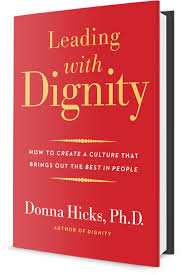
“The common denominator is the human reaction to the way people are being treated,” she writes in Leading with Dignity, her second, sometimes redundant, book on the topic, which tightens its focus to business. When people’s dignity is violated in the workplace, she writes, “they feel some of the same instinctive reactions that parties in international conflicts experience — a desire for revenge against those who have violated them. People want their grievances listened to, heard, and acknowledged. When this doesn’t happen, the original conflicts escalate, which only deepens the divide.”

Moreover, leaders play a major role in dignity violations and the outcomes that they produce. “The extent to which leaders pay attention to, recognize, and understand the dignity concerns underlying people’s grievances makes an enormous difference as to whether these conflicts can be resolved,” Hicks writes.

If you’ve been watching the leadership spectacle currently playing on the world stage, you might not be surprised to learn that most leaders, and the rest of us, too, have a woefully underdeveloped understanding of dignity. “Most people do not have a working knowledge of dignity,” Hicks writes. “I have found that most people are unaware of their own inherent value and worth, and are usually at a loss for how to recognize it in others.” Read the rest here.

Tuesday, November 27, 2018

Predictions for 2019: The productivity imperative

Learned a lot lending an editorial hand here:

Deloitte Capital H Blog, November 27, 2018

by David Mallon

If there is one line that sums up the outlook for HR in 2019, it might be that backhanded blessing, “May you live in interesting times.” These are interesting times, indeed. The increasingly influential role of social capital in organizational success is compelling companies to reimagine their purpose and redefine what it means to be a good citizen, internally and externally. In this new social enterprise, more collaborative and productive relationships with employees, customers, and communities go hand in hand with the quest for revenue and profit.

The need to support the emerging social enterprise and address the lack of enthusiasm with HR’s core services should give us all pause. When the demands on HR are greater than ever and the complexity and range of solutions are multiplying exponentially, HR professionals need to home in on the signal. We all need to tune into the core mission of HR and then make sure that every effort and investment serves it.

Addressing HR’s true value
The rise of the social enterprise is a global trend that positions HR at the center and gives greater weight and urgency to Net Promoter Scores (NPS) for core HR services. My colleagues have calculated these scores in the course of our High-Impact research and discovered that the NPS for performance management is negative-60 and the NPS for rewards is negative-15. If these were customer scores, many company leaders would declare a state of emergency. The scores for L&D and talent acquisition are positive (19 and 15, respectively), but neither would be cause for celebration in the C-suite if they were in customer realm.

What’s your Net Productivity Score?
We at BersinTM, Deloitte Consulting LLP are convinced that HR’s core mission is productivity. When you strip away the noise, HR’s job is to enable and enhance the productivity of people. This goal serves all of HR’s stakeholders—the enterprise, the individual employee, and the community at large. Thus, the most important metric on the HR dashboard isn’t the net promoter score (even though it is a useful indicator), it’s the net productivity score. The question that determines the real value of HR is simply this:

“Has what we’ve done today, this week, this month, and this year—the programs, the processes, the initiatives—resulted in a net addition or subtraction from individual and team productivity?”

In the days to come, look out for seven new articles from Bersin in which our analysts will share their viewpoints on the most relevant and interesting developments to watch in 2019, including their outlook on HR’s role around the productivity imperative. Read the rest here

Sunday, November 25, 2018

How to embed data-driven decision-making into your organisational culture

Learned a lot lending an editorial hand here:

InsideHR, November 20, 2018

by Jeff Mike


Thanks to the increasing sophistication of analytics, data and algorithms can inform and improve management, business, and HR decision-making throughout companies. But, the tools of data collection and decision-support algorithms are only one element in the quest to attain the full potential of analytics.

Another is the ability of employees at all levels to use these tools, a challenge that will require a broad-based upskilling of the workforce. And, there’s an additional element – the willingness to employ analytics to make decisions. Compounding all of this is the fact that organisations today are becoming social enterprises, where the ability to manage social, environmental and governance concerns are as important as financial returns. In this environment, workers have more influence than ever. Their voices are amplified through social media and other means, meaning errors made by an organisation can have far-reaching consequences.

So, what does all of this mean? To create a willingness to use more data and unbiased decision-support algorithms, a mindset of data-driven decision-making should be embedded in the organisational culture in a way that benefits employees in their work as well as other stakeholders. The need for a data-driven culture is important and shouldn’t be underestimated.

In fact, this need is one of the top findings in Bersin’s High-Impact People Analytics research, which revealed that a company can fully utilise people analytics only if – and when – using data to make decisions becomes part of the culture, or “how we do things around here.” In fact, the research determined that organisations that have achieved the highest levels of people analytics maturity are three times more likely to have such a culture than organisations at lower maturity levels.

However, just making the decision to implement a mindset of data-driven decision-making into an organisation’s culture won’t work. In an analytics-friendly culture, data-driven decision-making isn’t an afterthought, an add-on, or a justification; rather, it is a shared mindset in which:

  • Everyone recognises that data and analytics are essential to sound decision-making;
  • They use data and analytics in their decision processes for all aspects of the enterprise including financial, social and environmental well-being;
  • They use data and analytics to monitor – and adjust – decision outcomes to ensure desired results and to prevent bias.
Read the rest here...

Thursday, November 8, 2018

The Truth About Behavioral Change

Learned a lot editing this one:

MIT Sloan Management Review, Nov. 7, 2018 

by Damon Centola

When Twitter launched in March 2006, the earth did not move. Its founders and a few early funders were excited about the technology, but the microblogging site was not the immediate blockbuster you might imagine it was, given that it now has more than 300 million users and has become a wildly influential marketing tool for businesses, nonprofits, and even politicians. Rather, Twitter crept along in its early months, growing slowly.

So, what happened to transform it from another also-ran into one of the largest communication platforms in the world?

Twitter seems on the surface to be the kind of technology that journalist Malcolm Gladwell and Wharton School marketing professor Jonah Berger refer to as “contagious.” To jump-start Twitter’s growth, its founders decided to promote it at a South by Southwest (SXSW) Interactive conference in 2007, where it was a big hit. From there, people assume it rapidly spread across the United States through the internet, thanks to social contacts connected by what network researchers call “weak ties” and “long bridges.” Two years later, in 2009, Twitter adoptions were catapulted into a global orbit when a major opinion leader, Oprah Winfrey, sent her first tweet on her talk show.

That narrative is easy to grasp and compelling. It gives startups, and the people who invest in them, a road map for success. Unfortunately, it is also inaccurate, and the road map leads to a dead end.

In a very interesting study, Twitter’s actual growth pattern was revealed to be surprisingly geographic. Friends and neighbors adopted the technology from one another in much the same way people join a PTA fund-raiser or get excited about a candidate for town office. Twitter didn’t spread virally across the internet; it spread locally, like a grassroots social movement.

Although that explanation of Twitter’s success is less sensational than the usual “going viral” story, it is far more useful for understanding how social networks promote behavioral change. And it corresponds with a growing body of research that describes behavioral change as a complex contagion, which needs reinforcing ties and wide bridges to spread. We’ll explore those concepts here. They are key elements in a diffusion playbook for companies attempting to launch innovations and facilitate both customer and employee adoption. Read the rest here.

Monday, November 5, 2018

Best Business Books 2018: Management

strategy+business, November 5, 2018

by Theodore Kinni


Illustration by Martin León Barreto

Edgar H. Schein and Peter A. Schein, Humble Leadership: The Power of Relationships, Openness, and Trust (Berrett-Koehler, 2018)


Heidi Grant, Reinforcements: How to Get People to Help You (Harvard Business Review Press, 2018)

Yesterday, managers were the wizards of business. They learned profitability and productivity incantations at various branches of the Hogwarts School of Business. They were privy to arcane corporate knowledge that was withheld from the mere mortals in the rank and file. They pointed their wands, and the workforce did their bidding.

Tomorrow, it’s likely that employees will manage themselves. The incantations and knowledge that were once the manager’s stock-in-trade will be at their fingertips, perhaps on their smartphones. With the help of computers imbued with artificial intelligence, they will decide their own direction.

But what should managers be doing today? The authors of this year’s best business books on management offer conflicting answers. MIT professor emeritus Edgar Schein and his son Peter, now colleagues at the Organizational Culture and Leadership Institute, see a new, relationship-based managerial culture emerging. University of California at Berkeley management professor Morten Hansen identifies practices that defined high performance in the recent past and urges contemporaries to copy them. And social psychologist Heidi Grant of the NeuroLeadership Institute offers managers a way to develop a skill that they will surely need at some point — no matter what their future holds. Read the rest here.

Monday, October 29, 2018

Leading a Bionic Transformation

Learned a lot lending an editorial hand here:

strategy+business, October 29, 2018

by Miles Everson, John Sviokla, and Kelly Barnes


Illustration by Mark Matcho

What is it about companies such as Alphabet, Amazon, Apple, and Alibaba? No matter where they turn their attention — cars, banking, groceries, healthcare, media, retail, trucking — industries quail before them. Company leaders start wondering if their moats are deep enough. Investors flee before the drawbridges rise. These companies are among the largest and richest in the world, and they use this leverage to become larger and richer still — in 2018, Apple and Amazon became the world’s first trillion-dollar companies. These powerhouses attract huge numbers of extremely talented people to work for them, and they generate one innovation after another. But none of that explains the source of their industry-disrupting power.

There are probably 100 companies around the world — including at least 40 “unicorns,” startups with a market capitalization of US$1 billion or more — with similar qualities. They are known for rapid, exponential success. Most are in the U.S. and China right now, but they will probably become more common elsewhere soon. We think of them as bionic enterprises: a name that evokes the fusion of technological and biological systems for extraordinary performance and growth. These companies compete in unprecedented ways by combining digital prowess, human ingenuity, and strategic purpose, as if they were the corporate equivalent of superhuman cyborgs such as Marvel Comics’ Iron Man.

Over the past year, as we’ve been researching and writing about the nature of bionic companies (see “The Bionic Company,” by Miles Everson and John Sviokla, s+b, Feb. 22, 2018), it’s become apparent that no company has a monopoly on this way of doing business. A few companies are out in front, but many others will follow. Some will be part of consortia; some will take advantage of highly capable platforms. You can lead your own company toward a bionic transformation if you think about changing your business in the following ways.

• From a business model based on managing the supply of your product or service to one based on providing whatever customers demand, using any means possible

• From an operational approach based on stocks of information that you hold and capture, to one based on flows of knowledge that you collaborate on and share

• From a competitive position based on a stable landscape of rivals to one based on platforms where a single winner dominates the system

Underlying these three shifts of mind is a quiet revolution in the sources of wealth that businesses deploy and create — the first such major shift since the Industrial Revolution. These new intangible (but very powerful) assets are behavior capital, the awareness and insight developed by tracking ongoing activity; cognitive capital, knowledge codified into digitally managed routines; and network capital, the human and technological connection points available to an enterprise (see “Wealth in the 21st Century”). When you deploy these three forms of capital effectively, you transform your enterprise...read the rest here

Friday, October 26, 2018

Why It Doesn’t Always Pay to Be Decisive about Making Decisions

strategy+business, October 26, 2018

by Theodore Kinni

Banal bromides are my pet peeve. They all sound like the wisdom of the ages, until you think about them for a few seconds and discover they don’t make any sense at all. Consider this one, which popped up in my LinkedIn feed the other day: “The best time to make a decision is before you have to.”

This is nonsensical, if not downright dangerous. Why would you make a decision before you have to?

For starters, if you wait, you may find that you don’t need to make the decision at all. I once worked closely with a leader whom I admired and respected, except for what I thought was a bad habit of dithering with decision requests. He wouldn’t offer rulings on even simple matters. It took me a while to realize that the decisions he sidestepped resolved themselves — either something changed that eliminated the need for the decision or it was made in a collegial way by the people directly involved. It was less a bad habit than a refusal to micromanage.


Photograph by Westend61

Let’s assume that eventually you will have to make an important decision, though. If you make it before you have to, you’re betting that nothing is going to change before the time comes to act on it. Given the speed of change these days, what are the odds of collecting on that bet?

If, as is likely, conditions do evolve, you’ll need to reconsider your decision. That means at least some wasted work. But worse, it opens you up to a cognitive heuristic that psychologists Daniel Kahneman and Amos Tversky named “anchoring-and-adjustment.” They found that when people have an anchor in mind — a numerical estimate, for instance — and then receive new information that requires rethinking it, the adjusted estimate tends to hew too closely to the anchor. In other words, if you make a decision before you have to, and then the conditions on which it was based change, you probably will not make the proper adjustments. The result: a suboptimal decision.

What should you do instead? Read the rest here

Thursday, October 25, 2018

Changing the Way Your Company Thinks About Change

Learned a lot lending an editorial hand here:

Boss Magazine, November 2018

by David Mallon


In 2003, when General Stanley McChrystal assumed leadership of the covert Joint Special Operations Command (JSOC) in Iraq, his first order of business wasn’t tracking down dictator Saddam Hussein or jihadist Abu Musab al-Zarqawi, it was creating an organization capable of responding effectively to constant change.

A self-admitted “control freak” as a young officer, McChrystal quickly discovered that the complex conditions and enemy capabilities in Iraq were unique. “We realized pretty quickly that raids were not our product. People kept thinking it was the operators going through the [enemy’s] door, but, no, it was knowing where the enemy was and constantly adapting,” he explained in Deloitte Review.

The missions of most companies are not as dramatic—or dangerous—as JSOC’s mission. Nonetheless, many companies are facing disruptions and competitive challenges that require an unprecedented degree of agility and adaptability.

Every business leader knows that the ability to manage change is an organizational imperative. They also know that there can be significant people barriers to achieving change: employees don’t like change, so they resist it; and when they are forced to deal with too much change, they become fatigued.

But what if those barriers aren’t always as imposing as they seem? After all, change resistance and fatigue are psychological states, not immutable conditions. There is no reason why change can’t trigger enthusiasm and energy, instead of resistance and fatigue. In fact, such a transformation can be achieved with three shifts in your company’s change mindset...read the rest here.

Monday, October 22, 2018

The Four Building Blocks of Transformation

Learned a lot lending an editorial hand here:

strategy+business, October 22, 2018

by Al Kent, David Lancefield, and Kevin Reilly


Illustration by Miguel Montaner

If you are a business leader, you are probably thinking about radical change. New industrial platforms, geopolitical shifts, global competition, and changing consumer demand are reshaping your world. You face upstart competitors with high valuations encroaching on your business, and activist investors looking for targets. Meanwhile, you have your own aspirations for your company: to be a profitable innovator, to seize opportunities, to lead and dominate your industry, to attract highly committed talent, and to carve out a socially responsible role in which your organization makes a difference. You also probably want to clear away the deadwood in your legacy system: practices, structures, technologies, and cultural habits that hold your company back.

The conventional response is a transformation initiative — a top-down restructuring, accompanied by across-the-board cost cutting, a technological reboot, and some reengineering. Maybe you’ve been through a few such initiatives. If so, you know firsthand how difficult it is for them to succeed. These efforts tend to come in late and over budget, leaving the organization fatigued, demoralized, and not much changed. They don’t take into account the fundamentally new kinds of leverage available to businesses that have emerged in the last 10 years: new networks, new data gathering and analysis resources, and new ways of codifying knowledge.

Successful transformations may be relatively rare, but they do exist — and yours can succeed as well. A transformation, in this context, is a major shift in an organization’s capabilities and identity so that it can deliver valuable results, relevant to its purpose, that it couldn’t master before. It doesn’t necessarily involve a single major initiative (though it could); but the company develops an ongoing mastery of change, in which adaptability feels natural to leaders and employees.

An effort of this sort can take place on a large or small scale; it can involve the front, middle, or back office; it can be conducted by any type of enterprise, from a startup to a global enterprise; and it will affect every aspect of the organization’s structure, including such functions as innovation, finance, marketing, sales, human resources, and operations. At any scale, it requires a cultural shift and highly engaged leaders, who take control of the organization’s future in these four ways... read the rest here.

Saturday, October 13, 2018

Best fit vs best practice: 3 keys to developing a compelling rewards offering

Learned a lot lending an editorial hand here:

InsideHR, October 8, 2018

by Pete DeBellis


It’s a good time to think about your company’s rewards offering – not just because it’s essential to stand out in tight talent markets. But also, because you may be missing out on a valuable opportunity to attract candidates who are more in sync with your company, more likely to perform well, and more likely to stick around.

You can tell if you are missing this opportunity by answering a simple question: What information does your company use to design its rewards offerings?

If the answer is simply “best practices,” you’re not alone. It’s common practice to set rewards based on competitive benchmarks: just figure out what your competitors are offering and match or beat it. The problem is that a best-practices approach to rewards can be a prescription for mediocrity and anonymity in recruitment and retention.

Bersin’s High-Impact Total Rewards research reveals that high-performing organisations aren’t following the best-practices pack. Rather they are unapologetically different when it comes to rewards, and what makes them different is their approach to rewards design. They give a nod to best practices and benchmark data to make sure they understand what’s being offered by other companies. But they follow a best-fit approach to rewards that is tailored to their organisation.

The primary focus of the best-fit approach is finding candidates and keeping employees who are already aligned with your company. These are the people who like to do things the same way things get done in your company. And they are predisposed to go where your company is going.

Bringing a best-fit rewards offering to market

A properly designed rewards offering should represent a differentiated brand in and of itself. It entices the candidates you want to come to you. There are three principal steps to designing and bringing such an offering to market...read the rest here

Sunday, September 30, 2018

“A Blinding Flash of the Obvious”

Insights by Stanford Business, September 28, 2018

by Theodore Kinni


Tom Peters earned his MBA and PhD at Stanford Graduate School of Business in the 1970s, under the unconventional tutelage of organizational psychologists Eugene Webb and James March. But he pegs the beginning of his management studies to 1966 and his two tours of duty as a young naval officer and combat engineer with the Seabees in Vietnam during the war.

“That left an indelible impression,” Peters says of his first leadership role. “Cut the BS. Can the excuses. Forget the fancy reports. Get moving now. Get the job done. On this score nothing has changed in 50 years, including the maddening fact that all too often a business strategy is inspiring, but the execution mania is largely AWOL.”

A lot of other things have changed in the past half-century, but a lot of what Peters learned about management — in the Navy, at Stanford, while researching and writing In Search of Excellence with Bob Waterman at McKinsey in the early ’80s, and in the decades after — remains as relevant today as it was then. All of it and more is collected in Peters’ new book, The Excellence Dividend.

The fat, red exclamation mark that Peters chose as his logo a quarter-century ago is an apt symbol for The Excellence Dividend, which Financial Times management editor Andrew Hill called “shouty.” It’s a sobriquet that Peters embraces. “I give speeches that are noisy and I write like I speak,” he laughs.

Management Isn’t Complicated

Noisy helps when you’re saying things that most leaders already know, but that far too few act upon in a consistent way. In The Excellence Dividend, Peters pinpoints the most common infractions...read the rest here

Friday, September 28, 2018

Three Principles for Managing Technology's Productivity Paradox

Learned a lot lending an editorial hand here:

Boss Magazine, October 2018

by David Mallon

Automation and artificial intelligence (AI). Big data and advanced analytics. Collaboration platforms and instant messaging. The workplace is becoming a technological wonderland, in which a company can place virtually every resource that its employees need to work more effectively and efficiently at their fingertips. Nevertheless, growth in workforce productivity is hovering around its lowest rate in almost two decades.

We saw this paradoxical situation echoed across the findings of Deloitte’s 2108 Human Capital Trends survey. For example, 71 percent of the respondents to our survey said they are already using personal productivity technologies like collaboration platforms, work-based social media, and instant messaging, and 60 to 70 percent of them said that they believe workers will soon be using these technologies more frequently. Yet, nearly half (47 percent) of the respondents are also worried that these tools will notenhance workforce productivity.

Are their worries justified? Is it possible that, for all their promise and potential, new and emerging workforce technologies could actually drive down productivity?

It can happen. After all, technology is not a productivity panacea in and of itself. Surely, by now, we all know that the next text that pops up on our smartphones could interrupt us and distract us from our work just as readily as it could focus and facilitate our efforts.

The fundamental difference between the two outcomes lies in how you put productivity technologies to work in your company. Here are three principles that can go a long way to ensuring that technology enhances the productivity and well-being of your company’s employees and avoids becoming one of the greatest sources of cognitive overload in their work and lives. Read the rest here.

Wednesday, September 19, 2018

Physician, Disrupt Thyself

strategy+business, September 19, 2018

by Theodore Kinni


If I were a senior executive in healthcare, it would scare the hell out of me to learn that Amazon founder Jeff Bezos, Warren Buffett of Berkshire Hathaway fame, and JPMorgan Chase CEO Jamie Dimon formed an independent company “free from profit-making incentives and constraints” to provide “simplified, high-quality and transparent healthcare at a reasonable cost” to a million or so of their U.S. employees. The fact that the CEOs chose surgeon and author Atul Gawande — an outspoken critic of the healthcare industry’s practices — to lead it wouldn’t settle my nerves. The news might even be jarring enough to induce me to read Vijay Govindarajan and Ravi Ramamurti’s Reverse Innovation in Health Care. Although that might prove cold comfort indeed.

“The real reason the health-care debate hasn’t gotten anywhere is that would-be reformers are debating about the wrong things,” declare Govindarajan, Coxe Distinguished Professor of Management at Dartmouth College’s Tuck School of Business, and Ramamurti, University Distinguished Professor of International Business and Strategy at Northeastern University. “It’s not about who pays for what. Skyrocketing health insurance premiums are just a symptom of the underlying problem. The problem with American health care is that it costs too much, the quality is uneven, and too many people can’t get the care they need.”

The professors thus blame providers for the fact that the U.S. healthcare system is by far the most expensive in the world while its supposed beneficiaries rank 37th globally in average life expectancy. Healthcare delivery is the problem, they argue.

As we quibble about everything healthcare-related in the U.S., I could quibble with Govindarajan and Ramamurti about whether providers or payors or patients or the fee-for-service, free-market healthcare system itself is to blame for this mess. Clearly, the costs of the U.S. healthcare system have been rising far above the rate of inflation. And given the fact that my very healthy family’s health insurance is its biggest annual outlay, I, for one, would welcome relief from any quarter. 

Reverse Innovation in Health Care argues that the quarter that the relief is going to come from is…India, which ranks 104th in life expectancy. On the surface, this seems so outlandish that the authors had to include an appendix of questions and answers titled “India? Really?” After they spend an entire book making their case, they had to make it again! ...read the rest here

Friday, September 14, 2018

Making Change Contagious

strategy+business, September 13, 2018

by Theodore Kinni

Much of the conventional wisdom about the diffusion of new ideas, behaviors, and innovations comes from network science, where it tracks back to two sources: Mark Granovetter’s influential theory of weak ties and Albert-László Barabási’s work on network hubs. But in the past decade or so, researchers have revealed some nuances to their ideas that leaders undertaking change initiatives, especially full-scale transformations, should consider.

In 1973, the American Journal of Sociology published a much-cited article titled “The Strength of Weak Ties,” by Granovetter, then an assistant professor at Johns Hopkins University. Based on research Granovetter had done while earning his Ph.D. at Harvard, the article introduced the idea that people with whom you share few connections (your weak ties) are more conducive to the diffusion of your ideas than people with whom you share many connections (your strong ties). That’s because weak ties speed diffusion by extending your reach to more people you don’t know, while strong ties produce a kind of echo chamber in which whatever you are trying to spread reverberates among people you already know — slowing diffusion.


Illustration by mathisworks

But what if the theory of weak ties, which is now widely accepted, isn’t as universally applicable as it seems? Damon Centola, an associate professor in the Annenberg School for Communication and the School of Engineering and Applied Sciences at the University of Pennsylvania, thinks this is the case. In a new book, How Behavior Spreads, Centola describes his work — and the work of other social network researchers — over the past several years. He explains that strong ties can be better conduits for diffusion than weak ties in some situations. It all depends on what kind of diffusion (or contagion) you are trying to encourage...read the rest here

Tuesday, September 11, 2018

Why design thinking is now an essential capability for HR (and how to adopt it)

Learned a lot lending an editorial hand here:

InsideHR, September 10, 2018

by Jeff Mike


HR is undergoing a fundamental shift. The rigid, policy-driven programs and processes of yesterday, which were primarily focused on compliance, efficiency, and conventional approaches to talent management, are giving way. Leading HR practitioners are replacing top-down programs and processes with more agile, worker-centric offerings – offerings that are personalised for employees and that are informed by a robust understanding of work and workforce segments – and design thinking can play an important role in this process.

Bersin research backs this up, and high-performing HR organisations are 3.5 times more likely to focus relentlessly on user experience when designing HR offerings than lower-performing organisations. This is a significant finding: High-performing HR organisations are also associated with a host of positive business outcomes, such as meeting or exceeding financial targets, improved processes, greater responsiveness to change, and enhanced innovation. It is also why design thinking is becoming an essential HR capability.

A design thinking mindset can drive results

Design thinking is more than a set of rote practices. It requires a mindset composed of three elements:
  • User-centered design, which places the employee at the heart of the design;
  • Human-centered design, which ensures that the design speaks to the emotions of users;
  • Soft systems methodology, which ensures that multiple, divergent perspectives are incorporated into the design process.
When HR practitioners operationalise this mindset, they can achieve impressive results. Witness one of largest companies powering prosperity, use of design thinking to re-engineer its candidate assessment and selection process. The online financial solutions company’s redesign produced a 14-point increase in quality of hire (with almost two-thirds of new hires now receiving the highest quality rating), reduced average time to fill 12 days (or almost 20 per cent), and boosted new-hire net promoter scores by 14 per cent year over year.

A global leader in consumer transaction technologies used design thinking to address high rates of employee attrition, especially among new hires and key worker categories, such as customer engineers. It developed and used its new employee experience model to rebuild its onboarding process. The result: the volume of new hires who left dropped by 22 per cent, resulting in a savings of $7 million. In addition, turnover within the critical customer engineer segment fell from 34 per cent to 10.9 per cent...read the rest here.

Friday, August 31, 2018

Organizational Culture: Myths and Management

Learned a lot lending an editorial hand here:

Boss Magazine, Sept. 2018

by David Mallon


Organizational culture. It can be a free-flowing front of competitive advantage or an insurmountable obstacle to change. What it can’t be, is ignored.

It can’t be ignored because culture persists. Strip away everything else from a company—its strategy, operating model, and customer offerings—and its culture remains. That’s a major reason why 82 percent of the respondents to Deloitte’s 2016 Global Human Capital Trends survey cited culture as a potential competitive advantage.

The persistence of culture is a good news/bad news story. The good news is that an organization’s culture—that is, the norms, values, and behaviors that govern how things get done within a company—can make it strong and resilient. The bad news is that an organization’s culture can threaten its very existence if it is too hidebound to accept change. The paradox is that both the good news and the bad news can exist in the same culture.

These days, employees and customers are demanding greater cultural clarity and authenticity than ever before. They especially want “the way we do things around here” to include a robust concern for corporate citizenship, which we at Bersin define as a company’s ability to do social good and account for its actions. In our 2018 Global Human Capital Trends survey, 77 percent of the respondents cited citizenship as important and 36 percent rated it as very important. Read the rest here

Thursday, August 23, 2018

When Prediction Gets Cheap

strategy+business, August 8, 2018

by Theodore Kinni


I don’t usually write mash notes, but I recently sent one to Waze via Twitter. I figured the navigation app had helped me avoid more than 100 hours of traffic jams over a couple of years, and I felt compelled to declare my undying gratitude.

After reading Prediction Machines, by three Rotman School of Management professors, it turns out I’m not so much enamored with Waze as I am with the technology that powers it: artificial intelligence (AI). It is AI that enables the app to predict the best routes for its users.

According to Ajay Agrawal, Joshua Gans, and Avi Goldfarb, who are also, respectively, founder, chief economist, and chief data scientist of the Creative Destruction Lab, prediction is the essential output of AI. “The current generation of AI provides the tools for prediction and little else,” they write. “Today, AI tools predict the intention of speech (Amazon’s Echo), predict command context (Apple’s Siri), predict what you want to buy (Amazon’s recommendations), predict which links will connect you to the information you want to find (Google search), predict when to apply the brakes to avoid danger (Tesla’s Autopilot), and predict the news you will want to read (Facebook’s newsfeed).”

This is the key insight of Prediction Machines, and it is an extraordinarily useful one for any executive who has been grappling with the implications and ramifications of AI. AI will automate prediction, and as a result, prediction will become cheap. “Therefore, as economics tells us,” explain the authors, “not only are we going to start using a lot more of it, but we are going to see it emerge in surprising new places.” Read the rest here.

Thursday, August 2, 2018

Why Wandering Works Wonders for Managers

strategy+business, August 2, 2018

by Theodore Kinni

If you occupy the heights of the business world, staying grounded can be a challenge. The longer you reside atop a corporate Mount Olympus, the less connected you may become to the mundane world of work occupied by the rest of us and, perhaps more dangerously, the customers who pay the bills.

I’ve been investigating some whimsical solutions for leaders who need to get their feet back on the ground. One of them is the practice of shinrin-yoku, or forest bathing. Forest bathing, essentially hanging out in nature, sounds like nothing more than a walk in the woods to me. But Dr. Qing Li, a professor at the Nippon Medical School in Tokyo, whose book on the topic was published in April, says it “takes us all the way home to our true selves.” Sounds like a boon for leaders who want to be more authentic — or who just enjoy a good hike.


Photograph by XiXinXing / Alamy

If you don’t have a forest nearby, you can try "earthing." As Clinton Ober, a former cable TV salesman turned earthing evangelist, describes it in a book he coauthored, Earthing: The Most Important Health Discovery Ever?, the ground below your feet is chock-full of negatively charged electrons that can neutralize the positively charged free radicals building up in your body from stress and other bad stuff. You can absorb these healing electrons by walking around barefoot (on a beach, preferably). If you don’t have time for the beach, you can buy an earthing mat, plug it in, and stick it under your desk. Maybe it’ll work — who knows?

I’m always looking for an excuse to go for a walk, whether it’s in a forest or on a beach. I’m also a skeptic. And you may be, too. But let’s not throw the baby out with the bathwater. It is important that leaders stay grounded — if not in the natural world, then surely in the businesses they are responsible for shepherding...read the rest here