Wednesday, January 4, 2017

Samuel Bacharach’s Required Reading

strategy+business, January 4, 2017

by Theodore Kinni


It’s curious how often uncommonly clear and commonsensical thinking about management comes from long-time laborers in the field. Perhaps decades of experience enable them to distill the subject to its essence — or maybe it’s just that 40 or 50 years of hard work have earned them the right to speak plainly. Samuel B. Bacharach, organizational behavior professor at Cornell University’s Industrial and Labor Relations (ILR)  School since 1974, is one of those laborers.
“Leadership is a narrative of execution, that’s what it’s about,” says Bacharach, who is currently McKelvey-Grant Professor at Cornell. Until 2016, he served as director of the ILR’s Institute for Workplace Studies. Bacharach boils a leader’s job down to three things: working with people to generate ideas, mobilizing groups to move ideas forward, and sustaining momentum to get things done.
But just because leading is easily described, that doesn’t mean leading can be easily done. Bacharach has devoted much recent effort to bridging theory and practice to help leaders become more effective. He cofounded the Bacharach Leadership Group, a New York–based leadership development consultancy, has implemented his leadership training modules in a number of major corporations, and, with eCornell, the university’s online learning company, developed a 10-course corporate leadership training certificate for high-potential employees.
A prolific author and editor of more than 20 books, including Keep Them On Your Side: Leading and Managing for Momentum (Platinum Press, 2006), Bacharach has increasingly focused his writing on practical leadership, too. His newest book, the first in a planned series, is The Agenda Mover: When Your Good Idea Is Not Enough (Cornell University Press, 2016). In it, Bacharach paraphrases Thomas Edison, reminding us that “a good idea without execution is a hallucination.”
When I asked Bacharach to share an essential reading list for leaders who are moving agendas through the maze of complex organizations, he recommended four books. “The first two books are about why ideas get stuck,” he explained, “and the second two are about the political skills you need to move ideas forward. In terms of moving strategy, these books raise essential questions that all mindful leaders should think about.” Read the rest here.

Wednesday, December 7, 2016

Marina Gorbis's Required Reading: Human Nature and Networks

strategy+business, December 7, 2017

by Theodore Kinni

Marina Gorbis has studied the future of just about everything. It’s her job. Since 2006, the Ukrainian-born social scientist has been the executive director of the Institute for the Future (IFTF), a Silicon Valley–based research and consulting nonprofit founded almost a half-century ago to explore the future and create organizational tools and programs for successfully navigating it.

Recently, Gorbis has been focused on the future of work and learning. Her book, The Nature of the Future: Dispatches from the Socialstructed World (Free Press, 2013), which was named as one of the year’s best business books by s+b in 2013, explored the economic, political, and educational ramifications of the large, distributed networks of individuals that are forming with the help of social technologies. In the IFTF’s Future of Learning project, Gorbis is leading an effort to map the disruptions that are reshaping education and the future scenarios they might produce.
Gorbis previously created the Global Innovation Forum, a project comparing innovation strategies in different regions, and the IFTF’s Global Ethnographic Network, a multiyear research program aimed at understanding daily lives of people in Brazil, Russia, India, China, and Silicon Valley. She is an active speaker and writer whose work has appeared iFast Company and Harvard Business Review, among other publications. 

When I asked Gorbis to share a few books that business executives should read, she said, “I have to tell you the truth. I hate business books and rarely read them.” But then she called out three titles that examine human nature and networks — essential knowledge for anyone who leads people. Read the rest here.

Wednesday, November 23, 2016

How to Get Off the Hook

strategy+business, November 23, 2016

by Theodore Kinni

The just-concluded presidential election has taught us Americans a lot about ourselves. One lesson it may have provided is about the efficacy of what Susan David, a psychologist on the faculty of Harvard Medical School, calls emotional agility.
Emotionally agile people are winners. “They demonstrate flexibility in dealing with our fast-changing, complex world,” David writes in Emotional Agility: Get Unstuck, Embrace Change, and Thrive in Work and Life (Avery, 2016). “They are able to tolerate high levels of stress and to endure setbacks, while remaining engaged, open, and receptive. They understand that life isn’t always easy, but they continue to act according to their most cherished values and pursue their big, long-term goals.” Although they experience feelings of anger and sadness, as all humans do, “they face these with curiosity, self-compassion, and acceptance,” she writes. “And rather than letting these feelings derail them, emotionally agile people effectively turn themselves — warts and all — toward their loftiest ambitions.”
Emotional agility is a kind of mashup of two concepts that are now popular among the corporate set: mindfulness and purpose. It is rooted in acceptance and commitment therapy (ACT), a psychotherapy approach dating to the 1980s that entails acknowledging emotional responses in a mindful way, without denial or overreaction, and then moving forward in a purposeful, value-driven direction. Read the rest here.

Why Innovation Isn’t Enough

MIT Sloan Management Review, November 23, 2016

by Theodore Kinni


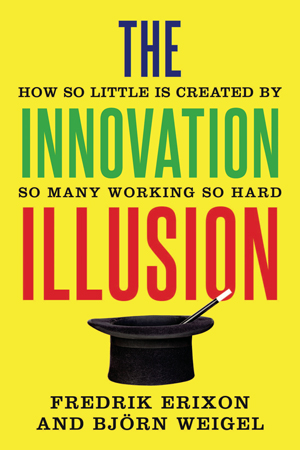
Innovation IllusionArtificial intelligence, robotics, blockchains, reusable rockets, self-driving cars, genetic engineering — there is an unprecedented explosion of innovation going on all around us, and nowhere is it creating more froth than in the corporate sphere. And yet, as Fredrik Erixon and Björn Weigel point out in their new book, The Innovation Illusion: How So Little Is Created by So Many Working So Hard (Yale University Press, 2016), GDP growth, productivity, and corporate investment in the capitalist economies of the West are all on the decline.

Erixon and Weigel, both of the European Centre for International Political Economy, an economic think tank, peg this counterintuitive reality to “gray capitalism, excessive corporate managerialism, second-generation globalization, and complex regulations.” They contend that these “Four Horsemen of capitalist decline” have rendered large companies moribund and risk-averse, and thus have produced an environment in which innovation flourishes, but never generates a full measure of economic output.

In the following excerpt, the authors remind us that while innovations may produce unicorns that enrich founders and VCs, they can’t drive broad-based economic progress on their own. Read the excerpt here.

Thursday, November 10, 2016

TechSavvy: Is Your Company Winning the Race to Digital Transformation?

Digital Transformation Race WinningMIT Sloan Management Review, November 10, 2016

by Theodore Kinni


In some respects, the digitization of business is a pretty nebulous subject. It’s not like a company achieves digital transformation on some specific date — the darn target moves as new technologies and applications appear. That’s one reason why Jane McConnell’s 10th annual inquiry into “The Organization in the Digital Age” is worth a look.

McConnell frames digital transformation as an organizational imperative that manifests itself in three dimensions: people, workplace, and technology. Over the past decade, she has been gauging the progress that a broad, international group of 300+ companies and other institutions has been making toward this imperative in three stages.

The Starting stage is defined by an individual (rather than organizational) digital awareness — digital initiatives are ad hoc and infrequent; senior leaders are minimally involved; most decisions are made by traditional hierarchy; work mainly takes place in established channels, with some virtual venues. The Developing stage is defined by mobilization — a compelling vision for digital transformation exists; senior managers are leading the charge; most functions, levels, and entities are involved in digital initiatives. The Maturing stage is defined by trust — digital is considered a strategic asset; it is embedded in work practices; much decision making is decentralized; information and collaboration is organization-wide and includes customers and external partners.

“The 2016 data shows 16% of the survey participants in the Maturing stage, 52% in the Developing stage, and 32% in the Starting stage,” McConnell reports. Where does your company place? Read the rest here.

Wednesday, November 9, 2016

Margaret Heffernan’s Required Reading

strategy+business, November 9, 2016

by Theodore Kinni

By 2100, we are going to eradicate disease and colonize Mars. In a time when it can be hard to tell corporate leaders from sci-fi writers, Margaret Heffernan speaks more to achieving lofty visions than announcing them. The author, speaker, and executive coach is particularly interested in how to identify and empower talented people — a key trait of effective executives, whether they are bound for Mars or not.

Heffernan, a journalist by training, has written extensively on the theme of talent. In The Naked Truth: A Working Woman’s Manifesto on Business and What Really Matters (Jossey-Bass, 2004) and Women on Top: How Women Entrepreneurs Are Rewriting the Rules of Business Success (Viking, 2007), she examined the costs of undervaluing women in the workplace. In Willful Blindness: Why We Ignore the Obvious at our Peril (Walker & Company, 2011), Heffernan explored how having the right team can save leaders from catastrophic blind spots. In A Bigger Prize: How We Can Do Better than the Competition (Public Affairs, 2014), she explained why more inclusive, collaborative cultures outperform competitive ones. Most recently, Heffernan reprised her popular TED talks in Beyond Measure: The Big Impact of Small Changes (Simon & Schuster/TED, 2015), a short book that describes the powerful, positive effects that result from minor alterations in how we work together.

Heffernan began her career in television production at the BBC and subsequently led IPPA, an English film and television producer trade association. When the Internet disrupted media, she turned serial entrepreneur, serving as CEO of iCast, ZineZone, and InfoMation for CMGI, one of the first Internet company incubators. Currently, in addition to writing and speaking, Heffernan serves as a Merryck & Co mentor, teaches at several business schools, and serves on the boards of three organizations.

When I invited Heffernan to talk books, she quickly agreed. “I mentor a handful of senior and chief executives, and the ones that read a lot have so many more choices in their heads than those who don’t. So, I say read, read, read, read, and read some more,” she said, and offered up the following four titles. Read the rest here.

Tuesday, November 8, 2016

How to Develop a Great Digital Strategy

Learned a lot lending an editorial hand here:

MIT Sloan Management Review
, Winter 2017

by Jeanne W. Ross, Ina M. Sebastian, and Cynthia M. Beath


As leading technology companies embrace biometrics, artificial intelligence (AI), drones, and other exciting digital technologies, senior business executives at many other companies feel pressured to do the same. But if they are to maximize the value from investment in new technologies, business leaders first must make sure that their companies have a great digital strategy.

We studied digital strategies as part of a research project on designing digital organizations that the MIT Center for Information Systems Research conducted in partnership with The Boston Consulting Group; in that project, we interviewed more than 70 senior executives at 27 companies. Our findings underscored the importance of developing a winning business strategy that takes advantage of digital technologies. A great digital strategy provides direction, enabling executives to lead digital initiatives, gauge their progress, and then redirect those efforts as needed. The first step in setting this direction is to decide what kind of digital strategy to pursue: a customer engagement strategy or a digitized solutions strategy.

A customer engagement strategy targets superior, personalized experiences that engender customer loyalty. A digitized solutions strategy targets information-
enriched products and services that deliver new value for customers. The best strategy for a company will depend on its existing capabilities and the way it wants to compete. The most important requirement for a great digital strategy, however, is to choose one kind of strategy or the other, not both. A digital strategy aimed at operational excellence may appear to be a third choice, but increasingly, operational excellence is the minimum requirement for doing business digitally, not the basis for a sustainable competitive advantage. Read the rest here.

Thursday, November 3, 2016

TechSavvy: How “Smart” Is Your R&D Spending?

MIT Sloan Management Review, November 3, 2016

by Theodore Kinni


Strategy&’s annual Global Innovation 1000 study, which examines the 1,000 public companies that spend the most on R&D (collectively 40% of the world’s total R&D spending), is always insightful. The most dismaying finding: In every one of the past 12 years, the study has found no statistically significant relationship between the financial performance of the Innovation 1000 companies and their R&D spending.

Assuming that fact doesn’t cause you to throw up your hands and use your company’s R&D budget for a massive beer bash, this year’s study, published in strategy+business, provided another insight that is well worth considering: A transformation in R&D spending is occurring.

“R&D is shifting more and more toward developing software and services,” write Strategy& principals Barry Jaruzelski, Volker Staack, and Aritomo Shinozaki. “Software increasingly carries the burden of enabling product differentiation and adaptability, and enhancing customer experiences and outcomes. Services, offered along with or separately from physical products, now focus more on new customer needs, providing enhanced value and improved usability.”

This shift, explain the authors, is driven by the ever-increasing capabilities of software, the embedding of software and sensors in products, the ability to connect products via IoT and the cloud, and, as always, customer demand. It’s manifesting in every kind of “smart” product and service.

Since 2010, the Global Innovation 1000 companies have increased their R&D spending on software offerings by 65% — to $142 billion. In addition, report the authors, “companies currently allocating 25% or more of their R&D budgets to software offerings reported that their revenues were growing significantly faster than those of key competitors with lower allocations.”

What does your company spend its R&D budget on? Read the rest here.

Monday, October 31, 2016

Best Business Books 2016: Management

strategy+business, Winter 2016

by Theodore Kinni


It’s satisfying when corporate wrongdoing comes complete with a villain, preferably someone larger than life and twice as mean. Having an evil mastermind à la Bernie Madoff to pin things on sets up a happy ending. The bad guy or gal is brought to justice and, voilà, all is right in the business world.

Unfortunately, we are often denied that satisfaction. Some organizational disasters — such as the Deepwater Horizon oil spill and Dieselgate — seem to occur as a result of unintentional internal combustion. Scapegoats always seem to be found, but it’s a stretch to argue that there was a black-mustachioed villain who put match to fuse. Instead, when the investigations are over, the real culprit turns out to be a hodgepodge of systems, processes, or managerial decisions that didn’t raise alarms until the consequences suddenly exploded.

This year’s three best business books on management offer compelling and useful advice on how to avoid such problems. In Pre-Suasion, the best of the group, Robert Cialdini explains how managers can be predisposed to make constructive decisions and can predispose others to take constructive action. In Managing in the Gray, Joseph L. Badaracco shows how managers can make difficult decisions in a more responsible manner. And in The Process Matters, Joel Brockner explores how the decisions that managers make when constructing processes can help prevent undesirable outcomes. Read the rest here.

Monday, October 24, 2016

TechSavvy: Competing for Talent in the Platform Economy

Competing Talent Platform EconomyMIT Sloan Management Review, October 24, 2016

by Theodore Kinni


Platforms are all the rage these days. Companies are being urged to create their own — à la Uber and Airbnb. But platform advocates often take one thing for granted: a seemingly infinite supply of workers who will happily do the platform operator’s bidding in return for, well, whatever the operator is willing to give them.

That may not be a sound assumption, especially as the competition heats up in platform markets that prove viable. Witness Sheelah Kolhatkar’s article on Uber’s fast-growing rival, Juno, in The New Yorker. “Juno’s business model is to take what Uber has created and appropriate it,” writes Kolhatkar. “Most of what Juno does is predicated on the fact that many drivers feel mistreated by Uber. … If Uber seems cold and impersonal, Juno will smother its drivers with attention. If Uber has raised its commission — the part of each fare that the company keeps — Juno will set a much lower one.”

As the folks at Uber think about how to frame a response to the wooing away of its drivers, they might want to read the new report on platform workers from the Institute for the Future. The IFTF did an ethnographic study of a select group of platform workers. It found the workers fit into seven distinct archetypes and that there are seven qualities that define the platform working experience.

The study also found out what platform workers care about. Their top three concerns: income potential; control over choosing which jobs to take; and work frequency, immediacy of payment, and convenience.

Uber isn’t the only company that should be reading the IFTF report. Its battle for drivers suggests that eventually all successful platform companies will have to compete for contract workers. So they better get to know them. Read the rest here.

Thursday, October 20, 2016

TechSavvy: Beware the Paradox of Automation

Paradox AutomationMIT Sloan Management Review, October 20, 2016

by Theodore Kinni

Earlier this year, Facebook exorcised those pesky human editors who were introducing political bias into its Trending news list and left the job to algorithms. Now, reports Caitlin Dewey in The Washington Post, the Trending news isn’t biased, but some of it is fake. Turns out the algorithms can’t tell a real news story from a hoax.

Facebook says it can improve its algorithms, but errors of judgment aren’t the only pitfall in transferring human tasks to machines. There’s also the paradox of automation. “It applies in a wide variety of contexts, from the operators of nuclear power stations to the crews of cruise ships, from the simple fact that we can no longer remember phone numbers because we have them all stored in our mobile phones, to the way we now struggle with mental arithmetic because we are surrounded by electronic calculators,” says Tim Hartford in an excerpt published by The Guardian from his new book, Messy: The Power of Disorder to Transform Our Lives. “The better the automatic systems, the more out-of-practice human operators will be, and the more extreme the situations they will have to face.”

Hartford borrows William Langewiesche’s harrowing description of the crash of Air France Flight 447 to illustrate three problems with automation: “First, automatic systems accommodate incompetence by being easy to operate and by automatically correcting mistakes. … Second, even if operators are expert, automatic systems erode their skills by removing the need for practice. Third, automatic systems tend to fail either in unusual situations or in ways that produce unusual situations, requiring a particularly skillful response.”

The excerpt is worth a read — especially if it prompts you to ask if your company’s automation initiatives might entail similar risks. Read the rest here.

Wednesday, October 19, 2016

Can Conversation Supplant Bureaucracy?


strategy+business, October 19, 2016

by Theodore Kinni

In 2012, Catherine Turco became increasingly intrigued by what she saw as a corporate preoccupation with openness. The open communication, decision processes, innovation, and offices in Web 2.0 companies like Facebook and Google were on their way to becoming corporate memes. And stalwarts like IBM and GE were making well-publicized forays into wikis and crowd-sourced product development. In particular, the associate professor of organizational studies at the MIT Sloan School of Management was struck by the gospel of “radical openness” being fervently preached by the leaders of a fast-growing, 600-employee social media firm, which she identifies only as TechCo.

“‘Could this work?’ I wondered,” recalls Turco. “Maybe it was all talk — a savvy presentation of corporate self that masked the same bureaucratic and hierarchical practices firms have had for years. Then again, maybe it would carry lessons for how corporations really could change. One December morning I woke up and decided I had to study TechCo.”

Turco devoted 10 months to that study, spending four days per week at the company; conducting nearly 100 interviews with 77 employees, including the senior leadership team; shadowing and socializing with employees; and attending innumerable meetings during and after work hours, as well as the week-long new employee training program. The welcome result of her immersion into all things TechCo is The Conversational Firm: Rethinking Bureaucracy in the Age of Social Media (Columbia University Press, 2016). This well-written, insightful ethnographic study solidly establishes the notion that hierarchical command-and-control structures and distributed decision-making structures (like holacracy) are not the only choices for managing a company. Read the rest here.

Thursday, October 13, 2016

TechSavvy: Why Digitization Won’t Put Operations Managers Out of Work

MIT Sloan Management Review, October 13, 2016

by Theodore Kinni

Digitization Operations ManagementOn Oct. 3, ING Group joined a growing number of big European banks when it announced a big investment in digital technology (800 million euros) and a big reduction in force (11% or 5,800 jobs). “Unfortunately digital transformation means less jobs,” CFO Patrick Flynn told Bloomberg Television not very ruefully.

But perhaps not fewer management jobs. “Even as organizations balance lower investment in traditional operations against greater investment in digital, the need for operations management will hardly disappear,” write McKinsey consultants Albert Bollard, Alex Singla, Rohit Sood, and Jasper van Ouwerkerk in a new article in McKinsey Quarterly. “In fact, we believe the need will be more profound than ever.”

In the near term, the challenge will be the ability of companies “to embrace digital innovation and operations-management discipline at the same time.” That, the authors say, will require figuring out how to combine digital and human resources, modify employee roles to showcase and sustain digitization, support customers as they figure out how to work with the organization, and develop leaders and managers with “much stronger day-to-day skills in working with their teams.” Read the rest here.

Wednesday, October 12, 2016

Nilofer Merchant’s Required Reading

strategy+business, October 12, 2016

by Theodore Kinni


Nilofer Merchant knows something about value creation. By her reckoning, she has had a hand in launching more than 100 products that have netted a combined US$18 billion in sales — first in stints at Apple and Autodesk, and later as an advisor to technology companies such as Logitech, Symantec, and HP.

Rather than focusing on processes and tools, Merchant sees the humanist values of diversity, inclusivity, and collaboration as the keys to creating corporate value. “It’s not that everyone will but that anyone can contribute,” she says.

Her two books reiterate the message. In The New How: Creating Business Solutions through Collaborative Strategy (O’Reilly Media, 2010), Merchant traces the difficulties that many companies encounter in executing strategy to the conventional top-down approach to strategy formulation. She argues for a more inclusive approach to strategy-making that enlists the people responsible for executing it. In 11 Rules for Creating Value in the #SocialEra (Harvard Business Press, 2012), Merchant contends that social technologies and tools have given rise to a new era in which the basis for value creation is collaboration and co-creation by communities of people who are united by an aspirational purpose.

Named to the Thinkers50 list in 2015, Merchant is also a fellow at the Martin Prosperity Institute, where she is exploring the implications of “onlyness” on the future of democratic capitalism. “Each of us is standing in a spot that no one else occupies,” she says. “This individual onlyness is the fuel of vast creativity, innovations, and adaptability.”

I asked Merchant for a short list of the best reads on value creation. She called out the following three books and a seminal article on organizational learning. Read the rest here.

Thursday, October 6, 2016

Tech Savvy: Hacking Your Work-Life Balance

MIT Sloan Management Review, October 6, 2016

by Theodore Kinni


Tech Savvy Work Life BalanceWhen I read CEO memoirs, I always keep an eye out for insights into how people in demanding positions maintain a healthy work-life balance. But when the topic is addressed at all, it’s usually in a dismal admission that life — mainly family life — got the short end of the stick. Happily, Michal Lev-Ram’s Fortune profile of Qualtrics CEO Ryan Smith suggests there might be a better way.

Smith has his hands full. The Provo, Utah-based online survey company he helped co-found in 2002 has 1,200 employees and a valuation of more than $1 billion. He and wife Ashley, who has a business of her own, have five kids ranging from 4 months to 8 years old. But he says he keeps it all together by “hacking the integration” of life and work. That means tracking both work and family time.

“Smith continually uses data to inform and guide the way he allocates his time,” explains Lev-Ram. “With the aid of an executive assistant who’s a former statistician, Smith tracks everything from the number of hours he devotes to interviews to how much one-on-one time he spends with each of his children. Ask him how many nights he spent away from home last year, and all he has to do is consult a spreadsheet.” Quarterly, the CEO reviews a colored-coded spreadsheet that summarizes how he spent his time, and then sets new goals and rules for work and life.

Who knows? If Smith keeps it up for another 20 years or so, maybe his CEO memoir won’t be quite as dismal as all the others. Read the rest here.

Thursday, September 22, 2016

TechSavvy: That Sound You Hear Is Your Enterprise’s AI Technology

MIT Sloan Management Review, Sept. 22, 2016

by Theodore Kinni


Sound Enterprise AI Technology Artificial IntelligenceApple held its “Special Event” and, among other things, officially killed the iPhone’s 3.5-millimeter earbud jack, replacing it with $159 wireless AirPods. My first reaction: Meh. But then I read Mike Elgan’s paean to this development in Computerworld.

Elgan says that AirPods are actually artificial intelligence hardware. “The biggest thing going on here is the end of ‘dumb speaker’ earbuds, and the mainstreaming of hearables — actual computers that go in your ears,” he says. “Bigger still is that the interface for these tiny computers is a virtual assistant. When you double-tap on an AirPod, Siri wakes up, enabling you to control music play and get battery information with voice commands.”

What does this mean for your company? Soon every employee could have a supercomputer whispering in his or her ear. For instance, Hearables startup Bragi and IBM just announced that they plan to combine Bragi’s Dash earbuds and IBM’s Watson IoT platform “to transform the way people interact, communicate, and collaborate in the workplace.”

Earbud-sporting workers, according to the companies, will use the devices to “receive instructions, interact with co-workers, and enable management teams to keep track of the location, operating environment, well-being, and safety of workers.” Bragi and IBM have targeted six areas of initial focus: worker safety, guided instructions, smart employee notifications, team communications, workforce analysis and optimization, and biometric ID. Read the rest here.

Thursday, September 15, 2016

TechSavvy: Monitoring Your Employees’ Every Emotion

MIT Sloan Management Review, September 15, 2016

by Theodore Kinni


Monitoring Employee Emotions
Have you heard about the Cowlar? It’s a smart collar that dairy farmers can strap around the necks of cows to monitor their herds. It promises improved milk production, early disease detection, heat detection, and real-time monitoring and alerts. How would you feel about wearing one? I ask because it seems like it’s a question that more and more employers are asking their employees.

“Companies including JPMorgan Chase and Bank of America have had discussions with tech companies about systems that monitor worker emotions to boost performance and compliance, according to executives at the banks,” reports Hugh Son in Bloomberg Businessweek. They got the idea from MIT Sloan School prof Andrew Lo, who strapped wristwatch sensors that measure pulse and perspiration on 57 stock and bond traders to monitor their reactions in a simulated trading environment. “Imagine if all your traders were required to wear wristwatches that monitor their physiology, and you had a dashboard that tells you in real time who is freaking out,” Lo said to Son. “The technology exists, as does the motivation—one bad trade can cost $100 million.”

If this suggests that employee monitoring devices will be limited to high-risk occupations, you should read Thomas Heath’s Washington Post article on Boston-based Humanyze. Humanyze makes and monitors employee ID badges that hang around your neck. “Each has two microphones doing real-time voice analysis, and each comes with sensors that follow where you are in the office, with motion detectors to record how much you move,” writes Heath. “The beacons tracking your movements are omitted from bathroom locations, to give you some privacy.” The company’s CEO Ben Waber predicts that “every single” ID badge will be so equipped within three to four years.

As with other means of digitally monitoring and measuring employee activity, companies probably should expect some pushback, including legal challenges relating to privacy and discrimination. But Waber says that you can tell employees that their new IDs are “exactly like a Fitbit for your career.” I think it’s going to be a little harder to explain away their unflattering similarity to Cowlars. Read the rest here.

Wednesday, September 14, 2016

Amy Edmondson’s Required Reading

strategy+business, September 14, 2016

by Theodore Kinni

Amy C. Edmondson’s abiding interest in teaming may well be rooted in her intriguing stint as chief engineer to the iconoclastic R. Buckminster Fuller in the early 1980s. It was Fuller, after all, who plucked the word synergy from the lexicon of chemistry and expanded its use to include the way in which a holistic approach can help any interactive system — whether a geometric structure or a business — add up to more than the sum of its parts.
After Fuller’s death in 1983, Edmondson served as director of research at Pecos River Learning Centers, a training and development firm, where she designed and implemented transformational change programs for large companies. In 1996, after adding advanced degrees in organizational behavior and psychology to her undergraduate degree in engineering and design (all from Harvard), she joined the faculty at the Harvard Business School; 10 years later, she was named its Novartis Professor of Leadership and Management.
Since then, Edmondson has been teaching, consulting, and writing about the organizational synergies that can be created via teamwork, with a particular focus on the role leaders play in producing them. In Teaming: How Organizations Learn, Innovate, and Compete in the Knowledge Economy(Jossey-Bass, 2012) and Teaming to Innovate (Jossey-Bass, 2013), she explored teamwork in dynamic, unpredictable work environments. Most recently, in Building the Future: Big Teaming for Audacious Innovation(Berrett-Koehler, 2016), Edmondson and coauthor Susan Salter Reynoldsexamined the challenges and opportunities of teaming across sectors through the case of Living PlanIT, a startup that designs operating systems for urban  infrastructure.
When I asked Edmondson about the books that executives should read to become more effective team leaders and to capture the benefits of synergy for their companies, she shared the following three titles. Read the rest here.

Thursday, September 8, 2016

TechSavvy: A Code of Ethics for Smart Machines


MIT Sloan Management Review, September 8, 2016

by Theodore Kinni


Smart machines need ethics, too: Remember that movie in which a computer asked an 
impossibly young Matthew Broderick, “Shall we play a game?” Four decades later, it turns out that global thermonuclear war may be the least likely of a slew of ethical dilemmas associated with smart machines — dilemmas with which we are only just beginning to grapple.

The worrisome lack of a code of ethics for smart machines has not been lost on Alphabet, Amazon, Facebook, IBM, and Microsoft, according to a report by John Markoff in The New York Times. The five tech giants (if you buy Mark Zuckerberg’s contention that he isn’t running a media company) have formed an industry partnership to develop and adopt ethical standards for artificial intelligence — an effort that Markoff infers is motivated as much to head off government regulation as to safeguard the world from black-hearted machines.

On the other hand, the first of a century’s worth of quinquennial reports from Stanford’s One Hundred Year Study on Artificial Intelligence (AI100) throws the ethical ball into the government’s court. “American law represents a mixture of common law, federal, state, and local statutes and ordinances, and — perhaps of greatest relevance to AI — regulations,” its authors declare. “Depending on its instantiation, AI could implicate each of these sources of law.” But they don’t offer much concrete guidance to lawmakers or regulators — they say it’s too early in the game to do much more than noodle about where ethical (and legal) issues might emerge.

In the meantime, if you’d like to get a taste for the kinds of ethical decisions that smart machines — like self-driving cars — are already facing, visit MIT’s Moral Machine project. Run through the scenarios and decide for yourself who or what the self-driving car should kill. Aside from the fun of deciding whether to run over two dogs and a pregnant lady or drive two old guys into the concrete barrier, it’ll help the research team create a crowd-sourced view of how humans might expect of ethical machines to act. This essay from UVA’s Bobby Parmar and Ed Freeman will also help fuel your thinking. Read the rest here.

Thursday, September 1, 2016

TechSavvy: Every Company Is a Tech Company and Tech Is No Longer an Industry

MIT Sloan Management Review, September 1, 2016

by Theodore Kinni

If you’re competing on the uneven playing fields created by so-called tech companies — like Uber, Airbnb, and Alibaba — that seem to be able to ignore the rules of the game with impunity, you’ll want to read Anil Dash’s latest missive on Medium.


Tech Industry“Once upon a time, it made perfect sense to talk about ‘the high tech industry’ in America — pioneering companies like Intel or Fairchild Semiconductor or IBM or Hewlett Packard made computer processors and related hardware, and most of the companies in Silicon Valley dealt with actual silicon from time to time,” writes Dash. “But today, the major players in what’s called the ‘tech industry’ are enormous conglomerates that regularly encompass everything from semiconductor factories to high-end retail stores to Hollywood-style production studios. The upstarts of the business can work on anything from cleaning your laundry to creating drones. There’s no way to put all these different kinds of products and services into any one coherent bucket now that they encompass the entire world of business.”

But we try anyway, and that needs to stop ASAP, argues Dash. “The reason is simple: A reductive name for the industry masks an enormous set of social challenges that we need to tackle quickly. Mature industries develop their own regulatory frameworks, their own systems for self-regulation, and their own standards for monitoring transgressions within the industry. Today, tech as an industry is almost completely lacking in all of these areas.”

The consequences? A lack of accountability — resulting in situations like the Theranos scandal in which “its founder and its investors all shielded themselves under the cultural cover of being a glamorous member of the ‘tech industry’ rather than a prosaic medical supplier.” The spreading of the “tech’s well-known shortcomings around inclusion and diversity into new fields” is another conundrum. And, continues Dash, “companies ranging from AirBNB to Uber [that] have relied on their status as ‘tech companies’ to systematically shirk inconvenient laws in each new city they enter.”

The solution? Since all companies are tech companies these days, we should define them by the businesses in which they engage, not how they choose to compete. “All it takes is a little discipline in how we communicate,” concludes Dash. “How we talk to each other, to our lawmakers, to the media — each of those little shifts will affect how we think about the impact that tech-enabled companies are having on the world. There’s no doubt that technology itself can have a hugely positive impact. But ensuring that it does may depend on us taking apart the idea that technology is created or sustained by a ‘tech industry’ in the first place.” Read the rest here.