Saturday, March 25, 2017
2017 Commercial Aviation Trends
Posted by
Theodore Kinni
at
9:50 AM
0
comments
Labels: aviation, corporate success
Friday, March 17, 2017
The Flare and Focus of Successful Futurists
Enjoyed editing Amy Webb's adaptation of her book, The Signals Are Talking, for MIT Sloan Management Review:
Posted by
Theodore Kinni
at
1:23 PM
0
comments
Labels: articles to ponder, change management, competitive intelligence, corporate success, creativity, innovation, management, personal success, virtual reality
Saturday, March 11, 2017
Regulation, Who Needs It?

Posted by
Theodore Kinni
at
1:51 PM
0
comments
Labels: corporate success, economic systems, politics, regulation
Wednesday, March 8, 2017
Nir Eyal’s Required Reading
strategy+business, March 8, 2017
by Theodore Kinni
Nir Eyal teaches companies how to hook customers. When he says hook, he doesn’t mean entice or engage — he means designing products that are habit-forming.
“Habit-forming products change user behavior and create unprompted user engagement,” Eyal explains. “The aim is to influence customers to use your product on their own, again and again, without relying on overt calls to action such as ads or promotions. Once a habit is formed, the user is automatically triggered to use the product during routine events such as wanting to kill time while standing in line.”
Eyal first got interested in habit-forming products in 2008, as cofounder and CEO of AdNectar, a platform for advertisers trying to reach social gamers. In the process of launching the company, he became intrigued with the behavioral influence that gaming sites and other social media sites, such as Facebook and Twitter, exerted on users.
After AdNectar was acquired by Lockerz in 2011, Eyal took a deep dive into the nuts and bolts of habit formation. He taught at the Stanford Graduate School of Business and the Hasso Plattner Institute of Design. He invested in and consulted with companies seeking to hook customers. Eyal encapsulated his findings in the best-selling book Hooked: How to Build Habit-Forming Products (Portfolio, 2014), which details the Hook Model, a four-step cycle for creating habit-forming products.
One of Eyal’s motivations for developing the Hook Model and writing Hooked was his own frustration with the lack of information on the topic for product designers. When I asked him about the books that had influenced him, he shared the following four titles. See the titles here.
Posted by
Theodore Kinni
at
2:10 PM
0
comments
Labels: books, corporate success, marketing, personal success, Required Reading, selling, strategy+business
Zero-based trade for CPG leaders: Five steps for raising the impact of your trade promotions
Learned a lot lending an editorial hand here:
PwC Strategy&, March 8, 2017
by David Ganiear and Edward Landry
The next wave of profitability for consumer packaged goods (CPG) companies will come from zero-based trade (ZBT). This adaptation of zero-based budgeting goes beyond cost management of trade promotion. It helps manufacturers rethink their patterns of spending and increase the profitability of this all-important way of reaching end consumers in retail stores. Trade promotion, which directs shopper awareness at the point of sale, is a valuable strategic capability. In the annual expenses of a CPG company, it typically ranks second; only the cost of goods sold is greater.
ZBT represents a five-step process for raising the impact of that spending. The first step is to diagnose your situation and look for previously unseen opportunities for improvement. Second, develop trade promotion strategies that are aligned with your business strategy, reflecting both the financial returns you expect from your trade promotion investment and the level of freedom you have to redeploy it. Third, employ trade optimization levers — budgeting, pricing, analytic planning, and post-event analysis — to implement these new strategies. Fourth, bring your overall trade budgets in line with your new approach. Finally, give this new ZBT practice the enabling capabilities needed to sustain it over time. Together, these steps add up to a new overall trade promotion strategy that can yield millions in savings for your CPG company and give it a customer-facing competitive edge. Download the white paper here.
Posted by
Theodore Kinni
at
2:08 PM
0
comments
Labels: articles to ponder, corporate success, innovation, marketing, selling
Thursday, March 2, 2017
RSA 2017: 5 Takeaways From the Biggest Cybersecurity Conference
Lent an editorial hand here:
WSJ.CustomStudios, March 2, 2017
by David B. Burg and Grant Waterfall, PwC
The annual RSA Conference acts like a microcosm of the global cybersecurity ecosystem: everyone’s there, and it’s as kinetic and chaotic as the industry itself. Yet the industry’s biggest cybersecurity conference also provides some valuable insights, as we recently found.
Since returning from RSA in mid February, where PwC maintained a lively presence amid the hubbub, we’ve condensed our takeaway into five key points:
Efficiency: A record 43,000 information security professionals attended this year’s RSA, roaming 550 vendor booths and choosing among more than 500 educational sessions to attend. As the cybersecurity world continues to expand and grow in importance and relevance, this event continues to grow as well — just five years ago, only 17,000 information security professionals attended RSA, according to the event managers. So for anyone who wants to find out just about anything about cybersecurity, it’s all there. Someone new to the cybersecurity and privacy industry could theoretically cram months of research and learning into just a few days in San Francisco. Read the rest here.
Posted by
Theodore Kinni
at
4:20 PM
0
comments
Labels: cybersecurity
Wednesday, February 22, 2017
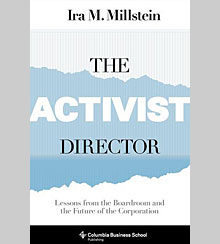
The Sisyphean Task of Activating Boards of Directors
strategy+business, Feb. 22, 2017
by Theodore Kinni
In addition to being an optimist, 90-year-old Millstein is a patient man. He has been making this particular argument for nearly 40 years, since the late 1970s, when he began helping the Business Roundtable draft a series of reports that defined the role and responsibilities of boards. At the time, shareholder activism was starting to manifest itself in leveraged buyouts and hostile takeovers, and Millstein wanted “to ensure that boards exert some initiative to restore corporate competitiveness.”
Toward this end, Millstein didn’t simply write about boards — he advised them. And he advised them to be aggressive. Most notably, he served as external counsel to the board of General Motors for about a decade starting in 1985. During that period, GM was losing money and market share. Yet chairman and CEO Roger Smith, the “Roger” in Michael Moore’s scathing documentary Roger and Me, refused to treat the board as anything more than a rubber stamp — which was the de rigueur role of most corporate boards. Braving Smith’s legendary temper, Millstein helped GM’s board find its feet. And when Smith retired, he advised the board as it took a more active role in governance — hiring Robert Stempel as CEO and then, within two years, firing him and other members of GM’s senior management team when they did not move quickly enough to right the ship. Read the rest here.
Posted by
Theodore Kinni
at
4:30 PM
0
comments
Labels: bizbook review, books, business history, corporate success, ethics, strategy+business
Wednesday, February 8, 2017
Susan David’s Required Reading
strategy+business, Feb. 8, 2017
by Theodore Kinni
Posted by
Theodore Kinni
at
4:46 PM
0
comments
Labels: books, corporate success, leadership, management, personal success, Required Reading, strategy+business
Tuesday, February 7, 2017
Exaggerated Truth-Telling Is Commonplace, But Not Admirable
LinkedIn Pulse, Feb. 7, 2017
by Theodore Kinni
In 1919, as the White and Red armies fought a brutal, seesaw war for control of Russia, British War Secretary Winston Churchill prodded his government to commit troops to the fight. The Bolsheviks, he declared, were “swarms of typhus bearing vermin.” They “hop and caper like ferocious baboons amid the ruins of their cities and the corpses of their victims.” Churchill’s rhetoric was so inflammatory that, after he addressed the House of Commons on the topic, Tory Party leader A.J. Balfour felt compelled to comment. With quintessential British coolness, the former Prime Minister told the future Prime Minister, “I admire the exaggerated way you tell the truth.”
Unfortunately, exaggerated truth-telling is as commonplace in business as in politics. Walter Isaacson cites Steve Job’s “reality-distortion field” repeatedly in his go-to biography of the Apple’s mercurial chief. “[Jobs] would assert something—be it a fact about world history or a recounting of who suggested an idea at a meeting—without considering the truth,” writes Isaacson. He would conjure up an impossible production date, for instance, and demand it be met. Surprisingly, as Isaacson recounts, it often was.
Elon Musk seems to have picked up Job’s penchant for exaggerated truth-telling. Musk says that Tesla’s factory in Fremont, CA will produce as many as 500,000 vehicles in 2018—an “extraordinary leap in production” from less than 84,000 in 2016, according to Jeff Rothfeder’s insightful analysis in The New Yorker. Can Musk’s employees and suppliers deliver on his promise or is this exaggerated truth-telling? Well, as The Wall Street Journal calculates it, Tesla has missed Musk’s projections more than 20 times in the past five years. Read the rest here.
Posted by
Theodore Kinni
at
4:39 PM
0
comments
Labels: communiques, corporate success, ethics, government, leadership, personal success, politics
Tuesday, January 31, 2017
2017 Chemicals Trends
By Vijay Sarathy, Marcus Morawietz, Jayant Gotpagar, and Jeremy Bebiak

The structural headwinds in the chemicals industry are blowing like a gale out of the global economy. In a funk since peaking in 2007, global economies have been unable to reach the 35-year GDP growth average of 3.5 percent in six of the past eight years. And the two years of “high” growth were more of a bounce back from the sharp downturn of 2009 than precursors of a sustained turnaround.
Within this problematic macroeconomic environment, made worse for many multinationals by the strong dollar, demand for chemicals has fallen. Overall industry sales growth increased an anemic 2.1 percent in 2016 as the sector faced declining industrial production and broad inventory rightsizing by many of its customers. Chemicals companies that sell petroleum-based products often fell short of these industry averages because lower oil prices led to sharp top-line declines, sometimes in the range of 30 to 40 percent. Only naphtha-based producers benefited from oil price weakness, because it translated into materials cost reductions of about 60 percent for some companies, which greatly improved profit margins. Read the rest here.
Posted by
Theodore Kinni
at
5:33 PM
0
comments
Labels: articles to ponder, chemicals, corporate success, economics
Monday, January 30, 2017
Private-sector participation in the GCC: Building foundations for success
Learned a lot lending an editorial hand here:
PwC Strategy&, Jan. 30, 2017
The governments of the Gulf Cooperation Council (GCC) states have decided to change their economic development model. The state-led approach which relied upon natural resources successfully raised incomes from developing to developed country levels in a little over a generation. However, that model is no longer appropriate as it is undermined by oil dependence, a lack of workforce diversity and skills, a growing need for public services, and insufficient innovation.
One effective response is private-sector participation (PSP). GCC states are already using PSP, but have wielded it tactically and ad hoc. As a result, they have not tapped its full potential. Instead, a comprehensive strategic program of public–private partnerships (PPPs) and privatization initiatives that covers all major sectors of the economy is needed to define a country’s PSP plan. If GCC states can successfully develop, launch, and execute such a PSP program, they can transform their economies. The GCC states could avoid US$164 billion in capital expenditures by 2021 and generate $114 billion in revenues from sales of utility and airport assets alone, and up to $287 billion from sales of shares in publicly listed companies.
Furthermore, GCC states could narrow the innovation gap with other countries, enhance the delivery of and access to government services, and improve their infrastructure. To capture these benefits, GCC governments will need a rigorous and comprehensive approach to PSP and a clearly articulated, long-term implementation plan that encompasses all economic sectors. Such an approach rests on three foundational elements: A governing policy for PSP that is either a standalone policy or part of a broader national policy; a legal framework that encompasses the new laws or modifications to existing laws necessary to facilitate PSP activities; and an institutional setup that clearly defines and allocates authority over PSP to existing government entities or establishes new entities to govern it. Download the white paper here.
Posted by
Theodore Kinni
at
5:11 PM
0
comments
Labels: articles to ponder, business history, economic systems, economics, entrepreneurship, government
Wednesday, January 25, 2017
Peter Diamandis’s Excellent Adventure
strategy+business, January 25, 2017
by Theodore Kinni
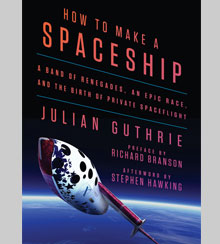
Stephen Hawking believes we humans won’t survive another thousand years unless we colonize space. And if we do colonize space, people will probably erect statues of Peter Diamandis in town squares across the universe. At least that’s the impression that ex–San Francisco Chronicle reporter Julian Guthrie gives in How to Make a Spaceship (Penguin, 2016).
In Spaceship, Guthrie tells the story of the Ansari XPrize and of SpaceShipOne — the privately developed, piloted craft that, in 2004, won the US$10 million competition by flying into space and back twice within two weeks. Although it was an inspirational feat, the book is a bit of a mixed bag. It’s a terrific yarn, to be sure. But it’s also an overly detailed biography of Diamandis that verges on hagiography and a missed opportunity to explore how new industries emerge from the intersection of government and the private sector.
Diamandis was 8 years old when Neil Armstrong stepped onto the moon in 1969. Like millions of American kids of similar age, he dreamed of becoming an astronaut. Unlike almost all those other kids, he never outgrew the dream — even as he attended Harvard Medical School, where he graduated only after promising the school’s dean never to actually practice medicine.
Instead, Diamandis became a serial entrepreneur in the space business. Among the numerous ventures he cofounded and led from the late 1980s to the 2000s were International Microspace, which provided low-cost satellite launch services; Zero Gravity, which offered well-to-do thrill-seekers parabolic “weightlessness” flights in a Boeing jet; and BlastOff, which aimed to fly a mission to the moon. The business results of his ventures were mixed at best: Zero Gravity is the only one of these three still operating independently. But in zooming from one business to another, Diamandis got the idea to jumpstart a private-sector space race with a prize — a competition modeled on the $25,000 Orteig Prize that prompted Charles Lindbergh’s solo flight across the Atlantic in 1927. Read the rest here.
Posted by
Theodore Kinni
at
5:42 PM
0
comments
Labels: bizbook review, books, business history, corporate success, creativity, entrepreneurship, innovation, leadership, space, strategy+business, technology
Wednesday, January 4, 2017
Samuel Bacharach’s Required Reading
strategy+business, January 4, 2017
by Theodore Kinni
Posted by
Theodore Kinni
at
6:05 PM
0
comments
Labels: books, change management, corporate life, corporate success, human resources, leadership, management, personal success, Required Reading, strategy+business
Wednesday, December 7, 2016
Marina Gorbis's Required Reading: Human Nature and Networks
strategy+business, December 7, 2017
by Theodore Kinni
Marina Gorbis has studied the future of just about everything. It’s her job. Since 2006, the Ukrainian-born social scientist has been the executive director of the Institute for the Future (IFTF), a Silicon Valley–based research and consulting nonprofit founded almost a half-century ago to explore the future and create organizational tools and programs for successfully navigating it.
When I asked Gorbis to share a few books that business executives should read, she said, “I have to tell you the truth. I hate business books and rarely read them.” But then she called out three titles that examine human nature and networks — essential knowledge for anyone who leads people. Read the rest here.
Posted by
Theodore Kinni
at
5:49 PM
0
comments
Labels: books, corporate life, corporate success, human resources, management, personal success, strategy+business, work
Wednesday, November 23, 2016
How to Get Off the Hook
strategy+business, November 23, 2016
by Theodore Kinni
Posted by
Theodore Kinni
at
5:59 PM
0
comments
Labels: bizbook review, change management, corporate life, corporate success, human resources, leadership, management, personal success, strategy+business, work
Why Innovation Isn’t Enough
MIT Sloan Management Review, November 23, 2016
by Theodore Kinni
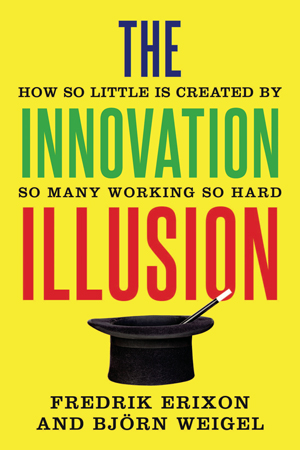
Artificial intelligence, robotics, blockchains, reusable rockets, self-driving cars, genetic engineering — there is an unprecedented explosion of innovation going on all around us, and nowhere is it creating more froth than in the corporate sphere. And yet, as Fredrik Erixon and Björn Weigel point out in their new book, The Innovation Illusion: How So Little Is Created by So Many Working So Hard (Yale University Press, 2016), GDP growth, productivity, and corporate investment in the capitalist economies of the West are all on the decline.Erixon and Weigel, both of the European Centre for International Political Economy, an economic think tank, peg this counterintuitive reality to “gray capitalism, excessive corporate managerialism, second-generation globalization, and complex regulations.” They contend that these “Four Horsemen of capitalist decline” have rendered large companies moribund and risk-averse, and thus have produced an environment in which innovation flourishes, but never generates a full measure of economic output.
In the following excerpt, the authors remind us that while innovations may produce unicorns that enrich founders and VCs, they can’t drive broad-based economic progress on their own. Read the excerpt here.
Posted by
Theodore Kinni
at
10:08 AM
0
comments
Labels: books, business history, corporate success, creativity, entrepreneurship, innovation, leadership, management
Thursday, November 10, 2016
TechSavvy: Is Your Company Winning the Race to Digital Transformation?
MIT Sloan Management Review, November 10, 2016
by Theodore Kinni
In some respects, the digitization of business is a pretty nebulous subject. It’s not like a company achieves digital transformation on some specific date — the darn target moves as new technologies and applications appear. That’s one reason why Jane McConnell’s 10th annual inquiry into “The Organization in the Digital Age” is worth a look.
McConnell frames digital transformation as an organizational imperative that manifests itself in three dimensions: people, workplace, and technology. Over the past decade, she has been gauging the progress that a broad, international group of 300+ companies and other institutions has been making toward this imperative in three stages.
The Starting stage is defined by an individual (rather than organizational) digital awareness — digital initiatives are ad hoc and infrequent; senior leaders are minimally involved; most decisions are made by traditional hierarchy; work mainly takes place in established channels, with some virtual venues. The Developing stage is defined by mobilization — a compelling vision for digital transformation exists; senior managers are leading the charge; most functions, levels, and entities are involved in digital initiatives. The Maturing stage is defined by trust — digital is considered a strategic asset; it is embedded in work practices; much decision making is decentralized; information and collaboration is organization-wide and includes customers and external partners.
“The 2016 data shows 16% of the survey participants in the Maturing stage, 52% in the Developing stage, and 32% in the Starting stage,” McConnell reports. Where does your company place? Read the rest here.
Posted by
Theodore Kinni
at
10:25 AM
0
comments
Labels: articles to ponder, blockchain, change management, competitive intelligence, corporate success, data science, digitization, entrepreneurship, innovation, leadership, TechSavvy
Wednesday, November 9, 2016
Margaret Heffernan’s Required Reading
strategy+business, November 9, 2016
by Theodore Kinni
By 2100, we are going to eradicate disease and colonize Mars. In a time when it can be hard to tell corporate leaders from sci-fi writers, Margaret Heffernan speaks more to achieving lofty visions than announcing them. The author, speaker, and executive coach is particularly interested in how to identify and empower talented people — a key trait of effective executives, whether they are bound for Mars or not.
Heffernan, a journalist by training, has written extensively on the theme of talent. In The Naked Truth: A Working Woman’s Manifesto on Business and What Really Matters (Jossey-Bass, 2004) and Women on Top: How Women Entrepreneurs Are Rewriting the Rules of Business Success (Viking, 2007), she examined the costs of undervaluing women in the workplace. In Willful Blindness: Why We Ignore the Obvious at our Peril (Walker & Company, 2011), Heffernan explored how having the right team can save leaders from catastrophic blind spots. In A Bigger Prize: How We Can Do Better than the Competition (Public Affairs, 2014), she explained why more inclusive, collaborative cultures outperform competitive ones. Most recently, Heffernan reprised her popular TED talks in Beyond Measure: The Big Impact of Small Changes (Simon & Schuster/TED, 2015), a short book that describes the powerful, positive effects that result from minor alterations in how we work together.
When I invited Heffernan to talk books, she quickly agreed. “I mentor a handful of senior and chief executives, and the ones that read a lot have so many more choices in their heads than those who don’t. So, I say read, read, read, read, and read some more,” she said, and offered up the following four titles. Read the rest here.
Posted by
Theodore Kinni
at
9:54 AM
0
comments
Labels: books, corporate life, corporate success, creativity, human resources, leadership, management, org culture, personal success, Required Reading, strategy+business, work, writing
Tuesday, November 8, 2016
How to Develop a Great Digital Strategy
Learned a lot lending an editorial hand here:
MIT Sloan Management Review, Winter 2017
by Jeanne W. Ross, Ina M. Sebastian, and Cynthia M. Beath
As leading technology companies embrace biometrics, artificial intelligence (AI), drones, and other exciting digital technologies, senior business executives at many other companies feel pressured to do the same. But if they are to maximize the value from investment in new technologies, business leaders first must make sure that their companies have a great digital strategy.
We studied digital strategies as part of a research project on designing digital organizations that the MIT Center for Information Systems Research conducted in partnership with The Boston Consulting Group; in that project, we interviewed more than 70 senior executives at 27 companies. Our findings underscored the importance of developing a winning business strategy that takes advantage of digital technologies. A great digital strategy provides direction, enabling executives to lead digital initiatives, gauge their progress, and then redirect those efforts as needed. The first step in setting this direction is to decide what kind of digital strategy to pursue: a customer engagement strategy or a digitized solutions strategy.
A customer engagement strategy targets superior, personalized experiences that engender customer loyalty. A digitized solutions strategy targets information-
enriched products and services that deliver new value for customers. The best strategy for a company will depend on its existing capabilities and the way it wants to compete. The most important requirement for a great digital strategy, however, is to choose one kind of strategy or the other, not both. A digital strategy aimed at operational excellence may appear to be a third choice, but increasingly, operational excellence is the minimum requirement for doing business digitally, not the basis for a sustainable competitive advantage. Read the rest here.
Posted by
Theodore Kinni
at
4:30 PM
0
comments
Labels: articles to ponder, corporate success, digitization, leadership, management, strategy
Thursday, November 3, 2016
TechSavvy: How “Smart” Is Your R&D Spending?
MIT Sloan Management Review, November 3, 2016
by Theodore Kinni
Strategy&’s annual Global Innovation 1000 study, which examines the 1,000 public companies that spend the most on R&D (collectively 40% of the world’s total R&D spending), is always insightful. The most dismaying finding: In every one of the past 12 years, the study has found no statistically significant relationship between the financial performance of the Innovation 1000 companies and their R&D spending.Assuming that fact doesn’t cause you to throw up your hands and use your company’s R&D budget for a massive beer bash, this year’s study, published in strategy+business, provided another insight that is well worth considering: A transformation in R&D spending is occurring.
“R&D is shifting more and more toward developing software and services,” write Strategy& principals Barry Jaruzelski, Volker Staack, and Aritomo Shinozaki. “Software increasingly carries the burden of enabling product differentiation and adaptability, and enhancing customer experiences and outcomes. Services, offered along with or separately from physical products, now focus more on new customer needs, providing enhanced value and improved usability.”
This shift, explain the authors, is driven by the ever-increasing capabilities of software, the embedding of software and sensors in products, the ability to connect products via IoT and the cloud, and, as always, customer demand. It’s manifesting in every kind of “smart” product and service.
Since 2010, the Global Innovation 1000 companies have increased their R&D spending on software offerings by 65% — to $142 billion. In addition, report the authors, “companies currently allocating 25% or more of their R&D budgets to software offerings reported that their revenues were growing significantly faster than those of key competitors with lower allocations.”
What does your company spend its R&D budget on? Read the rest here.
Posted by
Theodore Kinni
at
10:17 AM
0
comments
Labels: articles to ponder, corporate success, creativity, cybersecurity, data science, entrepreneurship, innovation, IoT, technology, TechSavvy