Thursday, September 22, 2016

TechSavvy: That Sound You Hear Is Your Enterprise’s AI Technology

MIT Sloan Management Review, Sept. 22, 2016

by Theodore Kinni


Sound Enterprise AI Technology Artificial IntelligenceApple held its “Special Event” and, among other things, officially killed the iPhone’s 3.5-millimeter earbud jack, replacing it with $159 wireless AirPods. My first reaction: Meh. But then I read Mike Elgan’s paean to this development in Computerworld.

Elgan says that AirPods are actually artificial intelligence hardware. “The biggest thing going on here is the end of ‘dumb speaker’ earbuds, and the mainstreaming of hearables — actual computers that go in your ears,” he says. “Bigger still is that the interface for these tiny computers is a virtual assistant. When you double-tap on an AirPod, Siri wakes up, enabling you to control music play and get battery information with voice commands.”

What does this mean for your company? Soon every employee could have a supercomputer whispering in his or her ear. For instance, Hearables startup Bragi and IBM just announced that they plan to combine Bragi’s Dash earbuds and IBM’s Watson IoT platform “to transform the way people interact, communicate, and collaborate in the workplace.”

Earbud-sporting workers, according to the companies, will use the devices to “receive instructions, interact with co-workers, and enable management teams to keep track of the location, operating environment, well-being, and safety of workers.” Bragi and IBM have targeted six areas of initial focus: worker safety, guided instructions, smart employee notifications, team communications, workforce analysis and optimization, and biometric ID. Read the rest here.


Thursday, September 15, 2016

TechSavvy: Monitoring Your Employees’ Every Emotion

MIT Sloan Management Review, September 15, 2016

by Theodore Kinni


Monitoring Employee Emotions
Have you heard about the Cowlar? It’s a smart collar that dairy farmers can strap around the necks of cows to monitor their herds. It promises improved milk production, early disease detection, heat detection, and real-time monitoring and alerts. How would you feel about wearing one? I ask because it seems like it’s a question that more and more employers are asking their employees.

“Companies including JPMorgan Chase and Bank of America have had discussions with tech companies about systems that monitor worker emotions to boost performance and compliance, according to executives at the banks,” reports Hugh Son in Bloomberg Businessweek. They got the idea from MIT Sloan School prof Andrew Lo, who strapped wristwatch sensors that measure pulse and perspiration on 57 stock and bond traders to monitor their reactions in a simulated trading environment. “Imagine if all your traders were required to wear wristwatches that monitor their physiology, and you had a dashboard that tells you in real time who is freaking out,” Lo said to Son. “The technology exists, as does the motivation—one bad trade can cost $100 million.”

If this suggests that employee monitoring devices will be limited to high-risk occupations, you should read Thomas Heath’s Washington Post article on Boston-based Humanyze. Humanyze makes and monitors employee ID badges that hang around your neck. “Each has two microphones doing real-time voice analysis, and each comes with sensors that follow where you are in the office, with motion detectors to record how much you move,” writes Heath. “The beacons tracking your movements are omitted from bathroom locations, to give you some privacy.” The company’s CEO Ben Waber predicts that “every single” ID badge will be so equipped within three to four years.

As with other means of digitally monitoring and measuring employee activity, companies probably should expect some pushback, including legal challenges relating to privacy and discrimination. But Waber says that you can tell employees that their new IDs are “exactly like a Fitbit for your career.” I think it’s going to be a little harder to explain away their unflattering similarity to Cowlars. Read the rest here.

Wednesday, September 14, 2016

Amy Edmondson’s Required Reading

strategy+business, September 14, 2016

by Theodore Kinni

Amy C. Edmondson’s abiding interest in teaming may well be rooted in her intriguing stint as chief engineer to the iconoclastic R. Buckminster Fuller in the early 1980s. It was Fuller, after all, who plucked the word synergy from the lexicon of chemistry and expanded its use to include the way in which a holistic approach can help any interactive system — whether a geometric structure or a business — add up to more than the sum of its parts.
After Fuller’s death in 1983, Edmondson served as director of research at Pecos River Learning Centers, a training and development firm, where she designed and implemented transformational change programs for large companies. In 1996, after adding advanced degrees in organizational behavior and psychology to her undergraduate degree in engineering and design (all from Harvard), she joined the faculty at the Harvard Business School; 10 years later, she was named its Novartis Professor of Leadership and Management.
Since then, Edmondson has been teaching, consulting, and writing about the organizational synergies that can be created via teamwork, with a particular focus on the role leaders play in producing them. In Teaming: How Organizations Learn, Innovate, and Compete in the Knowledge Economy(Jossey-Bass, 2012) and Teaming to Innovate (Jossey-Bass, 2013), she explored teamwork in dynamic, unpredictable work environments. Most recently, in Building the Future: Big Teaming for Audacious Innovation(Berrett-Koehler, 2016), Edmondson and coauthor Susan Salter Reynoldsexamined the challenges and opportunities of teaming across sectors through the case of Living PlanIT, a startup that designs operating systems for urban  infrastructure.
When I asked Edmondson about the books that executives should read to become more effective team leaders and to capture the benefits of synergy for their companies, she shared the following three titles. Read the rest here.

Thursday, September 8, 2016

TechSavvy: A Code of Ethics for Smart Machines


MIT Sloan Management Review, September 8, 2016

by Theodore Kinni


Smart machines need ethics, too: Remember that movie in which a computer asked an 
impossibly young Matthew Broderick, “Shall we play a game?” Four decades later, it turns out that global thermonuclear war may be the least likely of a slew of ethical dilemmas associated with smart machines — dilemmas with which we are only just beginning to grapple.

The worrisome lack of a code of ethics for smart machines has not been lost on Alphabet, Amazon, Facebook, IBM, and Microsoft, according to a report by John Markoff in The New York Times. The five tech giants (if you buy Mark Zuckerberg’s contention that he isn’t running a media company) have formed an industry partnership to develop and adopt ethical standards for artificial intelligence — an effort that Markoff infers is motivated as much to head off government regulation as to safeguard the world from black-hearted machines.

On the other hand, the first of a century’s worth of quinquennial reports from Stanford’s One Hundred Year Study on Artificial Intelligence (AI100) throws the ethical ball into the government’s court. “American law represents a mixture of common law, federal, state, and local statutes and ordinances, and — perhaps of greatest relevance to AI — regulations,” its authors declare. “Depending on its instantiation, AI could implicate each of these sources of law.” But they don’t offer much concrete guidance to lawmakers or regulators — they say it’s too early in the game to do much more than noodle about where ethical (and legal) issues might emerge.

In the meantime, if you’d like to get a taste for the kinds of ethical decisions that smart machines — like self-driving cars — are already facing, visit MIT’s Moral Machine project. Run through the scenarios and decide for yourself who or what the self-driving car should kill. Aside from the fun of deciding whether to run over two dogs and a pregnant lady or drive two old guys into the concrete barrier, it’ll help the research team create a crowd-sourced view of how humans might expect of ethical machines to act. This essay from UVA’s Bobby Parmar and Ed Freeman will also help fuel your thinking. Read the rest here.

Thursday, September 1, 2016

TechSavvy: Every Company Is a Tech Company and Tech Is No Longer an Industry

MIT Sloan Management Review, September 1, 2016

by Theodore Kinni

If you’re competing on the uneven playing fields created by so-called tech companies — like Uber, Airbnb, and Alibaba — that seem to be able to ignore the rules of the game with impunity, you’ll want to read Anil Dash’s latest missive on Medium.


Tech Industry“Once upon a time, it made perfect sense to talk about ‘the high tech industry’ in America — pioneering companies like Intel or Fairchild Semiconductor or IBM or Hewlett Packard made computer processors and related hardware, and most of the companies in Silicon Valley dealt with actual silicon from time to time,” writes Dash. “But today, the major players in what’s called the ‘tech industry’ are enormous conglomerates that regularly encompass everything from semiconductor factories to high-end retail stores to Hollywood-style production studios. The upstarts of the business can work on anything from cleaning your laundry to creating drones. There’s no way to put all these different kinds of products and services into any one coherent bucket now that they encompass the entire world of business.”

But we try anyway, and that needs to stop ASAP, argues Dash. “The reason is simple: A reductive name for the industry masks an enormous set of social challenges that we need to tackle quickly. Mature industries develop their own regulatory frameworks, their own systems for self-regulation, and their own standards for monitoring transgressions within the industry. Today, tech as an industry is almost completely lacking in all of these areas.”

The consequences? A lack of accountability — resulting in situations like the Theranos scandal in which “its founder and its investors all shielded themselves under the cultural cover of being a glamorous member of the ‘tech industry’ rather than a prosaic medical supplier.” The spreading of the “tech’s well-known shortcomings around inclusion and diversity into new fields” is another conundrum. And, continues Dash, “companies ranging from AirBNB to Uber [that] have relied on their status as ‘tech companies’ to systematically shirk inconvenient laws in each new city they enter.”

The solution? Since all companies are tech companies these days, we should define them by the businesses in which they engage, not how they choose to compete. “All it takes is a little discipline in how we communicate,” concludes Dash. “How we talk to each other, to our lawmakers, to the media — each of those little shifts will affect how we think about the impact that tech-enabled companies are having on the world. There’s no doubt that technology itself can have a hugely positive impact. But ensuring that it does may depend on us taking apart the idea that technology is created or sustained by a ‘tech industry’ in the first place.” Read the rest here.

Wednesday, August 31, 2016

The “Jobs to Be Done” Theory of Innovation

strategy+business, August 31, 2016

by Theodore Kinni


Since 2005, Strategy& has been conducting an annual study of the 1,000 biggest corporate R&D spenders. One conclusion has held true through all 11 installments: There is no statistically significant relationship between the financial performance of the so-called Global Innovation 1000 companies and their R&D spending.

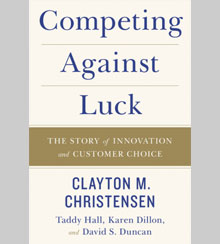
The fact that, in 2015, these companies collectively spent US$680 billion buying R&D lottery tickets bothers Harvard disruption guru Clayton Christensen. “Innovation processes in many companies are structured and disciplined and the talent applying them is highly skilled.… From the outside, it looks like companies have mastered an awfully precise, scientific process,” he and coauthors Taddy Hall, Karen Dillon, and David S. Duncan write in Competing Against Luck: The Story of Innovation and Customer Choice (HarperBusiness, 2016). “But the results show that, for most companies, innovation is still hit or miss.”

Christensen and his coauthors think they have an explanation for this conundrum: Companies know a lot about the characteristics and attributes of their customers, but they don’t know why customers buy their products and services. In other words, companies know the correlations between types of customers and their products and services, but they don’t understand what causes customers to buy their offerings. And without grasping causation, they can’t be sure whether their R&D spending will yield a winning ticket.

Competing Against Luck proposes that companies get to causation by asking customers, “What job did you hire that product to do?” This is a question that surely would have warmed the heart of Theodore Levitt, the Harvard Business School professor who immortalized an otherwise forgotten guy named Leo McGivena for saying “Last year one million quarter-inch drill bits were sold — not because people wanted quarter-inch drill bits but because they wanted quarter-inch holes.” But Christensen et al. take McGivena’s insight far beyond Levitt’s interest in customer needs and desires by cobbling together an approach to innovation that they plainly, if a bit clunkily, call the Theory of Jobs to be Done (aka Jobs Theory). Read the rest here

Monday, August 22, 2016

TechSavvy: Delta’s Digital Black Swan


MIT Sloan Management Review, August 22, 2016

by Theodore Kinni


Black Swan
Condolences if you were flying — or more accurately, not flying — on Delta last week. As the tally of cancelled and delayed flights climbed into the thousands, Nick Taleb came to mind — you know, the Black Swan guy. Taleb wrote that black-swan events have three characteristics: “rarity, extreme impact, and retrospective (but not prospective) predictability.”

I don’t know if the power failure at Delta — and the chain of unexpected events that followed it — qualifies as a black swan by Taleb’s standards, but it must have felt that way to CEO Ed Bastian. The day after the failure, he apologized for the second time and ruefully explained that over the past three years, Delta has invested “hundreds of millions of dollars in technology infrastructure upgrades and systems, including back-up systems, to prevent what happened yesterday from occurring.”

Delta isn’t the only airline whose systems have crashed recently, and with more and more companies integrating their systems, it seems like a good bet that digital black swans may become more and more common. In an article for CIO Dive, associate editor Naomi Eide offers some lessons from Delta for companies hoping to avoid similar events. First, she says, beware centralized control points, because when they go down, everything goes down. Regionally dispersed control centers are more expensive, but more robust. Second, ensure redundancy measures are in place and test them regularly. Third, practice recovery plans and responses to worst-case scenarios.

All of this still may not be enough to save your company from a true black-swan event; Taleb made a pretty strong case that they will be with us always. But it may be enough to avoid the growing numbers of gray ones. Read the rest here.

Thursday, August 18, 2016

Use Social Influences to Be a Better Manager


by Theodore Kinni


Chamelon in leaves
When Jonah Berger was a PhD student at Stanford Graduate School of Business, he biked through Palo Alto, slipping surveys under the windshield wipers of BMWs. He wanted to compare why owners bought their Beamers to why they thought others bought theirs. Berger discovered that BMW owners assumed other owners were strongly influenced by the social cachet associated with the luxury brand, while they themselves believed they were influenced by more rational and practical reasons.

Berger, who is now an associate professor of marketing at the University of Pennsylvania’s Wharton School, dives into this theme in his new book, Invisible Influence: The Hidden Forces That Shape Behavior. “It’s hard to find a decision or behavior that isn’t affected by other people,” he says. “In fact, looking across all domains of our lives, there is only one place we don’t seem to see social influence — ourselves.”

In Invisible Influence, Berger helps us understand how we are affected personally by the sometimes contradictory forces of social influence, and how managers can use these influences to more effectively lead others. Read the rest here

Wednesday, August 17, 2016

John Kotter’s Required Reading

strategy+business, August 17, 2016

by Theodore Kinni

John Kotter has been the go-to guy on the subject of change leadership longer than most of us have been working. For the past 35 years or so, he has been making the compelling argument that the essential role of leaders lies in their ability to achieve change — to shepherd their organizations to new and better places. The fast-paced and fundamental disruptions caused by advances in digital technologies make his work more relevant than ever.
Kotter codified his findings in an eight-step change leadership process in the mid-1990s, while at Harvard Business School. He taught there full time from 1972 (when he earned his doctorate) to 2001, when he retired as the Konosuke Matsushita Professor of Leadership. In 2008, he cofounded Kotter International, a consultancy that helps sitting leaders at large companies apply his ideas. Among many other honors, he is a recipient of the Lifetime Achievement Award from American Society for Training and Development.
A prolific writer, Kotter has authored 19 books. Leading Change (Harvard Business School Press, 1996), which Time selected as one of the 25 most influential business management books ever written, The Heart of Change (with Dan S. Cohen; Harvard Business School Press, 2002), and A Sense of Urgency (Harvard Business Press, 2008) detail and explore his change leadership process. To spread the word still further, Kotter teamed up with Holger Rathgeber and wrote a business parable featuring penguins, Our Iceberg Is Melting (St. Martin’s Press, 2005), which also landed on the New York Times’ bestseller list.
Kotter’s latest book, That’s Not How We Do It Here! (Penguin, 2016), is another parable written with Rathgeber. This time, the main characters are African meerkats, whose struggle to cope with a drought illuminates the obstacles organizations face in disruptive conditions.
I asked Kotter about the books that had most influenced him in his work. He offered up the following titles, calling them “the big three that helped lead me where I am today.” Read the rest here.

Friday, August 12, 2016

TechSavvy: Four Lessons from IoT Early Adopters


MIT Sloan Management Review, August 12, 2017
by Theodore Kinni
To paraphrase the late Roy Scheider in one of the greatest of all summer movies, you’re gonna need a bigger router. In 2025, Machina Research predicts, the Internet of Things is going to be a $3 trillion market of 27 billion devices generating more than 2 zettabytes of data. Two zettabytes of data is something like twice the total global IP traffic we’ll generate this year, according to Cisco.
The IoT data deluge is, by the way, the first of four lessons drawn from early IoT adopters by contributing writer Howard Baldwin for his article in Computerworld. IoT initiatives at ARI Fleet Management, for instance, generate the same amount of data every two weeks as the company previously collected in two decades. “Understand where data is coming from, and determine how you’re going to analyze it,” writes Baldwin.
The second lesson is that IoT will require cross-functional collaboration. Because IoT is deployed and used in factories and fleets and products, the IT department is going to need to partner with other functions and business units. “Determine how and when to combine operations and information technologies for maximum data insight,” writes Baldwin.
Baldwin’s third lesson for early adopters is that IoT is likely to require working with and coordinating across multiple vendors. The new Kansas City streetcar line, for instance, required collaboration with Sprint, Cisco and other vendors. “In orchestrating the many moving pieces of an IoT rollout, make sure you know who plays what part,” writes Baldwin.
Fourth and finally, as applies to forays into any young, fast-emerging technology, watch out that you don’t get caught out too far on the IoT growth curve. “Some early IoT adopters have reported reliability issues with either sensors or vendors or both, and others have struggled to reconcile competing protocols,” writes Baldwin. “Be prepared for setbacks in an immature market, and try to select a protocol that has long-term industry support and a sound security footprint.” Read the rest here

Thursday, August 4, 2016

Techsavvy: A Call to Arms Against the Hacker Hordes

MIT Sloan Management Review, August 4, 2016

by Theodore Kinni

Tech Savvy Hacker Hordes
Imagine being enthroned at the end of the long table in the C-suite. You’ve got riches beyond imagination at your disposal; tens of thousands of vassals are toiling day and night for you. Your knights surround you, awaiting your command. And, at this very moment, some evil-minded jester with a computer and an Internet connection is breaching the castle walls.

But wait, is that a war horn you hear in the distance? Yes, it’s the lawyers from Steptoe & Johnson riding to your rescue. Enough, says partner Stewart Baker and trusty clerk Victoria Muth in an article for Brink. “It’s pretty clear that building higher walls around our networks is a dead end. So is tighter scrutiny and control over what happens on the network,” they write. “Government is failing us…, too.” The solution? Fight back.

Attribution and retribution are the weapons in this counterattack. “It might mean building ‘beacons’ into documents so that when they are opened by attackers, they phone home to alert defenders that their information was compromised,” suggest Baker and Muth. “It might mean using information provided by beacons to compromise the attackers’ network and gather evidence as to the attackers’ identities. It might mean stopping a DDOS attack by taking over the botnet, or by patching the vulnerability by which the botnet conscripted third-party machines.”

And, of course, you’ll need more lawyers. “We need to bring private resources to bear on retribution as well as attribution — not by endorsing network attacks, but by encouraging retribution within the law,” the authors continue. “Luckily, once an attack has been attributed, legal remedies begin to look quite realistic.”

“In short, you don’t have to sit and take it anymore,” conclude Baker and Muth. “There are plenty of risks in trying to go beyond passive network defenses, but there may be more risk in doubling down on an approach to network defense that has been failing ever more spectacularly for 30 years.”

Oh yeah, we’re going all “Game of Thrones” on hackers. Read the rest here.

Wednesday, August 3, 2016

How to Become an Ambidextrous Leader

strategy+business, August 3, 2016


by Theodore Kinni

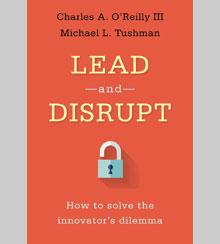
A few pages into Lead and Disrupt: How to Solve the Innovator’s Dilemma (Stanford University Press, 2016), business professors Charles A. O’Reilly III and Michael L. Tushman present two lists of companies. At first glance, there doesn’t seem to be too much difference between them. Each features 27 companies, most with familiar names and long histories, such as GM, Siemens, and Lego.

The second list includes some dead companies — such as Circuit City and Bethlehem Steel — and some companies that are shadows of their former selves, such as RadioShack. But the histories of the companies on the first list reveal that many of them have experienced their fair share of hard times, too. For example, the French media conglomerate Vivendi endured a period of turmoil after a series of aggressive acquisitions in the late 1990s.

Nevertheless, O’Reilly, the Frank E. Buck Professor of Management at Stanford’s Graduate School of Business, and Tushman, the Paul R. Lawrence MBA Class of 1942 Professor of Business Administration at Harvard Business School, see a clear difference in the success of the companies on the two lists. And they peg leadership as its source.

The companies on the first list, they contend, “had ambidextrous leaders who were able and willing to exploit existing assets and capabilities in mature businesses and, when needed, reconfigure these to develop new strengths.” The companies on the second list were not so lucky. Their leaders, say the authors, “were rigid in one way or another — unable or unwilling to sense new opportunities and to reconfigure the firm’s assets in ways that permitted the company to continue to survive and prosper.” Read the rest here.

Thursday, July 28, 2016

TechSavvy: Not All Digital Threats Are Disruptions

MIT Sloan Management Review, July 28, 2016

by Theodore Kinni


Digital Threats Disruptions
Thanks to Clayton Christensen, we throw the word “disruption” around pretty freely these days. But Strategy& consultant Alexander Kandybin reminds us that many of the competitive challenges that we call disruptions don’t actually fit Christensen’s definition of the term: “An innovation that is disruptive allows a whole new population of consumers at the bottom of a market access to a product or service that was historically only accessible to consumers with a lot of money or a lot of skill.”

In an article in strategy+business, Kandybin warns executives that misidentifying major competitive challenges — like new products, technologies, and business models — as disruptions can lead to flawed strategic responses. Instead, he counsels them to learn to recognize different kinds of market dislocations (“radical breakaways from the existing market that occur when a company introduces a business model or a product that sits apart from those of competitors”), the directions from which they can come, and the best responses for each.

Kandybin’s approach offers more nuanced strategic responses to digital competitive threats. “Two of them, matching the threat and absorbing the threat, can be effective when incumbents are facing new entrants coming from any direction (from the top, side, or bottom),” writes the consultant. “A third, leapfrogging the threat, is most effective in dealing with dislocation from the top and from the side. And finally, the strategy of ignoring the innovation is most commonly associated with disruption from the bottom.

“Each strategy has risks, especially when it is used at the wrong moment or against the wrong threat,” Kandybin adds. “But when you understand where the threat is coming from and how it is changing your market, you can choose a strategic response that is likely to sustain your business.” Read the rest here

Monday, July 25, 2016

Catalyst or threat? The strategic implications of PSD2 for Europe’s banks

Learned a lot lending an editorial hand here: 

PwC Strategy&, July 25, 2016

Catalyst or threat?

The adoption of the revised Directive on Payment Services (PSD2) has set the stage for open banking in Europe. By providing standardized access to customer data and banking infrastructure, PSD2 will lower the barriers for entry to third-party providers and financial technology companies (FinTechs), and it will stimulate the development of new business models and a wide range of new banking services. In this way, PSD2 will be a catalyst for both disruption and strategic renewal in Europe’s banking markets.

Europe’s consumers have started to embrace the kinds of services and companies that PSD2 will foster. A PwC Strategy& study on PSD2, conducted in the first quarter of 2016, suggests that 88 percent of consumers use third-party providers for online payments, which indicates that there is a large, primed base of customers for other digital banking services.

Nevertheless, the overall response of Europe’s bankers to PSD2 is one of uncertainty: Although 68 percent of bankers fear that PSD2 will cause them to lose control of the client interface, many of them remain unsure how to respond to the new directive. As a result, they are adopting a defensive, wait-and-see stance that is risk averse.

In contrast, there are a few banks — and more third-party providers and FinTechs — that are embracing the possibilities of open banking and pursuing strategies aimed at winning a leading role in the future. They are not waiting until the implementation of PSD2.

In this report, we bring together the attitudes and behaviors of banking customers, the mind-set and concerns of bankers, and the responses of first-mover banks and FinTechs to analyze the implications and ramifications of PSD2 for Europe’s banks. And we offer five strategic options that banks can consider to expand their offerings, better serve their customers, and grow their market share and revenues.

With the adoption of PSD2, an irrevocable shift to open banking in Europe has become inevitable. Europe’s banks cannot afford to wait for the official PSD2 implementation date in 2018 to formulate a strategic response. Download the full paper here

Thursday, July 21, 2016

TechSavvy: The $105 Billion Enterprise Market for Pokémon Go


Playing Pokemon Go Augmented Reality Virtual Reality

MIT Sloan Management Review, July 21, 2017

by Theodore Kinni
Suddenly, Pokémon Go, the app based on the 20-year-old video game, is everywhere. People with smartphones are more like zombies than ever. Marketers are formulating their Pokémon Go strategies. Thanks, augmented reality!

The consumer market is not the only place AR is taking off, according to Bhavesh Kumar of VMWare AirWatch. “There’s increasingly reason to believe that AR could take off for businesses long before it goes mainstream with consumers,” he declared in a blog post that appeared one day before Pokémon Go, well, went mainstream with consumers.

But that doesn’t mean Kumar is wrong. He’s right in saying that the AR device ecosystem is more developed for the enterprise market than for the consumer market, and that the industry standards needed to put AR to work are already emerging.

Moreover, Kumar is backed up by a new study from Index AR Solutions, a developer of customized AR business solutions for the corporate market that is collaborating with Newport News Shipbuilding. Index AR forecasts that the enterprise market for AR will hit $105 billion within 15 years, including $49 billion in hardware, $11 billion in software, and $45 billion in services. Assuming, of course, that we can tear ourselves away from Pokémon Go. Read the rest here.

Wednesday, July 20, 2016

Steve Blank’s Required Reading

strategy+business, July 20, 2016
by Theodore Kinni 
From black ops to lean startups, it seems there has never been a dull period in Steve Blank’s career — except, perhaps, the one semester Blank spent at the University of Michigan before dropping out and enlisting in the U.S. Air Force, where he did a stint repairing avionics in Thailand during the Vietnam War.

Blank landed in Silicon Valley in 1978, where he did classified intelligence work for ESL, a government contractor in national reconnaissance. He quickly internalized the entrepreneurial ethic of the valley. By the time he retired two decades later, he had been involved with eight startups, including software company E.piphany, which he cofounded in his living room.

Like an increasing number of baby boomers, Blank didn’t actually retire. He invested in and advised new startups. He wrote a book about building early-stage companies, The Four Steps to the Epiphany: Successful Strategies for Products That Win (K&S Ranch Press, 2003), which is now in its fifth edition. It details Blank’s “customer development process,” a parallel process to product development aimed at ensuring that startups discover viable markets, locate their first customers, validate their product assumptions in their targeted markets, and adapt their products when necessary. And he began teaching classes in entrepreneurship at the University of California at Berkeley and Stanford University.
These strings all came together when Blank invested in a company cofounded by Eric Ries, who read his book and took his class. Ries incorporated and popularized Blank’s thinking as a cornerstone in the lean startup movement. Blank, to his own surprise, became something of a guru. He wrote a second book, with Bob Dorf, The Startup Owner’s Manual: The Step-by-Step Guide for Building a Great Company (K&S Ranch Press, 2012), and a third, a collection of his articles titled Holding a Cat by the Tail: Lessons from an Entrepreneurial Life (K&S Ranch Press, 2014). Read the rest here

Thursday, July 14, 2016

TechSavvy: Better Management Through A/B Testing

MIT Sloan Management Review, July 14, 2016


by Theodore Kinni

Marketers and product developers love A/B testing. Want to figure out the most compelling offer for an online ad or the best design for new app? Test two of alternatives head to head and see which one people like better. Voilà!

Split Testing AB Testing ManagementA/B testing works so well that Instacart's vice president of product, Elliot Shmukler thinks managers should adopt it to improve their decision-making prowess, too. “There are many effective decision-making frameworks out there, but I wanted to use one that would simultaneously surface the best choice for the product while still encouraging the inherently different approaches to ideation among my product managers,” he explains.

When Shmukler’s product teams can’t resolve conflicting ideas and come to him for a final decision, he refuses to issue an edict. “Instead of giving a verdict, [I] test both theories and let data be the judge,” he says. “At first pass, this method may seem to favor the data-driven people, but it empowers each PM to push ideas forward. They learn independently rather than feeling that a decision was made for them.”

A/B testing also allows Shmukler to approve multiple product ideas, with the proviso that they be tested. “It increases experimentation, autonomy and learning throughout the organization,” he says. “Most critically, it fosters goodwill among smart — but very different — PMs who want to try out their ideas.”

For more on the benefits — and the challenges — of using A/B testing for management decisions, read Shmuckler’s interview in First Round Review. Read the rest here

Thursday, July 7, 2016

TechSavvy: Does Social Media Enhance Employee Productivity?


MIT Sloan Management Review, July 7, 2016

by Theodore Kinni


Do you know what your employees are doing online? Come next May, Singaporean prime
 minister Lee Hsien Loong won’t have any trouble answering that question. That’s when 100,000 computers used by the city-state’s civil servants will be disconnected from the Internet. The government is taking this drastic action to “tighten security,” writes tech editor Irene Tham in The Straits Times.

Social Media Productivity

Being of a cynical bent, I think that eliminating employee access to Facebook and Twitter and other social media platforms might give Singapore’s government a nice bump in productivity, too. But I might be wrong, according to a report from the Pew Research Center that delves into the use of social media in the workplace.

“Today’s workers incorporate social media into a wide range of activities while on the job,” explain Pew Center researcher Kenneth Olmstead and University of Michigan School of Information professors Cliff Lampe and Nicole Ellison. “Some of these activities are explicitly professional or job-related, while others are more personal in nature.”

Sure, their survey says — ding! — that the number one reason why American workers use social media at work (34% of respondents) is “to take a mental break from their job.” Moreover, reason number two (27% of respondents) is to “connect with friends and family while at work.” But then comes a list that might make your inner CEO perk up a bit: 24% of the respondents use social media at work to foster professional connections; 20% to help them solve work problems; 17% to foster relationships with co-workers and/or learn more about them; and 12% to ask work-related questions of people outside their organization and/or inside their organization.

So, maybe your company shouldn’t follow Singapore’s lead. Anyway, aren’t all those civil servants simply gonna go all Hillary Clinton with their personal devices? Read the rest here

Wednesday, July 6, 2016

Fit for Service government: The opportunity in the GCC’s fiscal challenge

Learned a lot lending an editorial hand on this white paper

PWC Strategy&, July 5, 2016


Fit for Service government

The Gulf Cooperation Council (GCC) countries are in a fiscal crunch. Even if the GCC member states can grow non-oil revenues by 10 percent annually over the rest of this decade and the average price per barrel of oil returns to US$50, their budgets will still need to be reduced by approximately $100 billion (7 percent of GCC GDP) on an annual basis to achieve fiscal balance.

All GCC governments have announced spending cuts, but conventional strategies, such as across-the-board or narrowly focused cuts, could do irreparable harm to their economic and social development. Instead, they need a more effective approach — one that enables them to cut costs and grow stronger simultaneously. This approach, which Strategy& developed for the private sector and customized for government, is called Fit for Service.

Fit for Service achieves substantial and sustainable reductions in spending, while bolstering investment in the government services and initiatives that are essential to the long-term security and well-being of governments’ constituents. It involves four actions: articulating strategy; transforming the existing cost structure of government services; building the necessary capabilities; and reorganizing the government’s operating model for high performance. There are two enablers of these actions. The first is digital, which drives the digital transformation of government. The second is the development of the talent needed within government and the national economy at large along with the creation of a change-friendly culture that can support and nurture stakeholders as they undertake transformational initiatives.

Fit for Service initiatives are difficult but worth the effort because the leaders of the GCC member states cannot simply cut costs by conventional means if they are to transform the cost base of their governments and create a more sustainable fiscal future. Download the full paper here.

ElBulli and the Limits of Corporate Innovation

strategy+business, July 6, 2016
by Theodore Kinni
In 2010, elBulli was named the second-best restaurant in the world. In 2011, superstar chef and co-owner Ferran Adrià shuttered the small restaurant in a small town on Spain’s Mediterranean coast, marking the end of a remarkable, three-decade run of culinary success. By that time, Adrià and his staff were receiving 2 million requests for reservations annually — from people who were willing to travel to the northeastern corner of Spain to eat the 8,000 meals conjured up during the six months the restaurant was open each year. Moreover, 3,000 or so of the world’s most talented culinary pros were applying for elBulli’s 30 unpaid internships.
What accounted for this unprecedented level of demand from foodies and the people who feed them? In Appetite for Innovation: Creativity and Change at elBulli (Columbia University Press, 2016), M. Pilar Opazo, a post-doctoral research scholar at Columbia Business School, says that it was the “search for radical innovation and endless reinvention.”
Adrià, of course, plays a leading role in the book. A culinary autodidact who started as a dishwasher, he began working at elBulli, a one-star Michelin restaurant serving French nouvelle cuisine, as a temporary intern in 1983. By 1990, when elBulli, then serving a locally inspired Mediterranean menu, earned its second Michelin star, he was its co-owner.
“We could have kept doing the Mediterranean style forever.… But we didn’t. I don’t really know why,” Adrià tells Opazo. Then, after a pause, “Well…we got bored. That’s why.” Read the rest here