My weekly book post on s+b:
The End of Work, Revisited
Jeremy Rifkin’s controversial prognostications on topics such as beef, biotechnology, and business have been sparking debate for at least 40 years. Who knows how far back they go? I picture a family dinner at the Rifkin home circa 1955: Jeremy’s dad, Milton (a manufacturer of plastic bags) is sitting at the head of table, his forkful of pot roast frozen midair, as his 10-year-old son tells him that the family business is going to destroy capitalism.

Rifkin the Younger’s new book, The Zero Marginal Cost Society: The Internet of Things, the Collaborative Commons, and the Eclipse of Capitalism (Palgrave MacMillan, 2014), weaves together many of the threads he has pulled over the years. It is the futurist’s most comprehensive inquiry into business and work yet, and it is built on a thesis that we’ve heard before: Capitalism is tottering and will not last out this century, a victim of “the dramatic success of the very operating assumptions that govern it.” Rifkin says that capitalism’s downfall is inevitable because of its ceaseless quest for productivity and the ever-growing sophistication and power of digital technology. The collision of these two forces is driving down the marginal cost of producing additional units of anything and everything to near zero, a process that will squeeze profits until they scream. (You can hear the argument in more detail here.)
This driving down of marginal cost includes the cost of human labor. Reprising the theme of his book, The End of Work: The Decline of the Global Labor Force and the Dawn of the Post-Market Era (Tarcher/Putnam, 1995), Rifkin explains that digitization is replacing jobs. This creates a situation that economists once assumed could not happen: Productivity will rise, but employment will fall.
Twenty years ago, Rifkin’s argument was tinged with foreboding: How, after all, would people survive without jobs? But in The Zero Marginal Cost Society, he is far more optimistic. When I asked him why, he said, “There are a few reasons that I am more optimistic today than I was in 1995. First, the nonprofit sector—the social commons—has been growing even faster than I had envisioned. Between 2000 and 2010, after adjusting for inflation, nonprofit revenues in the U.S. grew by a striking 41 percent, more than double the growth in GDP, which increased by only 16.4 percent.
“The nonprofit community is also the fastest-growing employment sector, outstripping both the government and private sectors in many countries. There are currently 56 million workers employed in the nonprofit sector in 42 countries, and in many of the most advanced industrial countries—including the United States, the United Kingdom, and Canada—employment in this sector now exceeds 10 percent of the workforce, and its trajectory has been rising year over year since 1995. During the Great Recession (2007–09), the nonprofit sector gained jobs at an average rate of 1.9 percent annually, while the private sector lost jobs at a rate of 3.7 percent.
“Second, the creation of social enterprises, some 35 percent of them nonprofits, has mushroomed in recent years thanks to a new generation of entrepreneurs. There are several hundred thousand social enterprises in the United States that employ over 10 million people and that have revenues of US$500 billion per year. These enterprises represented approximately 3.5 percent of the nation’s GDP in 2012.
“Third, what makes the social commons more relevant today than at any other time in its long history is that we are now erecting a high-tech global technology platform—the Internet of Things (IoT)—whose defining characteristics could support and nurture it. The IoT facilitates collaboration and the search for synergies, making it an ideal technological framework for advancing the social economy. Its operating logic optimizes lateral peer production, universal access, and inclusion, and its purpose is to encourage a sharing culture. The IoT will bring the social commons out of the shadows, giving it a high-tech platform to become the dominant economic paradigm of the 21st century.”
Wednesday, May 28, 2014
Jeremy Rifkin on tomorrow's jobs

Wednesday, May 21, 2014
Gregory Clark on how we get ahead

The storyline of capitalism—and the technological innovation that simultaneously supports and drives it forward—is almost always one of ever-greater personal freedom and opportunity. Slaves and serfs, whose families had been chained to the plows of noble-born landowners generation after generation, are transformed into wage earners who sell their services in demand-driven labor markets. Wage owners pull themselves up by their bootstraps and educate their children, who then enter the professional ranks. With the liberal application of hard work, inventiveness, or entrepreneurial chutzpah, anyone can rise through the ranks of society. The sky is the limit. Or is it?
This is the question that Gregory Clark, economics professor at the University of California, Davis, seeks to answer in his new book, The Son Also Rises: Surnames and the History of Social Mobility (Princeton University Press, 2014). Clark has a predilection for investigating interesting questions, as well as for literary puns. His last book, A Farewell to Alms: A Brief Economic History of the World (Princeton University Press, 2007), sought to explain why the Industrial Revolution sparked and caught fire in England, and not in other parts of the world. His Darwinian answer was that England was peopled by descendants of the upper classes, who over hundreds of years had survived at higher rates than people in the lower classes. As a result, English upper class values, such as hard work, rationality, and education, which were conducive to an industrialized society, also survived.
Clark figured this out by collecting and analyzing data on the English economy from 1200 to 1870. In The Son Also Rises, he uses a similarly data-driven approach. This time, he uses uncommon surnames, such as Pepys, “to track the rich and poor through many generations in various societies—England, the United States, Sweden, India, Japan, Korea, China, Taiwan, and Chile.” Specifically, he matches up the wealth of parents and that of their offspring. The more correlation, the less social mobility.
Just as Thomas Piketty’s Capital in the 21st Century (Belknap Press, 2014), calls into question the role of capitalism in wealth creation, Clark calls into question the role of capitalism in social mobility. But both conservatives and liberals will find justification for their views in the facts uncovered in The Son Also Rises. Clark, who rightfully opens his preface with the words, “This book will be controversial,” found to his surprise that intergenerational social mobility cannot be taken for granted. Industrialization did not move wealth to the wider population, at least not as freely as the prevailing free enterprise storyline would suggest. (Clark basically says that “a hundred years of research by psychologists, sociologists, and economists” into social mobility has all been incorrect.)
Instead, Clark’s research reveals that the global level of social mobility is basically unchanged over the past 800 years. In England, for instance, he finds that the level of social mobility was the same after the Industrial Revolution as it was before it. “The rich beget the rich, the poor beget the poor,” Clark concludes. “Social status is inherited as strongly as any biological trait, such as height.”
But Clark does not say that mobility doesn’t exist, or that social positions never change. Indeed, his research reveals that upward and downward mobility are both continuously at play in human society. One critical factor is the intermarriage between rich and poor, which over time creates a constant regression to the mean. “In the end, the descendants of today’s rich and poor will achieve complete equality in their expected social position,” explains Clark. “This equality may require three hundred years to come about,” but it will inevitably come, unless a family takes dramatic steps (for example, through its choice of marriage partners) to maintain its position in society.
For me, the salient point is that social mobility is being driven by “innate inherited abilities,” not by the ascendancy of capitalism or democracy or any other economic or political ideology. People born rich may go on to be successful, but wealth is not the most important thing they inherit. Far more important are nature and nurture: the genetic abilities they get from their parents (which they will only pass on if they marry people as capable as themselves), and the confidence, education, and connections their families provide.
This is a difficult message for the unlucky people born to less capable parents; they have high barriers to social mobility, as they have throughout history. Capitalism may make it easier for some individuals to realize their potential, but it does not create that potential in the first place. That’s an insight worth remembering when you hear claims to the contrary.
Tuesday, May 20, 2014

Christine Bader on Corporate Idealists
My Q&A with Christine Bader is up on s+b's website:
 Christine Bader’s Tales of a Corporate Idealist
The former BP policy development manager and U.N. business and human rights advisor on the nuances of promoting social responsibility and sustainability within companies.
Big Oil seems like an odd place for a social responsibility and environmental sustainability advocate to pursue her career, but after Christine Bader heard then CEO of BP John Browne speak at Yale, that was exactly where she went. Browne’s strong message about the social responsibility of corporations—a highly unusual statement from the leader of a major energy company in 1998—intrigued the first-year MBA student. It prompted Bader to intern with BP’s chief policy advisor and then to join the company full time in 2000. Over the next eight years, she was assigned to the development of a natural gas field and plant in West Papua, the planning of a massive ethylene production complex outside Shanghai, and finally BP’s London headquarters—“an MBA working on social issues in a company of engineers,” as she puts it.
In 2006, BP enabled Bader to work part-time, on a pro bono basis, with Harvard professor John Ruggie, who had been appointed by Kofi Annan as the United Nations secretary-general’s special representative on business and human rights. Two years later, not long after Browne resigned and Tony Hayward took over as BP’s CEO, Bader left the company and joined Ruggie full time, helping create the U.N.’s Guiding Principles on Business and Human Rights.
In 2011, after the adoption of the Guiding Principles, “Team Ruggie” split up and Bader began writing The Evolution of a Corporate Idealist: When Girl Meets Oil (Bibliomotion, 2014). The book is a thoughtful memoir of her experiences and a nuanced guidebook with many lessons for aspiring corporate idealists. Bader, who is currently a part-time human rights advisor to BSR (Business for Social Responsibility) and a visiting scholar at Columbia University, recently talked with strategy+business about how dedicated people can guide their companies to protect human rights and the environment...read the rest here
Wednesday, May 14, 2014
Selling after the unsuccessful close
Here's my weekly blog post on strategy+business:
What Part of No Don’t You Understand?
I have no idea who first snapped off the classic putdown, “What part of no don’t you understand?”
It’s not Shakespeare, but the sentiment is timeless. And I’ll bet that first barb was aimed at a salesman, probably a graduate of Glengarry Glen Ross University.
Until now, I’ve always thought that the correct response to this rhetorical question was to retreat. However, I may be wrong about that.

In their new book, When Buyers Say No: Essential Strategies for Keeping a Sales Moving Forward (Business Plus, 2014), sales consultants Tom Hopkins and Ben Katt parse “no” and find that it has a number of possible meanings. It might indicate that the buyer has unanswered questions and concerns about the salesperson’s offering, or might not be sure how it compares to the alternatives in the marketplace. Or the buyer might not be clear about the benefits of the offering. Or perhaps, the salesperson hasn’t properly qualified the buyer. Or the buyer doesn’t like the timing or features. Or maybe, the buyer just doesn’t like salesperson—a big factor in any sales arena that requires an ongoing relationship.
The upshot of all this, according to the authors, is that if you’re a sales professional, you better figure out exactly what the prospective buyer means by “no” before you head for the door. To paraphrase the great Yogi Berra, the sale ain’t over till it’s over.
The challenge is how you manage a “no.” If you treat it like an objection, and try to overcome it, chances are good you’ll get handed your hat. As the authors explain it, being asked to make a decision at the end of the close creates discomfort in the buyer. And too often, salespeople compound that discomfort by becoming unlikeable in response to a negative answer. “How do salespeople become unlikeable after the close?” they write. “They become tense. Their facial expressions reflect unhappy feelings of disappointment or impatience. Even worse, they become subtly belittling, implying with their nonverbal communication that anyone with commonsense would have said yes by now.”
This jives with something I just read in another new book, titled Conversational Intelligence: How Great Leaders Build Trust (Bibliomotion, 2014), by Judith E. Glaser. “Most people assume meaning is embedded in the words they speak,” Glaser writes. “But according to forensic linguists, meaning is far more vaporous, teased into existence through vocalized puffs of air, hand gestures, body tilts, dancing eyebrows, and nuanced nostril flares.”
When Glaser observed pharmaceutical reps making sales calls, she found that if doctors raised concerns about the products being sold, the salespeople usually communicated their displeasure with nonverbal cues, such as stiffened bodies, pained facial expressions, and tense tones of voice. The doctors, in turn, responded by stiffening up themselves and trying to end the sales calls. By now, it shouldn’t come as a surprise that the company where these reps worked was ranked 39th among 40 pharmaceutical firms in terms of sales effectiveness.
Interestingly, the authors of both books also offer similar solutions to negative buyer responses. Hopkins and Katt say that you should run through the “The Circle of Persuasion” again. That’s their generic four-step sales process: establishing rapport, identifying needs, presenting solutions, and closing questions. So, the first step after hearing “no” is to reestablish rapport by letting the buyer “know that it is okay that he didn’t immediately say yes.” In Glaser’s case, she taught the pharmaceutical salespeople to reframe buyer resistance as “simple requests for more information,” which shifted their focus “to relationship before task” and significantly bolstered sales.
The bottom line: When it comes to sales, whether a buyer’s no really means no depends first and foremost on how you respond to the word.
Wednesday, May 7, 2014
Hoist a mug to craft brewers
My latest book post is up at strategy+business:
 A Toast to Industry Disruption
I believe that brewing beer is one of the great humanitarian professions. If you agree, you already know that it’s a terrific time to be a beer drinker. Even the most committed among us are hard-pressed to keep up with the burgeoning numbers of high-quality beers being produced by small, independent breweries from near and far.
Steve Hindy traces the heady explosion of craft brewers in the U.S. over the past 40 years in his new book, The Craft Beer Revolution: How a Band of Microbrewers Is Transforming the World’s Favorite Drink (Palgrave Macmillan, 2014). Hindy is an expert guide: He was a Middle East correspondent in Beirut for the Associated Press when he became interested in home brewing. In 1988, when he was back in New York, he and Tom Potter founded The Brooklyn Brewery, which is now ranked among the top 20 breweries in the U.S. in sales volume—and that’s including the big brewers, like Anheuser-Busch Inc. and MillerCoors.
The stories of the craft brewers—such as Fritz Maytag of Anchor Steam and Jim Koch of Sam Adams—featured in the book are engrossing, but what I find most interesting about this story is the evolution of the beer industry, and the lessons it might hold for the big players in other industries. Historically, beer was a local product. According to the Brewers Association, there were 3,200 U.S. breweries in the 1870s. Then, over the next 100 years, technological advances and the drive for economies of scale changed all that; by 1978, there were only 89 breweries owned by 42 companies in the United States. Local beers were few and far between, and supermarket beer coolers were boring as well as cold. Now fast-forward to 2013—more than 2,800 breweries were operating in the U.S., 98 percent of which were owned by local brewers.
The big brewers and their now-global brands are still dominant in the U.S. marketplace, and they are fighting over fractions of a point in added market share with US$3 million Super Bowl ads in a market that is slowly shrinking. Meanwhile these pesky craft brewers have grabbed a 10 percent share of market. Their share is growing, and more and more of them are entering the fray every day.
It’s reminiscent of the process described in Clayton Christensen’s book, The Innovator’s Dilemma: When New Technologies Cause Great Firms to Fail (Harvard Business School Press, 1997). In this case, however, technology didn’t play the primary role in the disruption of the beer industry. In the 1970s, at the peak of Big Brewing, the U.S. government reduced the excise tax for small volume brewers and legalized home brewing for the first time since Prohibition.
“At the time,” writes Hindy, “I don’t think any of the players involved imagined that these measures would pave the way for the craft beer revolution. But they did.” The reduction in tax gave a respite to small brewers, who couldn’t compete against the scale and marketing might of the big players. Home brewing eventually brought new brewers into the market as entrepreneurially minded home brewers started new businesses. The stage was set for a “back to the future” scenario, in which the number of breweries in the U.S is approaching levels that haven’t been seen in about 140 years.
The best part is that this process of industry disruption has created a sort of golden era for beer drinkers. Although at the risk of incurring Brooklyn’s wrath, I admit that I haven’t yet acquired a yen for Hindy’s beers. Maybe that’s because I’ve only tried a couple of them, bought in bottles hundreds of miles from the brewery. But I’m a big fan of the packaging, designed by Milton Glaser—and I’ll keep tasting.
Tuesday, April 8, 2014
Why? What if? How?
My weekly post on s+b's blog is about a new book on the questions that drive innovation by Warren Berger:
Innovation Begins with Three Questions

Land’s story, according to Warren Berger, author of the new book A More Beautiful Question: The Power of Inquiry to Spark Breakthrough Ideas (Bloomsbury, 2014), does not necessarily illustrate the role of questions in spurring creativity as much as it shows that it’s important to ask the right questions. “The old, closed questions (How many? How much? How fast?) still matter on a practical level,” says Berger, “but increasingly businesses must tackle more sophisticated open questions (Why? What if? How?) to thrive in an environment that demands a clearer sense of purpose, a vision of the future, and appetite for change.”
The “old, closed” questions support the status quo. In other words, asking how you can make better, faster, and cheaper widgets assumes that you should be making widgets. This can become a recipe for disaster, as those leaders who came after Land discovered: Polaroid declared bankruptcy in 2001, a casualty of photography’s digital transformation.
Conversely, the three “open” questions—why, what if, and how—represent what Berger calls a “basic and logical progression” that he finds present in many stories of innovative breakthroughs.
“Why” questions—like the one Land’s daughter asked—are the catalyst in this progression. They’re the potential game changers that Berger thinks are not asked nearly enough. Try this: The next time you’re in a staff meeting discussing, for instance, how to raise the margins of a business unit, ask why you’re in that business at all. You’ll probably get a lot of rolling eyes and exasperated sighs, but no answer to your question. “Why” questions are potential game changers that are not asked nearly enough.
“What if” questions signal the beginning of the search for solutions. They prompt unconstrained, blue-sky thinking. For example, Berger imagines Land asking, “What if you could somehow have a dark room inside a camera?”
“How” questions get down to brass tacks. For instance, how exactly do you go about putting a darkroom in a camera? Land said that he went for a walk to ponder his daughter’s question and within an hour he had figured out the “what if” of instant photography. The “how” questions took a bit longer. “Strangely, by the end of that walk, the solution to the problem had been pretty well formulated,” Land later explained in speech cited in Victor K. McElheny’s Insisting On the Impossible: The Life of Edwin Land (Perseus Books, 1988). “I would say that everything had been, except those few details that took from 1943 to 1973.”
A More Beautiful Question does a fine job of exploring how these three questions can be used to create a “culture of inquiry” and drive the organizational innovation process. And as you might expect from such an accomplished writer, the book is an engaging read and well supported by the research and experiences of a veritable who’s who of academic and corporate experts. But as essential as asking the right questions is to the innovation process, it is certainly not all there is to successful innovation. Questions need to lead to answers, and answers to action.
Sunday, March 30, 2014
Killer quotes #6

"There are many pleasant fictions of the law in constant operation, but there is not one so pleasant or practically humorous as that which supposes every man to be of equal value in its impartial eye, and the benefits of all laws to be equally attainable by all men, without the smallest reference to the furniture of their pockets."
—Charles Dickens, Nicholas Nickleby
Wednesday, March 26, 2014
The d'oh of healthcare reform
In which I publicly complain about healthcare reform on s+b's blog for the first and last time:
The Long Road to U.S. Healthcare Reform
The HealthCare.gov team keeps sending me emails. The March 31 application deadline for coverage in 2014 is fast approaching and they’re concerned: “Millions of Americans are already benefiting from the quality, affordable health coverage available to them through the Marketplace. We want to make sure you join them.”
I appreciate that. Really. I can’t remember a time in the past 20 years when our health insurer has expressed any interest in whether my wife and I had quality, affordable coverage. Instead, it sent us annual rate increases—usually 15 to 20 percent—accompanied by a generally incomprehensible policy. Every three to four years, as the cost of our policy made the draconian risks of self-insuring start to look good, my wife renegotiated it—that is, she reduced our coverage until it reached a level that we could afford.
Of course, I was gung ho about healthcare reform. For years, I happily anticipated the competitively priced insurance that would be available on the government-run exchanges. In good humor, I waited out the silly death-panel debates and the heroic debugging of HealthCare.gov. And then, finally, I gleefully registered and followed the simple instructions to get my quote. The payoff? Higher deductibles and less comprehensive coverage at a cost approximately US$100 per month more than our existing policy. D’oh!
 This is a long-winded explanation for why I wasn’t particularly thrilled to receive an advance copy of the long-titled Reinventing American Health Care: How the Affordable Care Act Will Improve Our Terribly Complex, Blatantly Unjust, Outrageously Expensive, Grossly Inefficient, Error Prone System (Public Affairs, 2014), by Ezekiel J. Emmanuel. The author was a beacon of sanity throughout the battle over reform. He is the chair of the Department of Medical Ethics and Health Policy at the University of Pennsylvania and served as a special advisor for health policy to the director of the White House Office of Management and Budget for a couple years.
- The Affordable Care Act (ACA) will force a radical restructuring of the insurance industry as providers and payors integrate, and markets become more competitive.
- The chronically and mentally ill will get better care.
- The demand for highly expensive acute care will fall.
- Employer-sponsored health insurance will disappear.
- Healthcare cost inflation will subside.
- Changes in medical education will eliminate the shortage of health professionals.
Thursday, March 20, 2014
Kotter and McGrath on management structures for change
In my weekly book post for s+b's blog, both John Kotter and Rita Gunther McGrath argue that change will inevitably overwhelm hierarchical management systems, but their solutions differ:
Alternative Systems for Corporate Survival
Change, according to Harvard Business School professor emeritus and change management expert John Kotter, is coming faster than ever. And that’s a big problem because change is the great destroyer of corporations.
 In Accelerate: Building Strategic Agility for a Faster-Moving World (Harvard Business Review Press, 2014), Kotter argues that companies cannot adapt to change mainly because of their hierarchical management systems. These systems are designed to coordinate large groups of people in the consistent and efficient delivery of products and services—and they do it well. They are, Kotter says, “absolutely necessary to make organizations work.”
Here’s the conundrum: You can’t jettison the hierarchical system that runs your business, but if you don’t, it could kill your company. The very strengths of the hierarchical system become fatal flaws when swift change is required, Kotter says. It slows down communication and the flow of information. The policies, rules, and procedures that govern its workings become barriers to change. Its main focus—the maintenance of business as usual—takes precedence over new business. And the siloes, complacency, and habitual behavior it spawns inhibit new strategic initiatives and innovation. Earlier this year, in an interview with strategy+business, Rita Gunther McGrath discussed this same idea. As an example, she highlighted Kodak’s inability to adapt to the digitization of photography, which led to the 120-year-old company’s bankruptcy in 2012.
So what do you do? In her book, The End of Competitive Advantage: How to Keep Your Strategy Moving as Fast as Your Business (Harvard Business Review Press, 2013), which Walter Keichel picked as the best strategy book of 2013, McGrath suggests setting up different management systems for different businesses. Core businesses need the hierarchal management system that is focused on efficiency and wringing out every dollar of profit before change inevitably forces you to sell them off or just close them down. Emerging businesses need a more entrepreneurial management system, which is designed to move fast and capture new opportunities.
Kotter has a different prescription. He thinks that both management systems can exist within the same business as a “dual operating system.” Behind the hierarchical system is a secondary system that has a network structure with multiple nodes and connection points, and is charged with executing strategic initiatives. This network has “no bureaucratic layers, command-and-control prohibitions, and Six Sigma processes” and it is “populated by a diagonal slice of employees from all across the organization and up and down its ranks,” writes Kotter. Thus, the people in the network system are simultaneously working in the hierarchical system.
Both these solutions suggest that the Shiva-like destruction of companies is not inevitable. But that doesn’t mean that we’re going to see lots of companies living to Methuselah-like ages. McGrath identified only 10 companies out of all publicly held firms that she thinks have demonstrated an ability to weather the storms created by fleeting competitive advantage. Kotter doesn’t name any of the companies he uses as cases in his book, but in his YouTube video, he says that only “0.001 percent” of companies currently have a dual operating system in place.
Wednesday, March 12, 2014
"The most insightful management training film ever made"
My weekly book post on s+b's blog is up:
 The Freaky Friday Management Technique
Ben Horowitz’s first book, The Hard Thing about Hard Things: Building a Business When There Are No Easy Answers (HarperBusiness, 2014), is a humorous and often insightful book of managerial advice that seems certain to attract a big audience. Horowitz is the cofounder of Andreessen Horowitz—a venture capital firm with a portfolio that reads like an homage to the latest Internet bubble—and his popular blog purportedly has close to ten million readers.
The book reveals that Horowitz is a straight shooter with a penchant for quoting rappers. You don’t see a lot of rap lyrics in business books, even though both executives and rappers spend a lot of time talking about money. Like most rappers, Horowitz seems to have picked up his professional chops on the street—but in his case, that means the not-so-mean streets of Silicon Valley. He also has a rapper’s love for profanity. He describes it at length in chapter 6, which leads off with a particularly colorful lyric from the song “All Gold Everything” by Trinidad James. As you might expect from a guy who claims to have “developed CEO Tourette’s syndrome,” Horowitz finds profanity useful in the workplace, with the exception that it not be directed at people: “When the CEO drops the F-bomb, it gets repeated. And that’s good if you want your message to spread throughout the company. (On the other hand, it’s extremely bad if you don’t want your employees talking like a bunch of gangsta rappers.)” C’mon, Ben, isn’t this entire chapter just an elaborate excuse to avoid the adult responsibility of curbing your own tongue?
My favorite tactic in the rather inscrutably titled The Hard Thing about Hard Things, though, is considerably less edgy, and more useful to leaders, particularly those confronting the problems associated with organizational silos.
“Many years ago,” Horowitz writes in chapter 8, “I encountered a particularly tricky management situation. Two excellent teams in the company, Customer Support and Sales Engineering, went to war with each other. The sales engineers escalated a series of blistering complaints arguing that the Customer Support team did not respond with urgency, refused to fix issues in the product, and generally inhibited sales and customer satisfaction. Meanwhile, the Customer Support group claimed that the sales engineers submitted bugs without qualification, did not listen to valid suggested fixes, and were alarmists who assigned every issue the top priority. Beyond the actual complaints, the teams genuinely did not like each other. To make matters worse, these groups had to work together constantly in order for the company to function. Both teams boasted superb personnel and outstanding managers, so there was nobody to fire or demote. I could not figure out what to do.
“Around this time, I miraculously happened to watch the motion picture classic Freaky Friday, starring the underrated Barbara Harris and the incomparable Jodie Foster. (There is also a high-quality remake starring Jamie Lee Curtis and the troubled but talented Lindsay Lohan.) In the film, mother and daughter grow completely frustrated with each other’s lack of understanding and wish they could switch places and, through the magic of film, they do.
“Through the course of the movie,” he continues, “by being inside each other’s bodies, both characters develop an understanding of the challenges that the other faces. As a result, the two become great friends when they switch back. After watching both the original and the remake, I knew that I had found the answer: I would employ a Freaky Friday management technique.
“The very next day I informed the head of Sales Engineering and head of Customer Support that they would be switching jobs. I explained that, like Jodie Foster and Barbara Harris, they would keep their minds, but get new bodies. Permanently. Their initial reactions were not unlike the remake where Lindsay Lohan and Jamie Lee Curtis both scream in horror.
“However, after just one week walking in the other’s moccasins, both executives quickly diagnosed the core issues causing the conflict. They then swiftly acted to implement a simple set of processes that cleared up the combat and got the teams working harmoniously. From that day to the day we sold the company, the Sales Engineering and Customer Support organizations worked better together than any other major groups in the company—all thanks to Freaky Friday, perhaps the most insightful management training film ever made.”
Excerpt is reprinted courtesy of HarperBusiness, an imprint of HarperCollins Publishers. Excerpt © 2014 by Ben Horowitz.
Tuesday, March 11, 2014
Be Our Guest Q&A
Adriana Dunn over at StellaService's happycustomer blog kindly invited me to do a Q&A on Be Our Guest. Here it is:
Book of the Month: Be Our Guest: Perfecting the Art of Customer Service by Ted Kinni
Walt Disney shows Disneyland plans to Orange County officials in December 1954. Photo courtesy Orange County Archives.
In the Disney Institute’s Be Our Guest: Perfecting the Art of Customer Service, author Ted Kinni reveals the secrets to delivering magic to your customers the Walt Disney way.
The Walt Disney World resort enjoys a 70% return customer rate, and the Disney Approach to service has led to three decades of providing professional development programs through its Disney Institute. But just how does a company that was “all started by a mouse” and now employs 175,000 cast members worldwide ensure that its customers’ expectations are consistently being exceeded on such a grand scale? The Disney Magic, as you’ll read in Be Our Guest, is part art and part science — and Kinni details how the company approaches raising the bar at every customer touchpoint.
We think this book makes for a great read regardless of your industry or job title, especially given how much room there is for improvement when it comes to customer service. We spoke with Kinni over email to get a sense of what it takes to deliver Disney-level Quality Service to customers.
Your book discusses the “offstage” – the nuts and bolts of creating practical magic at Disney. What are some of the key takeaways from the process in which Disney consistently delivers exceptional customer experiences?
TK: The key takeaways in Be Our Guest are embedded in something that the Disney Institute calls the Quality Service Compass. There are four points on the compass. The first point is the art and science of guestology. You need to know and understand your customers (at Disney parks and resorts, customers are called guests, which helps create an entirely different mindset about how they should be treated). The second point is quality standards. You need to establish the criteria necessary to deliver great service and the metrics needed to determine how well you are delivering it. The third point is delivery systems. They are the three systems—cast (that’s Disney-speak for employees), setting, and processes—needed to deliver your quality standards. The fourth compass point is integration. You need to integrate the three systems so that they work together as one. If you box the compass—that is, if you work through each compass point in sequence, you can consistently deliver exceptional experiences.
Businesses are often faced with the challenge of scaling customer service operations. Disney employs 175k people worldwide — how have they successfully scaled Quality Service as the organization continues to expand?
TK: The secret is a systematic approach to service. When you look at companies that fail to scale customer experiences and service efforts, you usually find that they have missed one or more of the compass points. Sometimes, a company loses touch with the market as its customer base grows and changes. Sometimes, a company fails to define and measure its quality standards, and thus, there are no clear targets to hit. And often, the delivery systems break down or work at cross purposes to each. Maybe there’s a big influx of new employees who don’t get trained properly or the company’s technological capacity is overwhelmed by a surge of new customers. If you haven’t taken a systematic approach to service, you don’t have anything to scale.
What are some of the benefits the Walt Disney Company has enjoyed as a result of its relentless dedication to Quality Service?
TK: Brand equity, longevity, financial success. In 2013, Disney was #14 on Interbrand’s list of the world’s most valued brands. The brand is valued at $28 billion. The company has been around for 90 years and it’s now the largest media conglomerate.
A lot of this success is attributable to Disney’s park and resorts business. Walt Disney founded the modern theme park industry in 1955, when he opened Disneyland. Today, the industry is highly competitive and guests just don’t come back if they have a bad experience, especially when discretionary spending is constrained. Yet, Disney’s parks and resorts earned $14 billion in 2013 compared to $11.5 billion in 2008. And the Disney name is on eight of the top 10 most visited parks in the world. That’s a testament to Quality Service.
You note several times in the book that the simple fact is that everything speaks to customers. How does this apply to ecommerce websites where the customer is typically only interacting with technology throughout the transaction?
TK: The idea that everything speaks to the customer—that every customer touch point, whether it involves person-to-person contact or not, communicates something about a company’s attitude about service—is really important in ecommerce. Visiting a website is like visiting a theme park; using an app is like getting on a ride. Everything on every page and every click in every process should be designed to enhance the customer experience. If it doesn’t, you risk losing the customer.
What can ecommerce executives focused on customer service learn from the Disney approach to service?
TK: They can learn a lot, but here’s two big things. The first is that customer satisfaction is not enough. Exceeding customer expectations is the key to brand differentiation and customer loyalty in ecommerce and every other kind of business. Every customer arrives with a set of expectations. If that set of expectations isn’t satisfied, that customer isn’t going to come back. But that doesn’t mean the opposite is true: Customers who are satisfied might or might not come back. They might not come back if a competitor launches an interesting, new website or if their friends recommend another site. That’s why Disney thinks that the goal of service should be exceeding guest expectations instead of simply satisfying them. If you’re are committed to exceeding expectations, you will be the company with the best site and your customers will be recommending you to their friends.
The second is that service excellence isn’t built on heroic saves. It’s about eliminating the need for heroic saves. Quality Service is the result of a measured, consistent, and managed approach to understanding and exceeding the expectations of every guest at every touch point. It is hundreds and hundreds of little things that add up to world-class service, and for all of those things to happen, service excellence has to be embedded in the mindset of every employee, in the corporate strategy, and in the day-to-day operations of the business.
What types of objective data does Disney collect on its customers, and how is it applied to improve operations and service levels?
TK: The data that guestology generates comes from an ever-growing number of demographic and psychographic sources—surveys, listening posts, utilization studies, etc. Right now, the parks and resorts business is spending upwards of $1 billion to roll out the My Magic+ system, which will provide RFID-enabled wristbands to park visitors. Eventually, these wristbands will streamline and personalize the experiences of 30 million park visitors annually. They will also generate an endless stream of data about how Disney’s guests spend their time in the parks. All of this data will become fodder for continuing to improve every aspect of the guest experience.
How do you think Walt Disney would answer the question: Is the customer always right?
TK: Channeling Walt is way above my pay grade, but I bet he would say yes and no. Everything Walt ever did—animated and live films, television, and theme parks—was created with the customer in mind. He said, “You don’t build it for yourself. You know what the people want and you build it for them.” So, in that sense, Walt was convinced that the customer was always right.
I don’t know if Walt would say that every individual customer was always right. Nobody is always right. But we do know that he believed that all customers must be treated with respect and that whenever possible their expectations should be exceeded. That’s the ideal, right?

Wednesday, March 5, 2014
What doesn't work for women at work
My weekly book post on s+b's blogs is up today:
Outing Gender Bias
 I’ve never had any problems with women in the workplace. In fact, as far as I’m concerned, they can have the workplace. But, unfortunately, that says more about how I feel about working than how I feel about working with women. And with International Women’s Day approaching, I find myself compelled to admit that I’m as likely to exhibit gender bias as the next guy.
Here’s how I know: A while back, I attended an all-hands strategy+business editorial meeting during which we discussed our coverage of business books, among many other things. I had an idea about our book reviews, and as is my wont, I blurted it out. Everybody liked it. We decided to adopt it. I patted myself on the back (also my wont): Good thinking, Ted!
A day later, while considering what needed to done to implement the idea, it dawned on me that I had heard the idea before. Not once, but twice. In each of the previous two all-hands editorial meetings, female members of the team had suggested the exact same idea. I remembered that my reaction had been a distinct “meh” and that their suggestions hadn’t gone anywhere…except to the area of my mind reserved for stolen ideas. (My wife and writing partner believes that this particular area of my brain is extremely well developed.)
As it turns out, there was something more insidious going on than run-of-the-mill intellectual thievery. Joan C. Williams, a professor at the University of California Hastings College of Law, and the founder and director of its Center for WorkLife Law, and her daughter, Yale University School of Law student Rachel Dempsey, find that the “stolen idea” phenomena is related to a common type of gender bias that they call “prove it again!” In their book, What Works for Women at Work: Four Patterns Working Women Need to Know (NYU Press, 2014), they explain that the “prove it again!” pattern requires women to demonstrate their competence repeatedly, far more often than men, because “information about men’s competence has more staying power than equivalent information about women”...read the rest here
Friday, February 28, 2014
Corporate naming gaffes--BP
On Wednesday, I interviewed Christine Bader. She's written a personal and wonderfully nuanced book that explores the challenges that people who have strong social missions face as they pursue corporate careers. It's titled The Evolution of a Corporate Idealist: When Girl Meets Oil and it will be published by Bibliomotion in late March. Eventually, the Q&A will appear in strategy+business and I'll post it here.

Until then, I'd like to share a passage from the galley of the book that's off topic, but which caught my eye because I've written about the pleasures and perils of corporate naming in the past:
"When I first arrived in China, I was surprised to find that four years after the company officially changed its name from British Petroleum to BP, Chinese staff were still using the old name in conversation and written correspondence, and having their old business cards reprinted at local copy shops rather than ordering new ones from the company. I asked a few people why but got nothing more than giggles and shrugs in response, so I wrote it off to inertia.
"Finally, a friend outside of the company revealed that BP had fallen into an even worse trap than the apocryphal story about Chevrolet's Latin American launch of the Nova, which approximates Spanish for no-go, not a great name for a car. With the wrong combination of context and tone, B in Mandarin can sound like slang for 'vagina,' and P like 'fart.' In the dialect of Guangdong Province, it can also mean 'big pig.' No wonder the new corporate identity hadn't caught on."
Wednesday, February 26, 2014
Is investigative journalism dying out?
My weekly book post on s+b's blog covers two books--one that bemoans the dearth of muckrakers and one by a muckraker
 Muckraking Is Alive and Well
Investigative reporting is the pinnacle of journalism, and has been ever since the early 20th century when writers like Ida Tarbell, Lincoln Steffens, and Ray Stannard Baker exposed systemic corruption in the United States and changed the nation. They helped bring down business trusts, provided the impetus for much-needed regulation and oversight (in Steffen’s case, the establishment of the Federal Reserve System), and created political platforms for reformers, such as Teddy Roosevelt, who named them muckrakers. Is there a business reporter who doesn’t aspire to follow in their footsteps?
And yet, less and less investigative—or accountability—reporting is being published, according to Columbia Journalism Review (CJR) editor and fellow Dean Starkman. In his fascinating, if somewhat flawed book, The Watchdog That Didn’t Bark: The Financial Crisis and the Disappearance of Investigative Journalism (Columbia University Press, 2014), Starkman points to the subprime lending meltdown of 2007 as a primary example of his contention.
Although there has been no lack of high-profile investigative reporting since subprime lending imploded and caused a global recession, an examination of reporting on the subject in the years before the crisis tells another, rather curious, story. According to research that Starkman conducted at CSJ between 2004 and 2006—the period in which the worst lending excesses occurred—“mainstream accountability reporting [was] virtually dormant. The watchdog, powerful as it was, didn’t bark when it was most needed.”
But there’s more to the story... read it here
Monday, February 24, 2014
Zachary Shore on getting a sense of the enemy
My Q&A with professor Zach Shore for strategy+business was published today:
 Zachary Shore on How to Predict the Future
A historian’s approach to strategic empathy can help you anticipate your rivals’ next moves.
If Komatsu decides to cut prices in a bid to grow its market share, will Caterpillar match the cuts? If Amazon makes a full-out run at the grocery business, will Kroger compete online? If Google refuses to censor Internet searches, will China’s government deny its citizens access to the search engine? Predicting the actions and reactions of competitors—and other stakeholders—is often an essential element in executive decision making, and getting those predictions wrong can have costly consequences.
Historian Zachary Shore believes leaders in all spheres can reduce decision risks and improve the accuracy of their predictions by developing a skill that he calls strategic empathy. In his fourth and latest book, A Sense of the Enemy: The High Stakes History of Reading Your Rival’s Mind (Oxford University Press, 2014), the professor at the Naval Postgraduate School, a research university operated by the U.S. Navy in Monterey, Calif., offers a new perspective on predicting the behavior of others. Shore discussed his findings and their applications with strategy+business.
S+B: What is strategic empathy, and why does it matter?
SHORE: Strategic empathy is the ability to step out of our own heads and into the minds of others. It’s the ability to discern someone else’s underlying drivers and constraints—to understand what makes someone tick.
The idea behind strategic empathy has been around for a long time in the military and politics. Two thousand years ago, Sun Tzu wrote about the importance of thinking like the enemy. What we don’t have is a reliable way of doing it... read the rest here
Wednesday, February 19, 2014
The ROI on mega sporting events isn't Olympian
My weekly book post on the s+b blogs wonders how Russia will benefit from hosting the Winter Olympics.
 A Sucker’s Bet in Sochi
Truth be told, Olympic medal counts aren’t all that interesting anymore. Before the Cold War ended, medals were a leading indicator of global might: If one country’s hockey team beat another one’s hockey team, that meant the winner’s political and economic ideologies were righteous. But these days, it’s less about how many gold medals a nation wins and more about how many gold bars it spends. And hey, by that measure, Russia is back on top! The Winter Olympics in Sochi are the most expensive in history, reportedly costing US$51 billion—more than every other Winter Olympics Games combined.
That’s impressive, and so are some of the stories that have dug into the breathtaking scale of “waste and corruption” at Sochi, like Joshua Yaffa’s cover story in Businessweek. But countries and cities have been going on Olympic-sized spending sprees to land mega sporting events for a long time. The perennial question remains: Is it worth it? For the answer, I turned to the International Handbook on the Economics of Mega Sporting Events (Edward Elgar Publishing, 2012), edited by professors Wolfgang Maennig (an Olympic rowing champion himself) and Andrew Zimbalist, and reissued in paperback in December 2013.
I can’t follow all the economic analysis in this book, mainly because the use of letters and other non-numeric symbols in the equations marks the border of my mathematical nether regions. But the conclusions of the impressively credentialed group of academicians and researchers who contributed to the thick—and rather daunting—collection are clear: “Most studies have found no statistically significant economic effect from hosting [the Olympics and other mega sporting events] and a few have found a negative effect”...read the rest here
Tuesday, February 18, 2014
Strategy when competitive advantage is unsustainable
My Q&A with Rita Gunther McGrath has been published in strategy+business:
The Thought Leader Interview: Rita Gunther McGrath
The Columbia Business School professor says the era of sustainable competitive advantage is being replaced an age of flexibility. Are you ready?
Rita Gunther McGrath thinks it’s time for most companies to give up their quest to attain strategy’s holy grail: sustainable competitive advantage. Neither theory nor practice of strategy has kept pace with the realities of today’s relatively boundaryless and barrier-free markets, says the associate professor at the Columbia University Graduate School of Business. As a result, the traditional approach of building a business around a competitive advantage and then hunkering down to defend it and milk it for profits no longer makes sense.

In 1989, McGrath returned to school, first pursuing her Ph.D. in the Wharton School’s innovative social systems sciences department, which was founded by management iconoclast Russell Ackoff, and then joining Ian C. MacMillan at Wharton’s Sol C. Snider Entrepreneurial Research Center. It was the beginning of an extended collaboration between the two that continued long after McGrath joined the faculty at Columbia’s Graduate School of Business in 1993. McGrath and MacMillan wrote three books together: The Entrepreneurial Mindset: Strategies for Continuously Creating Opportunity in an Age of Uncertainty (Harvard Business School Press, 2000), MarketBusters: 40 Strategic Moves That Drive Exceptional Business Growth (Harvard Business School Press, 2005), and Discovery-Driven Growth: A Breakthrough Process to Reduce Risk and Seize Opportunity (Harvard Business Press, 2009).
Those books’ themes—entrepreneurship, innovation, and growth in fast-moving, uncertain markets—are also woven into The End of Competitive Advantage. “All these pieces of research that I’ve done over the years came together,” says McGrath. “Innovation used to be over there, and strategy was over here, but now they are inseparable. The idea of learning from failure, the notion of studying business portfolios, and the concept of building new capabilities are all linked when you consider the new competitive environment and how companies need to change in order to succeed within it.”
To buttress the core argument in The End of Competitive Advantage, McGrath identified every publicly traded company with a market capitalization of US$1 billion or more—there were 4,793—and eliminated any company that had been unable to grow its net income by at least 5 percent annually from 2000 to 2009 (about 1 percent more than the growth of global GDP during that time). That left just 10 companies, some well known, others less familiar: Atmos Energy, Cog-nizant Technology Solutions, and FactSet in the U.S.; HDFC Bank and Infosys in India; ACS and Indra Sistemas in Spain; Krka in Slovenia; Tsingtao Brewery in China; and Yahoo Japan.
McGrath then compared each company to its top three competitors. The major conclusion: The growth outliers were “pursuing strategies with a long-term perspective on where they wanted to go, but also with the recognition that whatever they were doing today wasn’t going to drive their future growth.” They are successful, McGrath wrote, because they are “exploiting temporary competitive advantages, not sustainable ones.”
McGrath spoke recently with strategy+business and described the ramifications of transient competitive advantage on corporate strategy and organizational structure...read the rest here
Wednesday, February 12, 2014
A love affair with stuff
My weekly book post on s+b's blogs explains why consultant and author Tim Halloran thinks it’s time to inject some romance into brand marketing.
How’s Your Brand’s Love Life?
Cupid is coming this week. Stores have heart-shaped boxes of chocolates stacked to the ceilings and the price of roses has trebled. But here’s what I’m wondering: Will your brands be getting any love on Valentine’s Day?
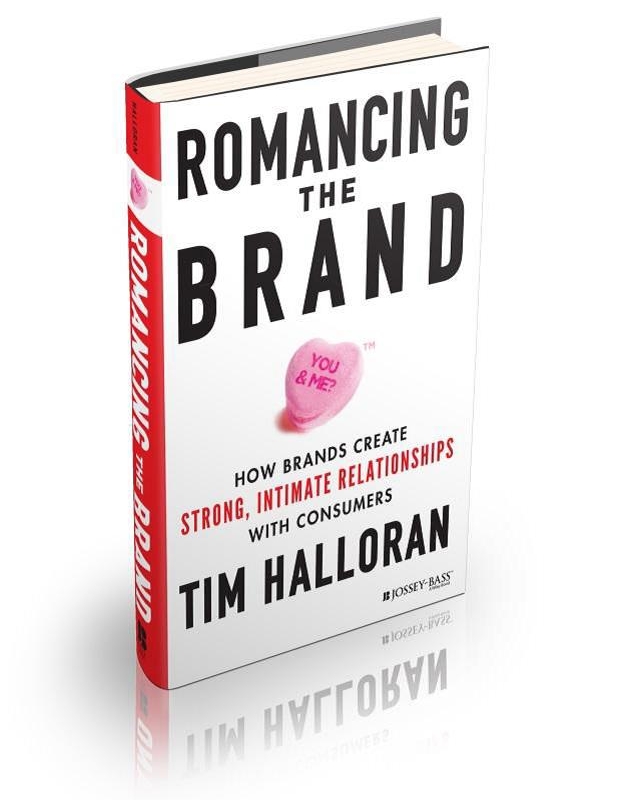
This question came to mind after I read the new book by Brand Illumination president Tim Halloran, Romancing the Brand: How Brands Create Strong, Intimate Relationships with Consumers (Jossey-Bass, 2014). Halloran begins the book with a story from his time as a brand manager at Coca-Cola. He was watching a focus group through a two-way mirror when a member of the group, a woman in her late 20s, held up a can of soda.
“I drink eight of these a day,” she said. “It is always with me, no matter what happens. It was there when my boss gave me my promotion last week. It was at my side two months ago when my cat died. It got me through it. I start and end my day with it. It’s never let me down. I can always count on it. To sum it up, it’s my boyfriend…Diet Coke.”
Leaving the health considerations aside (my doctor’s head would explode if I told her I drank that much of any kind of soda), this consumer’s relationship with a brand is clearly based on more than a cost-benefit analysis. “This was preposterous, wasn’t it?” writes Halloran. “We can’t connect with products the same way we connect with people!”
But of course we can. Research by academics like Jennifer Aaker and Susan Fournier suggests that brands can have personalities, and consumers can have highly emotional relationships with them just like they might with a significant other. In Romancing the Brand, Halloran explains how marketers can create such a relationship using an eight-stage approach that starts with “know yourself” and ends with “breaking up and moving on.”
This sounds like it has some Svengali-esque potential to me. So, I asked the author whether his book could be used as a pickup manual by manipulative marketers... read his answer here.
Wednesday, February 5, 2014
Decoding employee performance
My weekly book post on s+b's blogs covers The Decoded Company, which argues that it’s time to know your employees better than your customers.
Employee Management in the “Big Data” Era
 In December, I wrote about Dave Eggers’ novel, The Circle, and its creepily claustrophobic depiction of a Big Brother–like corporation that monitors, evaluates, and addresses its employees’ every action to supposedly drive productivity. This week, I’m writing about The Circle’s non-fiction doppelganger: a new business book titled The Decoded Company: Know Your Talent Better Than You Know Your Company (Portfolio, 2014), by Leerom Segal, Aaron Goldstein, Jay Goldman, and Rahaf Harfoush.
The main message of The Decoded Company is that companies are missing a major opportunity for growth and profit—by not applying the same technologies used to identify, track, and sell customers to improve employee performance. To remedy that, the authors say companies need to do three things: use technology as an employee trainer and coach, inform employees’ decision making with data, and create a culture that maximizes the ensuing benefits.
This all sounds very promising. If Joe Employee is struggling with some aspect of the task at hand, assistance can be delivered in real time. He doesn’t need to fail before he gets help, so his employer doesn’t need to bear the cost of that failure. Or before Jane Executive fires the manager of a project that has gone seriously over budget, she can consider a wealth of information regarding the manager’s performance and results over his entire tenure with the company.
Three of the book’s authors—Segal, Goldstein, and Goldman—are executives at Klick, a digital marketing agency serving global health clients. They say that they’ve integrated many of the tools needed to do these things into a system called Genome. Genome has helped Klick grow into a US$100 million company. It also helped them determine how many cups of coffee the company’s 400 employees drank in 2013. (The number was 61,392, in case you’re interested.)
But the underlying codicil is something of an iceberg...read the rest here


