 strategy + business, October 25, 2017
by Theodore Kinni
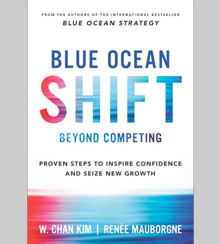
INSEAD professors W. Chan Kim and Renée Mauborgne hit the thought leadership lottery with the idea of blue oceans. Their 2005 book, Blue Ocean Strategy, Harvard Business School Press, which described the advantages of setting sail for new “blue ocean” markets devoid of competitors versus battling for percentage points of share in mature, commoditized “red ocean” markets, sold more than 3.5 million copies. The two professors, having found their own blue ocean, quickly ascended to the pinnacle of strategic consulting: INSEAD presented them with an institute and built blue ocean strategy into its MBA curriculum. Given all this success, the only truly surprising thing is that it took 12 years for Kim and Mauborgne to publish a follow-up.
For the most part, Blue Ocean Shift proves to be worth the wait. It is a practical, well-written guide to finding and exploiting blue ocean markets, informed by the experiences of companies and other organizations that have chosen to seek them out rather than compete toe-to-toe in established markets. Read the rest here.
Wednesday, October 25, 2017
Do-It-Yourself Oceaneering

Monday, October 16, 2017
Why Entrepreneurs Should Care Less About Disrupting and More About Creating
MIT Sloan Management Review, October 16, 2017
by Theodore Kinni
Sunday, October 15, 2017
How to Keep More of What You Make
Learned a lot about how to shelter wealth in private businesses while lending an editorial hand here. Read the rest at https://lnkd.in/gEFvJpu

Wednesday, October 11, 2017
Take a Timeout, Leaders
 strategy+business, October 11, 2017
by Theodore Kinni
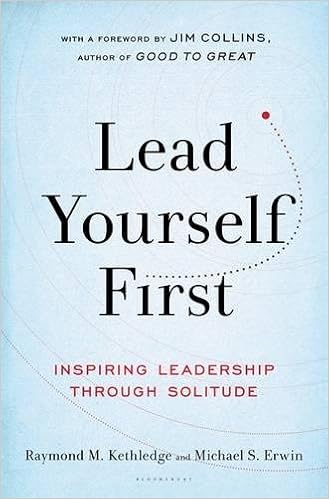
On July 4, 1845, Henry David Thoreau went to the woods to live deliberately. After spending two years, two months, and two days in a 150-square-foot cabin that he built himself for $28.12 and a halfpenny, Thoreau had worked out the gist of the transcendentalist classic Walden; or, Life in the Woods. In it, he wrote, “I never found the companion that was as companionable as solitude.”
CEOs and other leaders would do well to get on companionable terms with solitude, too, according to first-time authors Raymond M. Kethledge, a U.S. Court of Appeals judge, and Michael S. Erwin, a leadership development consultant and assistant professor at West Point. Leaders don’t necessarily have to get off the grid and live in a hut for two years. But in Lead Yourself First, the authors make an extended argument that leaders should reserve some alone time “to find clarity, creativity, emotional balance, and moral courage.” They illustrate their thesis with numerous examples. Read the rest here.
Tuesday, October 3, 2017
Three Career Tips for the Purposeless
In which, I vent my frustration with the fetishization of purpose...
LinkedIn Pulse, October 3, 2017

“I’m not here to give you the standard commencement about finding your purpose. We’re millennials. We’ll try to do that instinctively,” Mark Zuckerberg told Harvard’s Class of 2017. “The challenge for our generation is creating a world where everyone has a sense of purpose.”
Baloney. A sense of purpose is like an appendix. If you’ve got one, good for you. If you don’t, you’re not missing anything important.
I’ve always been purposeless. As a kid, I kinda worried about it. I thought I was missing something essential because all I wanted to be was a New Jersey Lottery winner. (In those days, the grand prize was a cool million. Pretax. Woo-hoo!)
But getting a purpose was never a burning issue for me. Getting a job was far more important. I needed money—mainly because the only thing my parents ever agreed on was that one kid wasn’t enough.
Sans purpose, it did take me a long time—15 years—to find work that worked for me. But I learned some lessons along the way. I offer them here as shortcuts to everyone else who drew a blank ticket in the purpose lottery. Read the rest here.
Tuesday, September 19, 2017
Moving Beyond the Silicon Valley State of Mind
 MIT Sloan Management Review, September 18, 2017
by Theodore Kinni
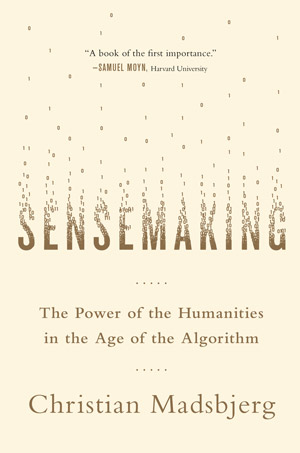
To steal a phrase from Anton Chekhov, the great danger of the Age of the Algorithm is that we will know everything and understand nothing. In his new book Sensemaking, a polemic defending the need for the liberal arts in business, Christian Madsbjerg, a founder of strategic consulting company ReD Associates based in Copenhagen and New York, argues that leaders shouldn’t try to know everything. Instead, they should try to make sense of something.
Madsbjerg offers up sensemaking as the antidote to algorithmic thinking — “a Silicon Valley state of mind” that relies exclusively on data for direction. Relying on data alone is taking “a journey determined by the reductions of a GPS,” according to the author. Sensemaking is the North Star: It provides the essential context for data — the rationale for collecting it and the perspective needed to gain insight from it.
In the excerpt below, Madsbjerg tells the story of Napa Valley’s Cathy Corison, comparing her approach to wine making with the data-driven approach of Leo McCloskey, founder of Sonoma, California-based Enologix, Inc., to illustrate the difference between traveling by the North Star and the GPS. Read the excerpt here.
Monday, September 18, 2017
Is Capitalism Killing America?
 Insights by Stanford Business, September 18, 2017
by Theodore Kinni
On August 2, 2017, the Dow Jones Industrial Average hit a record-breaking 22,000 — its fourth 1,000-point advance in less than a year. That same day, I read the first sentence in Peter Georgescu's new book, Capitalists Arise! End Economic Inequality, Grow the Middle Class, Heal the Nation (Berrett-Koehler, 2017): “For the past four decades, capitalism has been slowly committing suicide.”
How does Georgescu, the chairman emeritus of Young & Rubicam (Y&R) and a 1963 graduate of Stanford Graduate School of Business, reconcile the Dow’s ascent with his gloomy assertion?
“The stock market has nothing to do with the economy per se,” he says. “It has everything to do with only one thing: how much profit companies can squeeze out of the current crop of flowers in the garden. Pardon the metaphor. But that’s what corporations do — they squeeze out profits.”
In the latter half of the 1990s, Georgescu shepherded Y&R through a global expansion and an IPO. He has served on the boards of eight public companies, including Levi Strauss, Toys “R” Us, and International Flavors & Fragrances. He also is the author of two previous books, The Constant Choice: An Everyday Journey from Evil Toward Good (Greenleaf, 2013) and The Source of Success (Jossey-Bass, 2005). An Advertising Hall of Fame inductee, the 78-year-old adman is still pitching corporate leaders. Now, however, he is trying to convince them to fundamentally rethink how — and for whom — they run their companies. Read the rest here.
Friday, September 15, 2017
Why Airbnb will always be a better business than Uber
Learned a lot about the nuances of platforms while editing this one by Jonathan Knee of Columbia Business School
MIT Sloan Management Review, Sept. 15, 2017
by Jonathan A. Knee
 The dramatic influence of the internet on how businesses operate and the emergence of a handful of gigantic, digitally enabled corporations have led to breathless pronouncements regarding the importance of a peculiar new class of monopolies built on digital platforms. These platforms, it is argued, fuel network effects that lead inexorably to winner-take-all marketplaces. This perspective is invariably coupled with infectious optimism and investment euphoria regarding the extraordinary scale and strength of network-effects businesses.
In theory, the key attribute of a network-effects business is its momentum-driven flywheel. Every new participant increases the value of the network to existing participants, attracts more new users, and makes the prospect of a successful competitive attack ever more remote — thereby bolstering the relative attractiveness of the business. The imagined innate indomitability of network effects stems at least in part from the breathtaking strength of notable platform businesses, like Facebook’s social network or Microsoft’s Windows operating system.
The problem is that not all platform businesses exhibit network effects. Moreover, even a cursory survey of the landscape does not support the oft-repeated assertion that such effects are “likely to strengthen a market’s winner-take-all tendency.” For every Facebook and Microsoft, there are literally hundreds of network-effects businesses operating in crowded sectors or in sectors where it is not clear that anyone will ever turn a profit. Take, for example, the once hot peer-to-peer lending space, which after more than a decade has attracted dozens of aspiring entrepreneurs and spawned a billion-dollar IPO but nevertheless has largely been a bust. The first mover in U.S. P2P lending, San Francisco-based Prosper Marketplace Inc., continues to struggle to achieve consistent profitability, and the billion-dollar IPO of San Francisco-based Lendingclub Corp. quickly ended in tears for investors.
Nor are digital platforms necessarily better businesses than the analog versions that they displace. Analog malls had the benefit of their shoppers being many miles away from competing malls, and the benefit of their retail tenants being committed to long-term leases. On the internet, platform competitors are only a click away and companies regularly and dynamically optimize their customer reach across competing platforms and directly via their own sites.
It is not that marketplace businesses built on e-commerce platforms do not have advantages or that they cannot thrive. Rather, it is that the mere existence of network effects tells entrepreneurs and investors relatively little about the attractiveness of a particular business. For example, there is almost no fundamental difference in the network effects enjoyed by Uber Technologies Inc. and Airbnb Inc., the global leaders in the ride-hailing and short-term lodging marketplaces, respectively. Yet, other characteristics of those industries ensure that Airbnb will enjoy dramatically stronger results than Uber will ever achieve. Read the rest here.
Tuesday, September 5, 2017
Why First Impressions Are Often Wrong

strategy+business, September 5, 2017
by Theodore Kinni
The list of human foibles is long. The 2015 s+b article “Beyond Bias” lists 24 of the most common biases, including blind spots, the illusion of control, and the concept of sunk costs. Since the early 2000s, Princeton University psychology professor Alexander Todorov has been studying one of those long-standing human foibles: the first impression.
In his new book, Face Value, Todorov pulls together all he’s learned about first impressions. At first glance — and upon a careful reading — it makes for a fascinating and thorough examination of the subject. Todorov’s expansive tour includes the history of physiognomy (the dubious science of predicting character from physical appearance) and a survey of modern first-impression research, much of which Todorov has conducted in his Social Perceptions Lab at Princeton. His conclusion: We find judging others based on a single glance irresistible, but the judgments we reach are usually wrong. Read the rest here.
Thursday, August 3, 2017
Blockchain is poised to disrupt trade finance
Learned a lot lending an editorial hand here:
PwC Next in Tech blog, August 3, 2017
by Grainne McNamara

Trade finance has enabled the exchange of goods for millennia. Babylonian cuneiform tablets dating back to 3000 BC mention the kind of promissory notes and letters of credit that still underpin international trade. And, aside from incremental improvements in the ways and means of trade finance, not all that much has changed in the fundamental elements of this approximately US$40 billion sector of the financial services industry over the past 5,000 years.
That is, until now. The advent of blockchain technology is on the verge of revolutionizing trade finance—and it threatens to leave behind any financial services company that doesn’t move with the times. Read the rest here.
Wednesday, August 2, 2017
A Goldilocks Approach to Innovation

by Theodore Kinni
In 2008, when Nike executive Sarah Robb O’Hagan was tapped to lead Gatorade, the sports drink’s sales were in decline and it was losing market share to its principal rival, Powerade. She couldn’t turn to incremental innovation: Pursuing the tried-and-tested strategy of adding flavors and low-calorie options to the Gatorade portfolio had already run its course, and was not yielding returns. The idea of blowing up one of PepsiCo’s billion-dollar brands and the organization behind it in a bid for radical reinvention was too risky.
What did Robb O’Hagan do? Taking a page from Nike’s playbook, she refocused the company’s attention — and more meaningfully, its product development and marketing budgets — on Gatorade’s core customers: the serious athletes, young and old, who accounted for 46 percent of sales. Then, she began introducing new hydration and nutrition products designed particularly for that core group. Gatorade introduced a series of gels, bars, and protein shakes that complemented the sports drink and drove its sales, instead of cannibalizing demand for it.
“The innovations were diverse, targeted a specific set of customers, and posed little strategic risk,” writes Wharton School professor of practice David Robertson, author, with Kent Lineback, of The Power of Little Ideas. The new products also reversed Gatorade’s sales slide. By 2015, Gatorade, with sales of US$5.6 billion, owned 78 percent of the U.S. market for sports drinks, about four times Powerade’s 19 percent share. Read the rest here.
Saturday, July 29, 2017
Self-Publishing or Trade Publishing: Which is Best for Your Business Book?
LinkedIn, July 29, 2017
by Theodore Kinni
As a business writer and editor, I talk to lots of people who want a business book with their name on it. CEOs and other senior executives who are transitioning to new careers. Consultants who are establishing thought leadership platforms. Entrepreneurs who are building businesses. Speakers who want bigger audiences and something to sell at the back of the room. At some point or another, they all ask me the same question: Should I self-publish my book or find a publisher?
There is no pat answer. It depends on the book and what you want to achieve with it. But here are the three questions to ask to figure out the right answer for you. Read the rest here.
Wednesday, July 19, 2017
Moving Sales With Trajectory-Based Mobile Advertising
MIT Sloan Management Review, July 19, 2017
by Theodore Kinni
 What a difference a decade can make. In June 2007, Apple released the iPhone; now, mobile internet usage outstrips desktop usage. In the United States, consumers spend more time on mobile apps than watching television, and m-commerce is rapidly approaching $100 billion annually.
Given the fast rise of mobile, it’s no surprise that marketers are well aware of it as a sales channel. But mobile isn’t just a new channel for reaching consumers with the same old offers. It provides marketers with valuable new sources of information about consumers, and it enables them to deliver new kinds of offers.
Anindya Ghose, Heinz Riehl Chair Professor of Business at New York University’s Stern School of Business, is one of the pioneering explorers of the intersection of mobile and marketing. In his new book, Tap: Unlocking the Mobile Economy (MIT Press, 2017), he collects his findings and weaves them together into a set of nine forces that marketers can wield to drive sales via mobile technologies.
One of the forces that Ghose explores is trajectory. “In the online world, it took us only a few years to get accustomed to, and often even embrace, the idea that firms — including e-commerce firms, search engines, and website publishers — can track our browsing behavior and predict our next steps,” he explains. “A similar revolution is about to hit us off-line. The springboard for this revolutionary leap is the individual’s trajectory. An individual’s trajectory is the physical and behavioral trace of his or her off-line movements.”
Mobile devices allow marketers to track a consumer’s walking pattern and predict where he or she will go next. Moreover, they can create and deliver offers based on that trajectory. In the following excerpt, Ghose describes what he and his colleagues learned when they used trajectory-based advertising in one of Asia’s largest shopping malls. Read the excerpt here.
Smart Leaders Know the Difference Between Complex and Complicated. Do You?
Inc., July 19, 2017
by Theodore Kinni
You probably use the words 'complex' and 'complicated' interchangeably. Most of us do. Heck, most dictionaries use complex to define complicated and vice versa. There's just one problem: If you're a leader and you treat a complex problem like a complicated problem, you are setting up yourself and your company for failure.
If that sounds like baloney to you, it might be worth taking a look at Rick Nason's eye-opening new book, It's Not Complicated: The Art and Science of Complexity in Business (University of Toronto Press, May 2017). In it, Nason, a finance professor at Dalhousie University's Rowe School of Business, makes a compelling case that understanding the difference between complicated and complex is an imperative for highly effective executives.
Leaders, says Nason, tend not to realize that complicated issues are different than complex ones. Thus, they try to address them both in the same way. Want to guess what happens next?
You already know the answer. It's what happens when you try to treat employees as if they were interchangeable robots or when you try to remove a passenger with a ticket from your airplane or when you merge two companies with very different cultures together. The situation deteriorates really fast. Read the rest here.
The Sore Loser and the Supercomputer
strategy+business, July 19, 2017
by Theodore Kinni
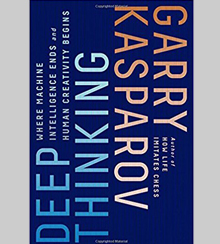 In June 1985, Garry Kasparov, the highest-ranked chess player in the world, simultaneously played 32 games against 32 computers. He swept the event, winning every game. Twelve years later, in May 1997, Kasparov played a high-stakes, head-to-hard-drive, six-game match against a single computer: IBM’s Deep Blue. The result? The supercomputer beat the reigning chess champ in regulation play. Artificial intelligence had hit the big time.
It’s taken Kasparov a long time to process his historic battle against Deep Blue. “I’m a sore loser,” he frankly admits in Deep Thinking, which is a meditation on both his personal history and the future of work. A full 20 years later, that characteristic is evident in Kasparov’s description and analysis of the match — and his detailed suspicions about spying and “human intervention” by IBM.
Kasparov clearly didn’t expect Big Blue, led in those days by Louis Gerstner Jr., to play to win. The company invested an estimated US$20 million in developing and promoting Deep Blue, and the win, Kasparov argues, boosted IBM’s stock by $11.4 billion in just over a week — to say nothing of the value that accrued to the brand. Nevertheless, Kasparov appears surprised that IBM treated the match as anything other than a collegial experiment in computer science (even though he had negotiated a guaranteed minimum payday of $400,000 in case of a loss; the Deep Blue development team received $700,000).
Unless you are a serious chess player, however, Kasparov’s account of the match isn’t the best reason to read Deep Thinking. Read the rest here.
Tuesday, July 18, 2017
Sheryl Sandberg: Develop Your Voice, Not Your Brand
Insights by Stanford Business, July 18, 2017
by Theodore Kinni
Today Sheryl Sandberg is known as a leading Silicon Valley executive and a champion of working women. But when she arrived in California in 2001, after a five-year stint at the U.S. Treasury, she wasn’t exactly welcomed with open arms.
“All the exciting stuff was happening out here, so I wanted to work in Silicon Valley,” recalls Sandberg. “Lots of people said ‘I would never hire anyone like you’ to my face. The first tech bubble had just burst. It was actually hard to get a job.”
But Sandberg did get a job — and an impressive one. She served as Google’s vice president of global online sales and operations until 2008, when Facebook founder Mark Zuckerberg convinced her to join the social networking site as its COO.
In 2013, Sandberg became a best-selling author with the publication of Lean In: Women, Work, and the Will to Lead. Since then, its readers have founded 33,000 Lean In peer support circles in 150 countries.
Sandberg’s life seemed charmed until May 2015, when her husband and the father of her two children, Dave Goldberg, died suddenly. “When Dave died, I didn’t think I was capable of anything. I could barely go to work and not cry. I was parenting two grieving children,” she says.
Sandberg channeled her own grief into a second book, Option B: Facing Adversity, Building Resilience, and Finding Joy. Co-authored with Wharton School professor Adam Grant, it, too, has found a global readership and, with the support of the Sheryl Sandberg & Dave Goldberg Family Foundation, has already attracted a community of 350,000 people.
On May 25, Sandberg described her journey and the lessons she has learned along the way to Stanford Graduate School of Business students at the final View From The Top event of the 2016-17 academic year. Read the rest here.
Monday, July 17, 2017
Want to Be a Better Decision Maker? Here Are 3 Timeless Guidelines for Leaders
Inc., July 17, 2017
by Theodore Kinni
Before McKinsey & Company senior partners Scott Keller and Mary Meaney decided what to include in their new book about organizational leadership, they grouped all of the leadership-related articles published by Harvard Business Review from 1976-2016 into 20 topics--culture, change, self-improvement, managing others, etc. Then, they analyzed how the number of articles written on those topics varied over time as a percent of all HBR articles.
"Our logic was that the lower the variance over forty years, the more timeless the topic," write Keller and Meaney in their introduction to Leading Organizations: Ten Timeless Truths (Bloomsbury, June 2017). The most timeless topic of all? Decision-making.
This didn't particularly surprise the consultants. They calculate that there are roughly 400 million decisions made every day in the average Fortune 500 company. Of course, the vast majority of those decisions are inconsequential, but a select few of them could be very consequential indeed.
Like, say, Time Warner CEO Gerald Levin's decision to merge with AOL back in 2000--on the eve of the dotcom meltdown. In 2003, the merged company posted a $99 billion loss on what is still widely hailed as the worst deal ever. The flamboyant Ted Turner, who was Time Warner's largest shareholder before the deal and lost about $8 billion personally, likened it to the Vietnam War on his personal disaster scale.
To avoid disasters like this and hone your decision-making process and prowess, Keller and Meaney offer the following advice: Read the rest here.
Friday, July 14, 2017
Want to Be a Better Salesperson? Start Practicing This 1 Crucial Skill
Inc., July 14, 2017

Monday, July 10, 2017
What a Bestselling Author Knows About the True Genius of Steve Jobs and Ben Franklin
Inc., July 10, 2017
by Theodore Kinni

In May, Walter Isaacson, CEO of the Aspen Institute and former chairman and CEO of CNN, came to my hometown to deliver the commencement address and pick up an honorary degree at The College of William & Mary. You probably know him for his best-selling biographies, including Steve Jobs (Simon & Schuster, 2011) and Benjamin Franklin: An American Life (Simon & Schuster, 2003).
Given Isaacson's obvious interest in the personality traits, innovative thinking, and entrepreneurial flair of geniuses, I expected his address to celebrate mavericks or, as Apple put it in the memorable "Think Different" ad campaign, "the crazy ones." But he threw a changeup.
"We taught you here to be individual achievers. We celebrated individual achievement and even singular visionaries," Isaacson told William & Mary's graduating class of 2017. "What we forgot to tell you is that in the real world it's not about singular achievement. It's about teamwork. It's about being able to collaborate. When you get to the real world, you are going to learn that innovation is a team sport and that success is a collaborative effort." Read the rest here.
Wednesday, July 5, 2017
'Hit 'em Where They Ain't!' and Two More Lessons in Strategy From General Douglas MacArthur
Inc., July 5, 2017
by Theodore Kinni

Seventy-two years ago today, on July 5, 1945, General Douglas MacArthur officially announced the liberation of the Philippines. It was a triumphal moment for the 5-star general. It marked the ultimate fulfillment of his memorable promise ("I shall return"), and it brought the war in the Pacific to Japan's doorstep.
MacArthur was one of the world's most admired leaders in those days, and although the Chinese and President Harry Truman would tarnish his shining reputation in the 1950s, MacArthur's strategic creativity, agility, and focus in World War II's Pacific Theater remain a high point in military history. They also offer valuable lessons to founders who are searching for innovative ways to gain a foothold in highly competitive markets populated by stronger, more established players.
Here are three of those lessons, drawn from No Substitute for Victory: Lessons in Strategy and Leadership from General Douglas MacArthur. Read the rest here.


